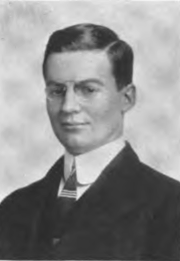
Joseph Spencer Kennard Jr. was born on April 28, 1890 in the village of Ossining in Westchester County, New York (near New York City) to Joseph Spencer Sr, and Isabella B. Kennard. At the time, his father was working as a lawyer, but he would later achieve international fame as an author and lecturer.
From 1895 to 1898, Joseph's family lived in Europe, specifically in Switzerland, Italy, and France. They then returned to America and settled in Philadelphia for about two years but moved to England the next year (in 1901). They stayed there until 1904 when they returned to Westchester County, this time to live in the town of Greenburgh. However, Joseph did not stay there and instead left home to attend boarding school. He first attended St. Paul's School in Concord, New Hampshire, but he transferred to Mackenzie School in Dobbs Ferry, New York. He graduated from Mazkenzie School in 1909 and then matriculated at Harvard University. At Harvard, Joseph was a standout student. He was awarded a scholarship (the Class of 1817 Scholarship) and graduated cum laude with an A.B. degree in 1913.
By the time he was a college student, Joseph had become deeply interested in Christianity and missionary work. In doing so, he was following in his grandfather's footsteps. His grandfather, also named Joseph Spencer Kennard, was a prominent Baptist preacher. Joseph Jr. would also remain with the Baptist church for most of his life.
Joseph shared some of his thoughts on religion in a 1911 article he wrote for The Harvard Illustrated Magazine. He wrote about the "missionary spirit" at Harvard. Simply stated, he found it lacking. While there was a society that had been formed to help organize missionary work, it was not very active, and students seemed indifferent to subject. He attributed this indifference to the nature of the education at Harvard. Unlike other American universities, Harvard did not emphasize the teachings of Christianity and instead promoted "a doctrine of mere ethics," which Joseph dismissively called "some new 19th century concoction."
After graduating from Harvard, Joseph enrolled at the Princeton Theological Seminary. At the seminary, Joseph was an exceptional student. He was awarded the Second Hodge Prize and the William Henry Green Fellowship in Semitic Philology. He received his S.T.B. degree in 1916.
 |
J. S. Kennard, circa 1916
From passport application |
Joseph began working as a church pastor in New York City after completed his degree at the seminary. However, he only did this for a short time. World War One had been raging for two years and left in June 1916 to do humanitarian work in Europe. He worked for the Y.M.C.A. in Germany, providing social and religious services to allied POWs.
During this time, tensions were rising between Germany and the United States. A tipping point was reached in February 1917 when the United States ended diplomatic relations in response to Germany's decision to resume unrestricted submarine warfare, a decision that put American sailors at risk. This development made Joseph's continued stay in Germany untenable. At the time, Joseph was living in Hannover, and he learned of the news while eating dinner at a restaurant after having spent all day visiting prison camps. Without even finishing his dinner, he left the restaurant, and a few days he had departed with other Y.M.C.A. workers on a special train for Switzerland.
After leaving Germany, Joseph ended up in France. He registered as a doctoral student at the Sorbonne, but he only studied there briefly as he was assigned to Bordeaux to provide services to American soldiers who were returning from Russia, where they had been supporting the Tsar in the Russian Civil War.
Joseph stayed in France for less than a year. That summer, he received a draft notice, so he was forced to return to America and join the army. He entered as a private on July 13, 1918 and was assigned to the Coast Artillery Corps. He served as a chaplain and spent the war at coastal forts in the northeast until December 1918, when he was honorably discharged.
After the war, Joseph attended Yale University's Graduate School to pursue advanced studies in philosophy and education. However, he left to work as a pastor in New York City after one year (the 1918-19 academic year). In New York, he continued his studies at Columbia University. However, in the summer of 1920 he would receive an appointment that would occupy him for the next two decades: missionary work in East Asia.
Joseph was sent to Japan by the American Baptist Convention, and he served as part of their Foreign Mission Society. He left New York City on August 18 and was stationed in Tokyo. Joseph moved to Japan at a time when militarism was on the rise. He would spend much of his time in the country opposing the growth of Japanese militarism. His activities attracted negative attention of internal security forces, and he was occasionally harassed by the police. Once a whole police squad was dispatched to his home.
Beyond politics, Joseph was in Tokyo when the city was struck by the Great Kantō earthquake of 1923. This massive earthquake destroyed large parts of the city and resulted in the deaths of over 100,000 people. Joseph's own home was narrowly spared destruction.
In 1925, Joseph was placed on furlough, so he returned to the west and resumed his education. He was able to complete his degrees from Yale and the Sorbonne, receiving a A.M. and a Ph.D. degree from Yale, a Doctorate of Literature from Université de Paris, and a Doctorate of the Protestant Faculty from the University of Strasbourg. All of his graduate work was on religious studies, especially the early history of Christianity. His doctorate from Université de Paris was awarded for his thesis "Politique et Religion chez les Juifs au temps de Jésus et dans l'Église primitive." At Yale, he wrote the 1927 dissertation "An Introduction To The National Consciousness Of Jesus"
Joseph returned to Tokyo in 1927. He was one of roughly five missionaries stationed in the city and was placed in charge of Mito Church, one of the ten Baptist church in Japan. In addition to serving at rural churches and teaching English, he founded the monthly periodical The Christian Graphic. The periodical was founded shortly after Japan invaded Manchuria in September 1931. The periodical was bilingual (in Japanese and English) and aimed to promote international understanding. By promoting internationalism, Joseph hoped to oppose militarism.
Joseph's decision to found the The Christian Graphic was timely as Japan began to undergo a series of crises that would swing the nation further in the direction of militarism. One of the most serious crises was a wave of right-wing political violence. In the early 1930s, right-wing nationalists assassinated a number of politicians including the prime minister. Some of these assassinations were committed as part of an attempt to overthrow the government in a coup. The coup attempts were unsuccessful, but they did severely weaken the civilian government.
At the same time that the government was facing political violence, it was also facing dissension from the military. The army and navy sharply disagreed with the civilian government over foreign policy issues like armament treaties and relations with China. Unable to compromise, the military began to act independently. The cumulative effect of all this was that, by 1932, democratic government effectively broke down in Japan. While political institutions like the Imperial Diet (the national legislative body) remained in operation until the end of World War Two, the military largely controlled the nation.
While Joseph strongly opposed Japan's turn towards right-wing militarism, in his writings to western audiences he was sympathetic towards the Japanese and emphasized the impact of western imperialism on political developments. For example, in a 1935 report to the Mission Society, he acknowledged that Japan had been acting belligerent but explained that this was a response to westerners treating it as an inferior nation and discriminating against its people. He felt this treatment was unwarranted. As evidence, he pointed to Japanese achievement in horticulture and the fine arts. In music, for example, cultured Japanese showed a refined appreciation of western music like Beethoven and Bach and were developing their own music traditions.
Joseph wrote that the trend to belligerency was primarily religious in nature. For example, Shinto and some sects of Buddhism "[exalted] the sword" and there was a widely held "belief in a world mission and the ultimate universal sway of the Imperial house." Being a religious issue, he wrote that American Christians should counteract it through religious acts. He encouraged Christians to (1) work to end racial discrimination against Japanese and (2) support missionary efforts as a way to counteract "the false in the nationalist cults of Japan."
Joseph activities in Japan were not entirely political. He also published his first book Thinking in English. This was a textbook for learning English as a foreign language. The book was written with Harold E. Palmer, an English linguist who was teaching in Japan.
 |
Mito Church
Japan Baptist Annual for 1933
|
Joseph time in Japan came to an abrupt end in October 1936. He had left Japan in winter 1935 to study at Union Theological Seminary in New York City. While he was in New York, the Japanese government became more hostile toward foreigners. Japanese officials stopped publication of the The Christian Graphic and forced the periodical's staff to leave the country. Later, one of the editors and his wife were killed by Japanese soldiers in the Philippines.
Joseph and his family became the target of this increased hostility foreigners in October 1936. That month, they tried to return to Japan by boat, but upon landing, they were told by the police that they were banned from the country. The police justified the ban on grounds that Joseph was a pacifist and a Communist. They made four specific accusations: (1) Joseph had been connected with the anti-war organization the Fellowship of Reconciliations, (2) he had proposed participating in a Shanghai peace conference that was to "open under Communist auspices," and (3) he edited a periodical (The Christian Graphic) that promoted anti-war principles "from the Communist standpoint," (4) he had been in contact with Alexander Buckman, an alleged Communist. Buckman was an American who had moved to Japan in 1933 and was deported later that year because of alleged Communist ties.
Joseph publicly denied all the accusations except being a member of the Fellowship of Reconciliations, and he offered to resign from organization if its members were unwelcome in Japan. Despite Joseph's denial, government officials upheld the ban. This brought an end to Joseph's time in China, but it did not mark the end of his missionary work. He was assigned to teach history at the West China Union University in Chengdu, China. He and his family moved there in the spring.
 |
| West China Union University |
West China Union University was a private university that had been founded by western church missionaries in the 1910s. During the time that Kennard was teaching, the population grew fivefold. Much of the growth was driven by Chinese Civil War and China's war with Japan. Chengdu was a major center for the Kuomintang, or Chinese nationalists. Many Chinese supportive of the nation's government fled to the city to escape war and general political disorder.
Kennard was still working in Chengdu when the Second World War broke out. Kennard's views on the war were nuanced. In a 1939 Letter to the Editor that was published in The Christian Century, a major periodical of American Protestantism, he expressed his views on the matter. Despite his anti-militarism and advocacy for peace, he argued that war with Japan was necessary as this was the only way to stop Japan military conquest of Asia. However, he argued that, for "psychological" reasons, defeat needed to come at the hands of the Chinese. America, he argued, should stop fighting against China, presumably meaning Chinese Communist Party. In contrast, he remarkably was against war in Europe. He wrote that, in "the balancing of the two sets of evils the moral degeneration attending armed resistance would seem to very nearly balance that of allowing Hitler's expansion into Poland." He contrasted this with what he felt was the greater evil of allowing Japanese militarists to "drug, debauch and enslave the people of China."
Joseph remained at the university for most of the war, seven years in total. However, the situation in the Chengdu became increasingly unstable as war dragged on. Finally, in 1944, Joseph and his family were evacuated out of the country and returned to America.
Upon returning to America, Joseph settled in the northeast. He remained deeply engaged in developments in Asia. During his first year back, he traveled the country and gave lectures on Asia, focusing on his experiences there. He also published several Letters to the Editor in national newspapers expressing his views on political developments. Having seen Chinese nationalist government up close in Chengdu for several years, Joseph was highly critical of it and felt the U.S. government should not offer it support. Joseph's criticism centered on two points. First, he simply felt that the nationalist government was a feudalist one that failed to need the needs of the Chinese people. Second, he felt that U.S. support for the nationalists was counterproductive because, with anti-imperialist sentiment growing in Asia, it would only drive the Chinese towards Communism. He advocated for the withdrawal of military and financial support for the nationalist government.
For a brief time, Joseph considered taking an active part in the Second World War. In early 1945, he was considered for service with the Office of Strategic Services (a precursor to the CIA) for a proposed operation in the South Seas. The operation was canceled, and in its place, Joseph suggested that he be parachuted into the mountains of north-central China so that he could support General Nieh Jung-chen fight against the Japanese. However, the proposal was vetoed by the nationalist leader Chiang Kai-shek, presumably because Jung-chen was part of the communist opposition.
Beyond his continued engagement with Asian politics, Joseph turned to teaching and scholarship. He taught for a semester at the State Teachers College at New Paltz (now SUNY New Paltz) and published several papers. All of his publications were on the early history of Christianity. He published two articles in the Jewish Quarterly Review (Gleanings from the Slavonic Josephus Controversy and Judas of Galilee and His Clan) and three in the Journal of Biblical Literature ("Hosanna" and the Purpose of Jesus, Nazorean and Nazareth, and Was Caparnaum the Home of Jesus). He also published the book Render to God; a study of the tribute passage. This marked Joseph's greatest period of scholarly activity.
 |
J. S. Kennard in 1945
The Plain Speaker [Hazleton, PA], November 12, 1945. p. 7.
|
 |
J. S Kennard (second from left) at a 1946 protesting anti-Semitic statements made by British politician Ernest Bevin
The Worker newspaper, June 23, 1946. p. 2. |
In fall 1952, Joseph left the northeast for Columbia, South Carolina to teach at Benedict College. Unfortunately, Joseph never wrote about his reasons for moving to Columbia, and even omitted discussion of his time at Benedict in a 1963 autobiographical account he wrote for an alumni publication. Joseph likely was drawn to Benedict for religious reasons. The university is closely affiliated with the Baptist church and, historically, many of its faculty had been white Baptists from the north. However, in many ways Joseph's employment was anomalous. The position at Benedict was his first at an American university, and by this time, Joseph was quite old to be starting a new job; he was in his sixties. Moreover, the position at Benedict was a challenging one as the faculty was faced with the task of educating African American students coming out of South Carolina's underfunded Black high schools and doing so under the constraints of the Jim Crow south. Some of Benedict's faculty relished the opportunity to effect political change in South Carolina, but while he certainly would have been sympathetic to their plight, Joseph does not seem to have had any particular interest in civil rights for African Americans. His political interests centered on Asia. Unless new records are found, Joseph's move to South Carolina remains somewhat of a mystery.
Joseph was hired to head Benedict's Social Science Department. His hire was announced in The State newspaper, albeit without any particular fanfare. Despite the impressive credentials that he brought, he was simply included in a list of the new hires that held advanced degrees.