|
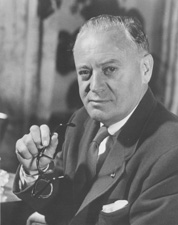
John G. Rideout in 1936
Colby Alumnus Vol 26, No. 1: October 1936. |
John Granville Rideout was born on February 1, 1915 in Danville, Vermont to Walter J. and Ruth Brickett Rideout. Later in life, John described himself to college students in Wisconsin as being descended from "old English Puritan stock." Both parents had deep roots in New England. They had been born in Maine and returned to the state shortly after John's birth.
By 1920, John and his family were living in Guilford, a town of a few thousand. Walter served as the town's superintendent of schools. During the 1920s and 1930s, the family moved frequently. Each move brought them to a new small town where Walter served as school superintendent. They had moved to Dover-Foxcroft by mid-1920 but were living in the town of Hartland by 1932.
 |
The town of Guilford, circa 1920
From ebay |
For high school, John attended Foxcroft Academy, a private academy in Dover-Foxcroft. He was standout student. As a senior, he received a scholarship to Colby College. Both of his parents were alumni of the college, and he followed in their footsteps, matriculating at the college in fall 1932. His younger brother Walter B. joined him two years later.
At Colby, John continued to distinguish himself. He was active on the Debate Squad and worked as a reporter for the Echo student newspaper. He also contributed several articles to the Colby Mercury student magazine. A 1935 article on novelist Sinclair Lewis that he wrote for the magazine received a college-wide award (the Solomon Gallert prize for English).
John's essay on Sinclair Lewis suggests an emerging interest in left-wing politics. The essay focuses on Lewis's literary merits, but his novels were best known for their critiques of American capitalism.
Further evidence of John's growing political interests is his involvement in an anti-war protest. The student yearbook lists John as a participant in a student anti-war demonstration held during his junior year. No details are given, but the demonstration may have been an April 12, 1935 campus demonstration held to express support for world peace and concern over the rise of Fascism. The April demonstration was held as part of a nation-wide student walkout against war.
 |
Colby College in 1935
The Colby Oracle 1935
|
The April demonstration received broad support on campus. Speakers included the university president, faculty, and students. The atmosphere was described by the student newspaper as "impressive, restrained, and thoroughly thought-provoking." The speakers largely expressed their opposition to war on the basis that it was pointlessly destructive. For example, one professor described the havoc and economic waste caused by warfare and argued that all wars should be avoided because they are irrational and wasteful.
John's time at Colby ended on a high note. During his senior year, he was awarded a Rhodes Scholarship to study at Oxford University in England. The scholarship was awarded so that he could study English literature, especially the Romanic Revival, at St. Edmund Hall. He was one of only three students in New England to receive the scholarship, and the first Colby student to receive it in a decade. In a write-up on John and his scholarship, the Colby Alumnus newsletter emphasized John's superior intellectual accomplishments. The scholarship targeted well-rounded students, especially student leaders, and the selection criteria included not only scholastic achievements but also things like athletic ability. As a Rhodes Scholar, John was unusual in that he had "no athletic record at Colby at all."
 |
Rideout (on the right) with another student at Oxford University in 1939
The Colby Alumnus, Vol. 28, July 15, 1839. Number 8. |
During his first year at Oxford (in 1937), John wrote a letter to the president of Colby College describing his experiences. Compared to the United States, John found England to be a small, impoverished nation divided by class differences:
England may seem comfortable to Englishmen, but to an American, the country's just a little pasture dotted with damp stone huts, partially warmed by pitiful grates; and the aristocracy of Britain that comes up to Oxford lives in "digs" the third year that the car-owning American laborer will scorn.
He found the University of Oxford to be a provincial place that focused on training "good members of society" rather than training intellectuals or producing research. He dismissed the education offered by saying that an American was "not likely to be impressed by it." He described the tutors as "usually prosaic and rather factual" and the lecturers as "uniformly bad." Moreover, the staff largely viewed themselves as teachers rather than lecturers. None of the teaching staff held a Ph.D., and many only held a B.A. degree from Oxford.
John described the social atmosphere among students as repressed. Compared to students at Colby, he found the Oxford students to be juvenile. A major issue, he said, was gender-relations on campus. Single-sex education was largely the norm in England. Although women had recently been admitted to Oxford, there was still little social interaction between the sexes. There were a few organized dances, and male students were allowed to invite women for tea in their rooms, but men mostly largely socialized among themselves, hosting tea parties or going out for dinner or drinks.
John did acknowledge that Oxford was successful in producing gentlemen. He found the Oxford students to be easier to live with than American students. There was none of the ostentatious display of wealth that was seen on U.S. campuses, especially at Harvard and Yale. John found this aspect of life at Oxford to be refreshing.
The academic schedule at Oxford provided John with ample time for travel. He fully took advantage of this opportunity. He traveled throughout England, Scotland, and Wales and visited every European county except for Russia and Greece. He was in England when Edward VIII abdicated the title of King of the United Kingdom (in order to marry a divorcee). He witnessed the coronation procession for Edward's successor, George VI.
John was in Paris during the signing of the Munch Agreement (resolving a territorial despite between Nazi Germany and Czechoslovakia). He celebrated the event. The agreement saw the British prime minister Neville Chamberlain negotiate an agreement that granted Nazi Germany its territorial claims. In a talk that he gave in America during the next year, about a month after the outbreak of World War 2, John pronounced Chamberlain's policy as "sound" as it had provided England with a year to make preparations for war.
John received his B.A. degree from Oxford in 1938. He would receive an M.A. degree from the university four years later, although that degree was an honorary degree granted in absentia (rather an award for further studies).
After receiving his degree, John remained in England for about a year and then returned to the United States. He went by boat from Southampton to New York City and then traveled to his parent's place in Maine. By then, his parents had moved to the town of Livermore Falls. John arrived in the United States in July 1939, only a few months before World War 2 broke out.
 |
John G. Rideout at Beloit College| The Beloit College Bulletin: Commencement Number, 1940. |
|
During the war, John began to work in higher education. He first taught for a year (from fall 1939 to spring 1940) at Beloit College in Wisconsin. However, that spring he fell ill and returned to Maine.
 |
Beloit College in 1940
The Beloit College Bulletin: Commencement Number, 1940. |
John continued his formal education after returning to Maine. He began graduate studies at Brown University. After two years at Brown (in 1942), he began teaching Wells College (a private women's college in upstate New York). He remained in graduate school while teaching. In 1945, he was awarded a Ph.D. by Brown. His dissertation, titled "Rhetoric, symbolism, and imagery in the poetry of Percy Bysshe Shelley," was on the poetry of Percy Bysshe Shelly.
After completing his Ph.D., John continued to teach English at Wells College for a year (until 1946). He then left to hold a professorship at the University of New Hampshire. It was in New Hampshire that John's politics made him the subject of controversy.
In spring 1947, around the time John arrived on campus, New Hampshire students formed the Liberal Club, a campus group that promoted politically progressive ideas on campus. For example, it organized a screening of the film "Deadline for Action" (a pro-Labor documentary produced for an electrical worker union), and it hosted a presentation by Daniel Boone Schirmer, then a prominent leader within the Communist Party. John was a member of the club, and another English professor, G. Harris Daggett, served as faculty advisor.
 |
The Liberal Club at the University of New Hampshire.
Rideout is the leftmost figure in the first row. The rightmost is Prof. Daggett
The Granite Yearbook, 1948. |
Of particular significance for John was an event held on October 7, 1947. On that day, former vice president Henry A. Wallace visited campus to deliver an address. Wallace had served as vice president during Roosevelt's third term (from 1941 to 1945). He'd been a Democrat since the 1930s, but after the Second World War, he became increasingly estranged from the party. The cause was the issue of relations with the Soviet Union: Wallace believed that the United States should not involve itself with Soviet affairs in Eastern European, but many Democratic politicians believed aggressive confrontation was necessary. The issue came to a head in September 1946. Wallace had been serving as secretary of commerce under President Truman, but Truman dismissed him after he delivered a speech in which he advocated for an American policy of non-involvement in Eastern European. Following his dismissal, Wallace abandoned the Democratic Party and began to organize a left-wing, third party. Wallace's speech at New Hampshire was part of his organizational efforts.
Initially, much of the support for Wallace was organized through the Progressive Citizens of America or PCA. The PCA had been formed in December 1946 as an American democratic socialist organization. By fall 1947, the PCA had made Wallace its candidate for president in the 1948 election.
 |
The University of New Hampshire campus in 1949
The Granite yearbook, 1949 |
The month after Wallace's visit to New Hampshire (on November 30), the state chapter of the PCA held its first convention. John was elected chapter president and his colleague Dr. Daggett was made area vice president. In addition to electing officers, the chapter adopted a political platform. The platform was a mildly democratic socialist one that emphasized workers' rights. Specific proposals included (1) an increase in teachers' salaries, (2) a legal right for public employees to collectively organize and bargain, (3) the establishment of public recreational facilities in the White Mountains, in cities, and in towns, (3) a repeal of the anti-union Taft-Hartley act, (4) a 75 cent minimum hourly wage, (5) an increase in unemployment benefits, (6) a state Fair Employment Practices act, (7) the compulsory immunization of dairy herds (to combat Bangs disease), (8) public ownership of water resources for the purpose of providing cheap electricity, (9) opposition to a state sales tax, and (10) support for a progressive tax system that increased the tax burden on the wealthy.
John's election as chapter president appears to mark a dramatic change for him. The PCA was viewed by many as a radical organization that was acting against the interests of the United States. The organization was suspected of being allied with, if not controlled by, the Soviet Union. Its members, especially those in leadership positions, were regarded as either subversive communist agents or naive dupes.
Nothing in John's record prior to his move to New Hampshire suggests a penchant for radical politics. He had been vocally opposed to militarism since college and promoting world peace was central to the PCA's politics. However, the views he'd expressed were always well within the mainstream. At Colby his views largely coincided with those publicly expressed by the college president.
Unfortunately, John does not appear to have ever written about the development of his political views, so we can only speculate about his turn towards progressivism. It could have been the case that John's political beliefs largely remained the same, but unlike at the more liberal Colby College, he was seen as a radical in conservative New Hampshire. Or it could have been the case that, during the 1940s, he decided that conventional politics were incapable of addressing the challenges present by recent developments like the invention of the atomic bomb.
 |
UNH faculty in 1947
Rideout is in the third row, second from the right
The Granite yearbook, 1947 |
Shortly after John was elected chapter president of the PCA, the organization began to focus its efforts on supporting the presidential campaign of Wallace. In February 1948, John announced that the chapter planned to merge with a new political party that was expected to emerge from a convention held by supporters of Wallace. That party became organized as the Progressive Party, and it held its first national convention that July.
John was a strong supporter of Wallace, and he served as state chairman for Wallace's election committee. In June, John announced that he was running as the Progressive Party's candidate for the position of New Hampshire's U.S. Senator. He was opposed by the incumbent, Republican Styles Bridges. In announcing his candidacy, John emphasized the need for progressive representation in Congress:
The people of New Hampshire can make a signal contribution to world stability and prosperity by defeating the consistently reactionary incumbent Sen. Styles Bridges, as retrogressive a member as the Senate [has?] today. . . . [The Senate] desperately needs genuinely progressive members. Apart from Senator Taylor and a handful of others in both parties, the Senate is a bi-partisan block of reaction ever ready to do the bidding of the Wall Street bankers, monopolists and militarists who administer their policies.
The political platform adopted by the New Hampshire Progressive Party was similar to the platform adopted by the PCA the previous year. The platform advocated mildly socialist policies such as increased support for workers' rights. However, the core issue for the party was foreign policy, especially with regards to the Soviet Union.
John presented his views on foreign policy in an October open forum. John said that he opposed both Republicans and Democrats because both parties were rushing the U.S. into war. He said that he opposed war with the Soviet Union because it would be disastrous for all nations: "The issue is not Berlin but the survival of humanity." He also said that he opposed the recently adopted Marshall Plan. However, he said he opposed it because it was a unilateral plan by the U.S., and that he would support a similar plan organized through the United Nations.
A delicate issue for Progressive Party was its relationship to communism. While many of its political positions were appealing to communists, open support for communists invited not only political attacks but potentially also suppression by the federal government, for example through FBI surveillance.
John addressed the issue of communism in a May Letter to the Editor that was published in the Portsmouth Herald newspaper. In the letter, he expressed his opposition to the recently proposed "Subversive Activities Control Act." This bill had been proposed by Richard Nixon (then a U.S. Representative) as an anti-communist measure. The proposed law had essentially three components: (1) it would have required subversive organizations to register with the federal government, (2) it would have imposed certain penalties on registered subversive organizations and their members (e.g. an organization would lose certain tax exemptions), and (3) it would have made it unlawful to try to establish a foreign controlled "totalitarian dictatorship" in the U.S.
John wrote that the bill's anti-communist rhetoric was just a "convenient front for the effort of the economic royalists to destroy the commonly accepted democratic rights of American people." He wrote that the bill was aimed not at the communism (a threat he deemed "imaginary") but rather at the Progressive Party. This was part of a larger project to "terrorize liberals" and "[rally] the country solely behind the ambitions of big business, which is leading us to depression and a third world war."
To justify his position, John examined the bill and explained how it described subversive activities in such a way that the description applied to many conventional liberal political activities. For example, a stated goal of the bill was to protect against efforts to disrupt trade and commerce, and a union strike could be categorized as such an effort. Similarly, the bill also sought to protect against propaganda efforts that aimed to undermine the government. John was concerned that this would make it unlawful to publicly oppose the Marshall Plan or to protest the draft.
Notable in light of John's later experiences in South Carolina is his mention of racial issues. He lists opposing racial discrimination, refusing to obey segregation laws and ordinances, and inducing Congress to enact anti-lynching and anti-poll tax laws as actions that could be characterized as inciting racial strife, another activity the bill was designed to guard against. This appears to be the first time John wrote about racial issues. Certainly, these were not issues John had much experience with. The African American population of Maine was miniscule. In 1940, the state was home to only about a thousand African-Americans (less than .02% of the population). Growing up, John would have had little or no interaction with African Americans. Of the towns he'd lived in, Guilford and Livermore Falls were all-white, and Hartland was home to only a single African American. Dover-Foxcroft had the largest African American population: two residents.
A few days after John's letter was published, the Subversive Activities Control Act passed in the House. However, the bill died in the Senate and never became law.
In July, John announced that communists would be allowed as members of the New Hampshire Progressive Party. Following the national party's policy, he announced that applicants for membership would not be asked if they were Communists. Instead, they would be asked to state that they subscribe to the party's principles and abide by its rules. Under those rules, communists, and members of other political groups, were only excluded if they believed in the overthrow of the U.S. government by force and violence.
John's concern about the misuse of anti-communist laws was not groundless. In 1947 (probably around the time he became involved with Progressive Citizens for America), the FBI began conducting surveillance on him. John would remain under surveillance for almost two decades, until 1965. John's FBI records are not yet accessible to the public, but the National Archives estimates that they will be able to release the records around 2026.
Ultimately, John's efforts for the Progressive Party yielded very limited results. John was soundly defeated in the election. He only received less than 1 percent of the vote, and Senator Bridges easily won re-election. Bridges received 129,600 votes, the Democratic candidate 91,760, and John a paltry 1,538. The election results for other Progressive candidates in New Hampshire were similar.
Nation-wide, Progressive candidates performed poorly, and the election was seen as defeat for the party. For example, as a presidential candidate, Wallace received no electoral votes and only around 2 percent of the popular vote. Not only did both the Republican and the Democratic candidate have stronger showings, but even the States' Rights candidate (Strom Thurmond) received more electoral votes and a greater share of the popular vote.
After his electoral defeat, John remained resolute in his support for the Progressive Party, at least in public. About a week after the outcome of the election was announced, John told a reporter that the Progressive Party was undeterred by its defeat:
There is no turning back for the Progressive Party of New Hampshire. We will continue to battle for a truly liberal government in this nation by using our pressure and our influence in a determined effort to hold President Truman to his campaign pledges, many of which reflect basic issues of the Progressive Party. . . . In a traditionally conservative state, we have perhaps encountered some of our greatest opposition and we are confident that some of this understandable conservatism has been penetrated; our party will continue to grow if our leaders retain the active participation which marked the Wallace campaign.
Despite his brave words, both John's activity in the Progressive Party and his employment at the University of New Hampshire came to an end later that semester. On May 2, 1949, it was announced that he had resigned from his professorship. His resignation was reported by newspapers. John said that he was leaving to take a professorship at Idaho State College, but otherwise he declined to comment.
 |
The University of New Hampshire in 1949
The Granite yearbook, 1949 |
John's resignation was a source of much interest and speculation, both on campus and in New Hampshire in general. Certainly, there was reason to speculate that he'd been forced to resign for political reasons. Earlier that January a state legislator (Harold Hart from Wolfeboro) introduced a resolution calling for an investigation into whether certain individuals at the university had been advocating the overthrow the government. He also proposed a bill that would prohibit the teaching of communism and require teachers to give an oath that they do not advocate the overthrow of government by force.
A public hearing on the resolution was held on February 1. John did not testify at the hearing, but a number of New Hampshire students did. The students uniformly opposed the resolution, largely on the grounds that it was unnecessary and damaging to the university. One student (John Bruce) told legislators that he "would not get his money's worth [at the university] nor enjoy his intellectual freedom" if professors were constantly in danger of being fired for political reasons.
Several weeks later, on February 24, the university president appeared before the legislature to speak about the allegations of subversive activity on campus. He reported that he believed the legislators' fears to be "ill-founded." He proceeded to address some of the specific rumors he'd heard. One of the rumors involved the activities of John and his colleague Dr. Daggertt. The president acknowledged that the two had been active in the Progressive Party, but he said that "all of those in a position to know these individuals are prepared to testify" that they are not communists, are not guilty of subversive acts, and have conformed to both university policy and the professional standards set by the AAUP (a national organization of university professors). He also acknowledged that there was a student club (probably the Liberal Club) interested in "explosive questions of social philosophy" that included members with extreme left-wing politics. However, he was confident that the club was not "Communistic dominated," and he saw no grounds for banning a student from the club, or denying any other opportunities, on the basis of political affiliations.
Also appearing before the legislature that day was the police chief of the city of Manchester, James F. O'Neill. Chief O'Neil said that there was a Communist cell in the town of Durham (where the university is located), and he believed students attended its meetings.
 |
University president Arthur Stanton Adams
The Granite yearbook, 1949 |
The resolution to conduct an investigation was adopted albeit in modified form. The legislature passed a resolution authorizing the governor to appoint a commission to investigate subversive activity and issue a report. However, the commission was charged with investigating activities throughout the state and not just at universities, so this outcome was seen as a victory for the university.
A university blogpost titled "History of Resistance at UNH" states that the bill requiring teachers to sign a loyalty oath passed into law in March. It further states that John did not sign the oath and was warned that his future at the university was "uncertain." No reference is given, and the blogpost is at least partially inaccurate. While the loyalty oath was ultimately enacted into law, the legislature had not even voted on it by the end of March. A vote by the House of Representatives was only held several month later, on June 30. Perhaps it was the case that the university enacted its own policy of requiring a loyalty oath. Or maybe the university president, anticipating that the bill was likely to pass, asked John if he'd sign an oath if was required by law.
 |
Dr. G. Harris Daggett in 1949
The Granite Yearbook for 1949
|
In any case, legislators' concerns about subversive activity on the New Hampshire campus appear to have created difficulties for left-wing professors. Around the same time that John announced that he was resigning, his colleague Dr. Daggett (who had also been active in the Progressive Party) was denied promotion to associate professor. Unlike John, Daggertt was very vocal about his treatment by the university. He told newspapers that the denial was made for political reasons. Students quickly rallied in his support. Within about a week, five hundred students had signed a petition urging the university to reconsider Daggett's promotion. Drawing on student support, Daggett was able to successfully challenge the denial. He was promoted and ultimately remained at the university, advocating for left-wing politics and acting as a thorn in the side of administration, for the next two decades, until he died of a heart attack in the 1960s.
Because John never publicly spoke about his reasons for resigning, the circumstances surrounding his departure remain unclear. An article in the student newspaper stated that there was "no evidence to show that [John's] decision [to resign] was not of his own volition." The article pointed out that John had not held a permanent appointment, so it was hardly unusual that he left for another university. However, an article in the New York Times gave more credence to the idea that the John had been forced to resign for political reasons. The article noted that, while John's appointment was on a temporary basis, his contact was not due to expire for another year, so the timing of his departure was anomalous. Private correspondence provides further evidence that John's resignation was the result of political attacks. That summer Henry A. Wallace himself wrote to John to expressing his sorry that John was moving and calling him "one of the most courageous of the progressives who have suffered for the cause." The most direct public statement was made almost a decade later by the governor of South Carolina. In his 1958 annual address, the governor said that John had been forced to resign because of his political views and activities.
Whatever the reasons were, John left New Hampshire for Idaho that summer. In fall, he began teaching at Idaho State College. His move marked a major change for him. John would only stay in Idaho for a few years, but he would never again return to New England.
Sources
1. "Colby Leads Maine College in Huge Demonstration For Peace." The Colby Echo. April 17, 1935.
2. "State PCA May Combine with Wallace Party," Nashua Telegraph [Nashua, NH]. February 3, 1948. p. 2.
3. "Rideout to Run Against Bridges for Senate Seat." Portsmouth Herald [Portsmouth, NH]. June 11, 1948. p. 14.
4. "Progressives will accept Red support." Nashua Telegraph. July 12, 1948. p. 6.
5. "Public Forum." Portsmouth Herald [Portsmouth, NH]. May 15, 1948. p. 4.