The Mississippi state legislature created Alcorn University, Mississippi's first public HBCU, on May 13, 1871. The act was part of a broader program to expand public education within the state. I've had a hard time tracking down deliberations, but the decision to create the university appears to have been a compromise between the "radical" and moderate wings of the Republican Party.
Providing a university education to qualified Black residents was a political necessity for Republican politicians. Despite being largely part of the frontier, Mississippi had long offered an elite education for white residents via the University of Mississippi. Not offering comparable educational opportunities to Black voters was politically unsustainable as the state had one of the largest Black majorities (55% of voters). The more "radical" wing of the state Republican Party supported forced racial integration of the University of Mississippi, and some preliminary steps were made in this direction. Once Republicans rose to power during congressional Reconstruction, one of their first acts was to re-organize the university. Among other changes, the governor was able to appoint a new Board of Trustees, and in the summer of 1871, he appointed Republicans to a majority of seats. The new appointments were a major step towards remaking the university as the trustees held the power to dismiss faculty members, many of whom were conservatives who had long taught at the university and were opposed to teaching Black students.
Predictably, the prospect of integrating the university was an anathema to conservative Democrats. Although Republicans held political power, they were led by Governor James L. Alcorn, a white moderate who had been a slave-owning planter before the war. Alcorn and his supporters appear to have also opposed integrating the University of Mississippi, so they instead threw their support behind the creation of a second university for Black students. The result was the creation of Alcorn University.
The legislature generously endowed Alcorn University. Three-fifths of the funding Mississippi had received from federal government via the Morrell Act (which amounted to $113,400) went to Alcorn, and an additional $50,000 per year was provided from state funds. The responsibility for using these funds to establish the university was given to Hiram Revels, the university's first president.
Revels was one of the most prominent Black politicians in 1870s. A Union veteran who had been born in North Carolina and raised in Ohio, he had moved to Mississippi after the Civil War to serve as pastor at an AME church in Natchez. He entered politics at the start of Congressional Reconstruction. At the time, Alcorn University was created, Revels was serving as a U.S. senator. He resigned the senate seat to become president of Alcorn University.
Revels was a moderate Republican and a close political ally of Alcorn University's namesake, James L. Alcorn. One of Revels's first duties was selecting a location for the new university. Originally, a location in Adams County, near the city of Natchez, was considered, but Revels ultimately chose to locate the campus forty miles northwest, in a rural part of Jefferson County. The location was that of a defunct Presbyterian-affiliated college (Oakland University) which Revels was able to purchase.
The campus consisted of the president's house, three dormitories, a dining hall, two halls that had housed campus literary societies, and several cottages. The novelist Chester Himes lived on the campus as a child in the 1910s, and he described a fictionalized version of the campus in his novel The Third Generation:
The college had originally been built for white students. But some years past, through a political deal, it had been turned over to Negroes. Traces of its former charm still remained.
The original buildings had formed a horseshoe about a spacious campus of shade trees dotting a level lawn. They were built of bricks and adorned by the tremendous, two-storied verandas supported by tall marble pillars which had become the architectural landmark of the old South.
At the curve of the horseshoe, overlooking the campus, stood College Hall with its thirty-three marble steps, then in bad decay, ascending to its pillared veranda. A beautifully designed wrought-iron railing, which had been imported from Italy, enclosed the staircase, and some of the original stained-glass windows still remained in the assembly hall where now church services were held.
To one side was the president's residence, a large white colonial structure with landscaped lawn and flower garden. The architect who designed it never dreamed that a Negro would once inherit it.
Himes's "College Hall" is likely a stand-in for Oakland Memorial Chapel.
 |
| Oakland Memorial Chapel |
 |
| Interior of Oakland Memorial Chapel |
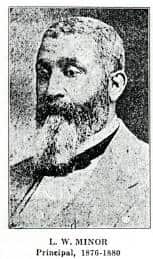
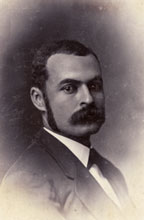
Revels purchased the old college campus in July. That month he also hired Alcorn University faculty. Lawrence W. Minor was hired as professor of Ancient Greek and Latin, John G. Mitchell as professor of agricultural chemistry and mineralogy, and John Blackburn as professor of mathematics and natural philosophy (i.e. science). All the men were well-educated. Minor and Mitchell had attended Oberlin College, while Blackburn had attended Dartmouth College.
All faculty members were Black. The number of college-educated Blacks in the United States was minuscule, so the racial make-up of the faculty likely reflected a conscious decision to try and placate Mississippi conservatives by avoiding a racially integrated campus.
In many respects, the professors were unlike the students they were charged with teaching. The vast majority of the college-age Black residents of Mississippi were former slaves who had grown up in rural areas. In contrast, Revels and Mitchells had been free before the war. Blackburn and Minor had been enslaved, but their fathers' had been their enslavers, and they had enjoyed lives of relatively privilege: each had been emancipated before the Civil War broke out and had received significant financial support from his father.
The first students arrived at Alcorn University around February 1872. A correspondent, publishing under the pen name "Don Carlos," described his visit to the National New Era newspaper. In his letter, he emphasized how the university reflected the changed nature of the post-war south: "The chapel bell which but a few years ago summoned the aristocratic Southerner to his duty, . . . now finds an echo in the chimes in the joyous hearts of a thousand new-born freemen."
Don Carlos's optimism for Mississippi's future is expressed eloquently in his description of the campus:
The "campus" is gently undulating from all points of this half circle towards the centre and front. It is covered with a forest of grand and proud oaks, festooned in the mossy drapery of nature, and rearing their lofty heads to the skies, in mute adoration of the new liberty over which they are now guardians. Truly, these old oaks themselves must open their sap veins and weep tears of joy at the sight which they now behold. As you pass into the "campus" through a spacious archway at either end of the semicircle, the tiny tendrils of the overhanging moss cling to the passer by and whisper in his ear the gladsome news – "Intellectual Freedom is here."
 |
| Belles Lettres |
 |
| President's House |
 |
| Chapel and President's House |
Classes began about a month after "Don Carlos" wrote his letter. Unfortunately, there is little information about the students and what they were taught. There were about forty students during the first year, and this expanded to over a hundred by the second year. Mississippi lacked both urban centers and a significant pre-war population of free people of color, the natural sources for college students. This was alleviated somewhat by financial support. Tuition was free for students, and each county was allowed to award three student scholarships which provided $100 each year.
The initial educational offerings were standard for an American university at the time. The university offered a two-year college preparatory program and two separate four-year college programs: a "classical" track and a "scientific" track. The "classical" track offered a fixed program that strongly emphasized the study of Ancient Greek and Latin but also included courses on mathematics, science, and English. The "scientific" track replaced the Ancient Greek and Latin with courses on modern European languages (French and Germany) as well as practical topics like navigation and free drawing. At least on paper, the university expanded its offerings in its third year and added courses on agriculture and mechanical engineering. It appears, however, that not all classes listed in the university catalogues were offered. A July 1873 article in the New National Era, a newspaper sympathetic to the university, published a letter from a trustee reporting that the teaching was mostly "elementary or preparatory" but more advanced courses in algebra, geometry, and Latin had also been offered. A more critical report written by state legislators in February 1875 stated that most of the classes offered were elementary courses in English grammar, arithmetic, geometry and reading, although the legislators had visited the campus during a chaotic period when teaching had been disrupted.
An account of the July 1873 commencement exercises by a trustee provides a look at the atmosphere on campus. The event was attended by the trustees, the university's namesake James L. Alcorn (then a U.S. senator), Governor Ridgley C. Powers, and a number of state congressmen and senators. After exams were complete, Alcorn gave a speech, and the next day sixteen of the most accomplished students delivered public speeches, declamations and orations. The titles indicate an effort by students to connect with American history. The student Edward Moffit gave a speech titled "A Supposed Speech of John Adams," while George H. Johnson honored Republican politician Daniel Webster with a speech on the "Last Hours of Webster." A. B. Barnes spoke a contemporary political issue: the "Importance of the Union." Other speeches like "Classical Writers of Athens" and "Last Hours of Socrates," displayed students' knowledge of classical western culture. Notably, there were no speeches about "uplift" (e.g. the dangers of alcohol or the importance of hard work and thrift) as became common at schools like Booker T. Washington's Tuskegee Institute. Also absent were any speeches with an overtly controversial theme.
Commencement ended with a speech by the governor. Governor Powers was an Ohioan who had fought for the Union during the Civil War. He had moved to Mississippi after the war to try and earn a living planting cotton. He had been elected as Alcorn's lieutenant governor but became governor after Alcorn resigned to accept a senate seat. Powers was a moderate Republican. Politically, he needed Black votes to hold political power, but he also needed cheap Black labor to profitably run his cotton plantation.
Powers's speech reveals the much of the contours of his support for his Black constituents. He expressed his full support for Black higher education and even indicated that they had tremendous potential: "Because Caesar and Napoleon, Homer and Virgil, Bacon, Shakespeare, and Milton all had white faces it did not prove but a greater than them all might still yet exist with a black face." Alcorn University, he said, was giving them the "key of knowledge," and he encouraged them to use it to unlock the treasurers of art and science.
The governor told those assembled that their university education would open up many professional opportunities, but he discouraged them from entering politics because it was a "uncertain and unsatisfactory" profession. He also emphasized that the students needed to balance their academic education with moral training because "perverted knowledge increase the power of doing evil, and leads to degradation." He encouraged them to show charity and work to defend and uplift others.
Powers concluding his speech by predicting great success for Alcorn University. Unfortunately, his prediction was not realized, and the university collapsed into chaos only a year later. Problems first arose during the summer of 1873 when the state legislature sent a joint special committee to investigate conditions on the campus. The committee found that food services and housing were poorly maintained. Over the winter, two students had even died of meningitis. They also criticized the coursework as being too elementary and recommended more strict regulation of student admissions.
The problems the committee reported appear to have persisted. Professors Blackburn and Mitchell left the university in the middle of 1873. They were replaced by George R. Vashon, another graduate of Oberlin, and Douglass Carr Griffin, a Dartmouth graduate. Unfortunately, the situation continued to deteriorate.
 |
| Dormitory #3 |
 |
| Dormitory #2 |
Events on campus are poorly documented, but a major issue appears to have been conflict between the students and university officials, especially the treasurer and superintendent Samuel J. Ireland. Ireland was responsible was responsible for campus food and housing arrangements, one of the main problems that the 1873 committee had reported. Students also charged that some professors engaged in profanity, lewdness, and drunkenness.
The superintendent also fought with President Revels, and the conflict concluded with Revels's July 1, 1874 resignation. Revels was well-liked by many students, so his removal inflamed tensions on campus.
Revels removal reflected state-wide political conflict. In the 1873 election, the Republican Party had split into two factions: one dominated by Black voters and newcomers from the north, and another one dominated by southern Republicans and moderate democrats. James Alcorn, the university's namesake and an ally of Revels, ran as the second faction's gubernatorial candidate. He was defeated by Adelbert Ames. Ames was the one who removed Revels, partially as a way to take power from a political opponent. The negative press coverage of events at Alcorn University may have been, in part, an effort to attack Alcorn, a weakened political figure.
Regards of the origins of the campus conflict, it became very serious in October 1874. Many students refused to attend recitations for two weeks and asked the executive committee of the board of trustees to remove Superintendent Ireland and three professors (who were not named by the press). Students charged that some faculty were engaging in profanity, lewdness, and drunkenness.
Exactly what transpired is unclear. Some accounts state that the students protested by walking out in a gentlemanly manner, and the only act of violence was the cutting off of the tail of a trustee's horse. However, some politicians reported that the matter was much more serious. State congressman James Cessor told the legislature that the student protest was beginning to break out into violence. According to him, some students were injuring those who supported the faculty, and they had even threatened professors with pistols. Two conservative senators, William Henry Haywood Tison and R. H. Allen, proposed requesting that the President send troops to suppress the "rebellion" at the university, although this proposal appears to have been made with tongue-in-cheek as a criticism of federal military intervention in the south. (Federal troops had recently been sent to Vicksburg to quell a riot, an act that angered many conservatives.) In any case, many legislators were outraged at the situation at the university. Senator William H. Gray, a Black Republican, said reports showed that the university was "a sink hole of iniquity and a gambling hell" where "the students are treated like faro banks than in a college." To address the situation, the legislature formed a joint special committee to form an investigation.
The investigative committee reported on conditions at the university in February 1875. By the time the committee had arrived on campus, things had settled down. The trustees had requested resignations of all faulty and immediately accepted the resignations of three (presumably the three who were the focus of student anger). This placated the students, although many had left the university. The trustees reported that only about sixty students, mostly from families in the area, remained. The investigative committee did not report any accounts of violence, but a number of students complained about the superintendent, and they confirmed some of the charges against the faculty.
In March 1875, following committee advice, the legislature discharged all the faculty, removed all officers, abolished the office of treasurer, and empowered the governor to remove trustees. The university remained open but only as a college preparatory school.
Even more dramatic changes took place in November. Following wide-spread political violence, conservative Democrats won an overwhelming electoral victory over the Republican government that had been in power. This marked the end of Reconstruction in Mississippi. For generations, conservative Democrats would remain in political power, and African American residents would be almost wholly removed from political life.
Despite these setbacks, Alcorn University continued to exist, and Hiram Revels was even re-appointed as president. However, it was a changed institution. A comparison of the 1872 description of campus by "Don Carlos" with the Chester Himes's later description vividly illustrates the nature of the changes. Where campus once had symbolized hopes to create a society where freedmen could take leading roles alongside former planter aristocrats, it became a symbol of lost antebellum prosperity and the degraded state of a Black population oppressed by segregation.
Faculty
7. Charles H. Thompson (1874)
Sources
1. "Personal." The Portland daily press. [volume], May 25, 1871, Image 2
2. The weekly Caucasian. [Lexington, Mo.], June 17, 1871, Image 2
3. Memphis daily appeal. [volume], June 17, 1871, Image 2
4. "A Life in Life." Nashville union and American. [volume], July 12, 1871, Image 1
5. The weekly Caucasian. [Lexington, Mo], July 15, 1871, Image 2
6. "The Colored Professor." The Cairo daily bulletin. [Cairo, Il], July 16, 1871, Image 3
7. "The State." Macon beacon. [Macon, Miss], July 22, 1871, Image 3
8. The weekly clarion. [Jackson, Miss.], August 17, 1871, Image 1
9. New Orleans Republican. [New Orleans, Louisiana], January 06, 1872, Image 1
10. "Governor's Message." The weekly clarion. [Jackson, Miss.], January 11, 1872, Image 1
11. "The Misappropriation of the Proceeds of the Agricultural Land Scrip." The weekly clarion. [volume], February 22, 1872, Image 2
12. "Letters from Mississippi." New national era. [Washington, D.C.], March 07, 1872, Image 1
13. "Items from Mississippi." New national era. [volume], April 04, 1872, Image 3
14. "'Alcorn University' in its True Light." New national era. [volume], May 02, 1872, Image 1
15. "Mississippi for Grant." New national era. [volume], May 16, 1872, Image 1
16. Chicago tribune. [volume], August 05, 1872, Page 4, Image 4
17. "The Martyr." The weekly clarion. [volume], January 09, 1873, Image 2
18. "The Governor's Message." The weekly clarion. [volume], January 30, 1873, Image 2
19. American citizen. [volume], February 08, 1873, Image 2
20. "Congratulations." The weekly clarion. [volume], February 13, 1873, Image 2
21. "Letter from Mississippi." New national era. [volume], March 20, 1873, Image 1
22. "Mismanagement of Alcorn University." The weekly clarion. [volume], April 10, 1873, Image 1
23. "Legislatures." Memphis daily appeal. [volume], April 11, 1873, Image 1
24. The Magnolia gazette. [volume], May 02, 1873, Image 1
25. New national era. [volume], June 19, 1873, Image 2
26. "Commencement at Alcorn University." New national era. [volume], July 24, 1873, Image 1
27. The daily dispatch. [volume], September 05, 1873, Image 3
28. "General News." Daily Kennebec journal. [microfilm reel], September 06, 1873, Image 2
29. The Potter journal and news item. [volume], September 24, 1873, Image 4
30. Memphis daily appeal. [volume], December 26, 1873, Image 1
31. "Personal." New Orleans Republican. [volume], April 09, 1874, Image 1
32. "Prof. Geo. B. Vashon." New national era. [volume], July 02, 1874, Image 2
33. "Current Paragraphs: Religious and Educational" Knoxville journal. [volume], July 23, 1874, Image 3
34. "Ireland's Tammany Tricks at Alcorn University" The weekly clarion. [volume], August 13, 1874, Image 2.
35. "The University Purchases – A Card from S. J. Ireland." The weekly clarion. [volume], August 20, 1874, Image 2
36. American citizen. [Canton, Miss], September 26, 1874, Image 2
37. The weekly clarion. [volume], November 19, 1874, Image 3
38. The weekly Louisianian. [New Orleans, La.], November 21, 1874, Image 3
39. New Orleans Republican. [New Orleans, La.], November 22, 1874, Page 4, Image 4
40. The Daily clarion. [volume], January 13, 1875, Image 2
41. "Notes from the Capitol." The Daily clarion. [volume], January 18, 1875, Image 2
42. "A Lively Time Over the Alcorn University Matter." The Daily clarion. [volume], February 02, 1875, Image 2
42. "Notes from the Capitol." The Daily clarion. [volume], February 05, 1875, Image 2
43. "Alcorn University." The Daily clarion. [volume], February 27, 1875, Image 2
44. "House – Forty-Sixth Day." The weekly clarion. [volume], March 04, 1875, Image 3
45. "The Alcorn University Bill." The weekly clarion. [volume], March 11, 1875, Image 4
46. National Republican, June 30, 1875, Image 4
47. "Alcorn University." The Greenville times. [volume], July 03, 1875, Image 1
48. "An Apostate to His Race." National Republican., December 27, 1875, Image 1
49. "Alcorn University." The weekly clarion. [volume], January 12, 1876, Image 1
50. "Letters from Oberlin, Ohio." New national era, November 23, 1871, p. 1.