Showing posts with label Reconstruction. Show all posts

Friday, January 6, 2023

'sivilizing Freedmen in Arkansas: the Branch Normal College


An artist's depiction of the Arkansas river as viewed from Little Rock.
The view from Pine Bluff would have been similar


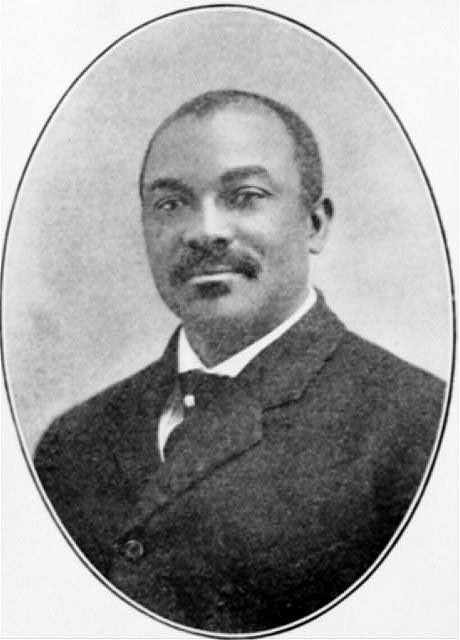
J. C. Corbin
From Wikipedia

On September 27, 1875, visitors to Pine Bluff, Arkansas could witness a scene that they could well mistake for a malaria-induced hallucination. In the middle of this rough river town in the Arkansas Delta, a scholarly-looking Black man was welcoming students to a newly opened college. That man was J. C. Corbin, a forty-two year old graduate of Ohio University and the founding principal of the Branch Normal College, Arkansas's public Historically Black College.

The mere existence of the college was a remarkable achievement. The college had been created by the state legislature two years earlier. This was a time when the state government was dominated by a Republican Party that strongly supported Black Arkansans. Much had changed in the intervening two years. The Republican party had collapsed in chaos, and political power was gained by conservative Democrats that included the state's former slave-owning elite. The new government rolled back many of the changes enacted by Republicans, but it preserved some measures enacted to support newly freed slaves as a paternalistic gesture intended to "fuse" Black voters with conservative Democratic politicians.

The early history of the Branch Normal College is of interest because it represents an unusual road in the development of higher education for freed slaves. Most HBCUs founded during this era were founded by men with a background either in the military or in missionary work. Fisk University's founding president Erastus M. Cravath was a white pastor affiliated with the American Missionary Association. Howard University was founded by the Union general O. O. Howard. Booker T. Washington, the most famous African American educator of the nineteenth century, was neither a military officer nor a missionary, but he had been mentored by Samuel C. Armstrong, who was both the son of missionaries in Hawaii and a former Union general.

Pine Bluff during the nineteenth century

Pine Bluff was a natural place to provide services for freed persons as the town had become a regional center for Black life. The town is located in the south central part of the state, on the Arkansas river. The surrounding area is part of the Arkansas Delta. In the years before the Civil War, aspiring planters brought large numbers of enslaved workers to the area as the Delta offers superior conditions for cotton-growing.

Census records clearly tell the story of this growth. In 1850, there were just under six thousand people living in the county. Ten years later, at the outbreak of the Civil War, the population had more than doubled to just over fifteen thousand. Throughout this period, just under half (or approximately forty-five percent) of the population was enslaved.

As a river town, Pine Bluff played a central role in this growth. The most efficient mode of transport in southern Arkansas was along a river, so aspiring planters arrived in the town by boat and then, after establishing themselves in the countryside, sent their cotton there to be sold at market. The town grew even faster than the surrounding countryside: the population increased four-fold, from just under three-hundred residents to almost one-thousand four-hundred. 

After the war broke out, the town's population swelled as freed slaves from the countryside went there seeking refuge. The town became a safe haven in fall 1863 when Union troops took control and set up a refugee camp. Soldiers remained there and even maintained an office of the Freedmen's Bureau until spring 1869. By 1870, Black residents represented nearly sixty-five percent of the town's population. This was a dramatic change. Before the war, they had been a substantial presence but never a majority.

The conditions that drew freedmen to the town also made it a challenging place to run a college. While Pine Bluff offered great economic opportunity before the war, it had never been an easy place to live. The town was subject to frequent flooding, and the climate was subtropical with hot humid summers. This made for an unhealthful, malarial environment that forced newcomers to go through a long and difficult period of enduring sickness while they acclimated. 

The war, especially the large influx of refugees, strained Pine Bluff's meagre public infrastructure, so problems with sanitation worsened the already bad public health conditions. Disease ran rampant through the freedmen population, and mortality rates soared.

In the face of these considerable obstacles, Corbin had few resources to support the newly formed college. During the first years, the college was run out of a rented house that also served as Corbin's residence. He was the sole faculty member and was even responsible for menial tasks like cleaning the classrooms. 

Skeptics would have questioned the value of providing Corbin with even this modest level of support. Slaves had largely been deprived of education, and Arkansas had only a negligible population of free persons of color. During the first few years after the war, the Freedman's Bureau and missionary societies had run schools for free slaves, but teachers focused on imparting basic skills like literacy rather preparing students for college. Corbin's own official reports on the college communicates a sense of frustration with the difficulties in recruiting and retaining qualified Black students. So, who were the students?

Map of Pine Bluff in 1869. The location of the Branch Normal in 1875 is indicated in red.
From Arkansas Digital Archive

The first students at the Branch Normal College

The first class of students consisted of seven students drawn from Pine Bluff and Drew County (another county located in the delta). The students appear to have come from families of relative privilege. Consider the student Robert Allen. Robert was twenty years old and was living with his parents in Drew County. Robert was born in Arkansas, but his parents had moved from out-of-state (from North Carolina and Virginia). There's no record of Robert's family before the war, but they were almost certainly enslaved. (No free persons of color lived in Drew County in 1860). Robert's father was a wagon maker and a carpenter. These were skilled professions that put the family on firm economic ground and enabled the father to purchase real estate.

Also a member of the first college class was Angeline Vester. Angeline was thirteen years old, much younger than Robert, and had moved from out-of-state. She had been born in Louisiana and had moved to Drew County with her mother and stepfather. The stepfather was a Union veteran (formerly a private in the 98th Colored Infantry), and he likely brought the family to Arkansas to take advantage of the availability of farm land. By the time Angeline began her studies, the family was running a farm.

Pine Bluff in 1908
The location of the Branch Normal College in 1883 is indicated by the light blue dot.

From the Library of Congress

The Branch Normal College in the 1880s

The college graduated its first student in 1882, seven years after it opened. A second student graduated the following year. Both students, James C. Smith and Alice A. Sizemore, remained at the Branch Normal to work as teachers, the first ones Corbin hired. Both were in their earlier twenties, so they had little direct experience with enslavement, but they had grown up around people who did. No information about Alice's background is available, but James seems to have come from a background similar to that of Robert Allen. James was born in Arkansas, but his parents had moved from out-of-state (from North Carolina, likely forcibly by an enslaver). His father worked as a carpenter and wheelwright.

The college moved to permanent facilities in January 1883. The new location was a modest one: a two-story brick building constructed on a twenty acre plot in the western outskirts of town. The college still offered no living facilities, so students continued to live off-campus in rented rooms.

The Branch Normal College in 1908. Only the left-most building existed in 1883.
The right-most building is a dormitory that was built in 1887.
The building between them is a shop building constructed in 1893.
From the Library of Congress

The college celebrated its achievements at a June 1883 public ceremony held to mark the end of the academic term. The event was held off-campus at St. John's AME church. The nature of the event reveals a bit about how Corbin ran the college. The event opened with a prayer by Rev. Sylvester Hutchinson, likely the pastor at St. John's. This was followed by three student speeches: a salutatory (or welcome speech) on "Fame," a speech on "The Human Hand," and a graduating address by Alice A. Sizemore on "The Past." At the end, Frank J. Wise, a prominent white lawyer,  presented diplomas. Music was played between the speeches. The first speech was preceded by the singing of the anthem and Hallelujah by the college choir. The "First Regimental March" was played next, following by "Spirit Creator of Mankind" by the Belgian composer Louis Lambillotte, and finally Gloria from Mozart's Twelfth Mass. 

The song "First Regimental March" was likely the "Marching Song of the First Arkansas Colored Regiment." Singing this son was an act of major political significance. The song was written during the Civil War, and it is sung to the tune of "John Brown's Body." The lyrics proudly proclaim Black soldiers' opposition to the Confederacy. Some lines are "We are going out of slavery; we're bound for freedom's light; / We mean to show Jeff Davis how the Africans can fight" and "[Former enslavers] will have to bow their foreheads to their colored kith and kin." This was a remarkably bold act by students and faculty at a college funded by a state legislature dominated by former Confederate soldiers!

While not as blatant, the rest of the event also held political significance. The speeches displayed academic knowledge and were the types of speeches delivered by students at Predominantly White Institutions during the 19th century. When had graduated from Ohio University several decades earlier, Corbin had delivered a speech on "The Dangers of Literary Distinction." Compares these speeches to those delivered by students at HBCUs like Booker T. Washington's Tuskegee Institute. At a similar exercise held in 1882, the titles of Tuskegee student speeches included "Go to Work" and "The Drunkard's Daughter." The content of the speeches was not recorded, but the titles suggested that they were exhortations to avoid vices that whites alleged were prevalent among freedpersons.

Later that year, in December, the Branch Normal College held another public exhibit. At this event, students gave speeches displaying their knowledge of classical culture. One student delivered a declamation of Anthony's Oration over Caesar, while another gave one on "Rome." Other speeches emphasized students' connections to American culture. One student read a selection from George Washington's Inaugural Address, another spoke on "Revolutionary soldiers."

The music choices suggest similar attitudes. The songs played at the June event were taken from the European musical tradition. This ran counter to common expectations. In public music performances, especially those held for white audiences, students at HBCUs typically played music that came from (sometimes real, sometimes imagined) Black traditions such as spirituals.

A closer look at Branch Normal Students

We can get an unusually close look at Branch Normal students during the 1880s thanks to the work of an interviewer employed by the Works Progress Administration. In the 1930s, the WPA sponsored a project to interview freed slaves. Among those interviewed was Joseph Samuel Badgett, a former at the Branch Normal. Here's what Badgett told the interviewer about his experiences:

After that I went to Pine Bluff. The County Judge at that time had the right to name a student from each district. I was appointed and went up there in '82 and '83 from my district. It took about eight years to finish Branch Normal at that time. I stayed there two years. I roomed with old man John Young.

You couldn't go to school without paying unless you were sent by the Board. We lived in the country and I would go home in the winter and study in the summer. Professor J.C. Corbin was principal of the Pine Bluff Branch Normal at that time. Dr. A. H. Hill, Professor Booker, and quite a number of the people we consider distinguished were in school then. They finished, but I didn't. I had to go to my mother because she was ill. I don't claim to have no schooling at all.

John Young is listed in the 1893 college catalogue as living in Pine Bluff, but I can't find any other information about him. The other two people he mentions were deceased at the time of the interview, but they had been prominent educators and religious leaders.

Former Branch Normal student A. H. Hill
From "The Sons of Allen"

A. H. Hill was Andrew Henry Hill. Hill was born after the war (in 1870) in Brentwood, Tennessee. I haven't been able to find much information about the parents, and in particular, it unclear if they were free or enslaved. When Hill was a child, the family moved to Monroe County and started a farm. When he was a young teenager, Hill became active in the AME church, but instead of immediately entering the ministry, he decided to enroll at the Branch Normal College. He completed his studies there in 1899 and then went to Ohio to attend Wilberforce University. He graduated the university three years later and then returned to Arkansas to serve as a minister at an AME church in Fort Smith. He also served president of Shorter College (an HBCU in Little Rock that is affiliated with the AME church) for almost a decade and was a minister in Pine Bluff.
Joseph A. Booker
From Encyclopedia of Arkansas

Professor Booker was Joseph Albert Booker. His life before the war is relatively well documented. In 1859, Booker was born enslaved on a plantation near the modern town of Portland, Arkansas. The plantation was run by John P. Fisher, an early settler from New Hampshire. By the time Booker was born, Fisher's plantation was a sizable farm of 600 acres which was cultivated by fifty-five enslaved workers. 

Booker experienced great hardship as a child. Both parents died when he was a baby. According to one account, his father was whipped to death for teaching other slaves to read. Booker remained on Fisher's plantation until after the Civil War. By 1870, he and his sister were working as farm laborer for a Black farmer (Jonia Georg).

A modern photo of the Fisher plantation where Booker was born
From Wikipedia

Booker followed a path similar to that of Hill. He became interested in Christianity as a teenager (although he joined the Baptist church rather than the AME church) and enrolled at the Branch Normal College. The timeline of his studies is a little confused. Badgett says that Booker was at the school in 1882 or 1883, but accounts of Booker's life state that he attended from 1878 to 1881. In any case, at some point, he left the college and moved to Nashville, Tennessee in order to attend Roger Williams University, a now defunct HBCU founded by white abolitionists. He stayed at the university for five years, earning a bachelor's degree in 1886. Booker returned to Arkansas after completing his education. He served as minister for a church in southern Arkansas for year, and then he was elected president of Arkansas Baptist College, a HBCU in Little Rock. He remained in that position for the rest of his life.

Booker credited J. C. Corbin for instilling in him a deep love of learning while he was at the Branch Normal College, but politically, the two differed in important respects. Booker was a supporter of Booker T. Washington and even hosted him when he visited Arkansas. In keeping with Washington's views, Booker advocated a conservative political approach that emphasized accommodation over confrontation. In the 1900s, he served on a city vice commission charged with cleaning up Little Rock's red light districts, and he was appointed by the governor to a race relations committee created in response to a major 1919 race riot. 

Joseph A. Booker
From AARG

Joseph Samuel Badgett was not a major public figure like Booker or Hill, but his life is also well-documented. In his interview, he says that his mother was enslaved and "had Indian in her." The last statement is consistent with other public records which record her race as "mulatto." Joseph was born during the last year of the Civil War, so he was born into slavery but had no memory of being a slave. 

Joseph says nothing about his father in his interview, and federal census records are contradictory about basic facts concerning him. The father is described as being born in Ohio in 1900 and 1910, but the 1940 census states he was born in Texas. One possibility for this silence and confusion is that the father was his enslaver, or another white man living in the household.

Joseph's enslaver was likely Madison Badgett, the only adult male with the last name "Badgett" who was recorded as living in the county in 1860. That year, Madison Badgett enslaved two women whose ages match the ages of Joseph's mother and older sister. No enslaved men were in the household, lending further support to the theory that Joseph's father was his enslaver. 

After emancipation, Joseph's mother found work as a domestic servant, and he helped support her by working as a farmhand. Joseph was educated in the state's newly formed public schools, and his teachers included J. C. Smith. Smith was likely teaching between terms at the Branch Normal College to earn some extra income.

His WPA interview focuses on his early life, but Joseph achieved major personal success after leaving the college. He settled in Little Rock and worked as an upholster and then as a barber. At the time of his interview, he had owned his own home for decades.

The Branch Normal College changed significantly after Corbin left. His departure was part of a wave of changes throughout the south as populist politicians rose to political power and created the Jim Crow political system that sought to reduce Black citizens to a state of near-slavery. At the Branch Normal, Arkansas politicians worked to replace the college's academic coursework with training for semi-skilled professions. The campus environment during the 1920s was depicted by novelist Chester Himes (whose father had been on the faculty) in his autobiography and, in fictionalized form, in his novel The Third Generation. Himes depicts the Branch Normal as a wild place where the children of poor and ignorant sharecroppers learned to become "good farmers an' good blacksmiths an' good Nigras," in the words of the governor in The Third Generation. The learning of classical western culture that Corbin had promoted was entirely gone.

Map of Pine Bluff in 1923. The location of the college is indicated in red.
University of Arkansas Library

Monday, March 21, 2022

The students of the Radical University: Green D. Williams

Green D. Williams
From A Historical, Biographical and Statistical Souvenir: Howard University Medical Department

Green Dawson Williams (b. 1848; d. February 8, 1917)
Massachusetts/North Carolina/South Carolina?  Black. 
Occupation: clerk, physician.

Little is known about the early life of Green D. Williams, and the available records are contradictory.  His father is listed as being born in New Hampshire in the 1900 U.S. Census and in North Carolina in the 1910 U.S. Census. Similarly, his mother is listed as being born in Virginia in the 1900 U.S. Census and in North Carolina in the 1910 U.S. Census.

Details about Green's own birthplace are also contradictory.  His birthplace is listed as South Carolina in the 1900 U.S. Census, as North Carolina in the 1910 U.S. Census, and as Boston, Massachusetts in a short biography published by Howard University.  

Williams first appears in the historical record in 1872 (when he was 24 years old). At that time, he was living in Anderson Court House (now the town of Anderson), the seat of Anderson County, South Carolina. Anderson County is the upstate and borders the state of Georgia. Like much of the region, the county was majority White, although by a small margin (about 56% of 16,407 residents were White and 44% or 12,720 were African-American).

The county was one of the first places in South Carolina to experience Ku Klux violence. Ku Kluxers threatened Republicans in the area during the run-up to the 1868 presidential election. Representative of Ku Klux activities was the experience of E. I. Pinson, a White silversmith living in the town of Williamston who was active in the Republican party. The night before the election he found a pasteboard coffin on his doorstep. Appended to it was a Republican voting ticket and the message "K. K. K. is about." He also reported bands of disguised men riding around and firing off guns in a threatening manner. In parts of the county, Ku Kluxers followed through on their threats by whipping or beating Republicans. The prominent Republican politician B. F. Randolph was shot to death in neighboring Abbeville county while traveling to Anderson by train.

The 1868 election was an important one because it was the first held after African-Americans were granted the right to vote. Within Anderson County, Democrats carried the election and largely remained in power throughout Reconstruction. Political violence within the county, especially violence by Ku Kluxers, largely died down after the election.

During his time in Anderson, Williams was active in the Republican Party. He was among the speakers at that year's county Republican Convention. The year was an election year, and Williams spoke about the political issues that he felt were important. He condemned the political corruption and extravagant spending by the administration of Republican governor Robert K. Scott. He called on African-American voters to elect honest Republicans in order to stop these practices. Williams's speech appears to have been well-received as he was elected as a delegate to the Congressional Convention and as an alternative delegate to the State Convention. On Election Day, he served as one of the three Election Managers for the Williamston Precinct.

The 1872 election saw Franklin J. Moses Jr elected to the governorship. In spring 1873, Moses removed the Anderson county auditor (Thomas J. Webb) and appointed Williams in his place. The Conservative newspaper, Anderson Intelligencer, reported that Webb was a "old-time" Republican who had discharged the duties of office "with credit to himself and satisfaction to the community." The newspaper attributed his removal to his political views. In the election, Webb had supported Liberal Republican Horace Greeley for president and Moses's opponent Reuben Tomlinson for governor. Of Williams, the newspaper reported that he was "of fair intelligence" and "good character" but his "education and abilities are scarcely equal to the important duties now devolving upon him." 

By fall, Williams began working as a teacher in addition to his duties as county auditor. He may have taught at the Greeley Institute, a newly formed private school for African-Americans. By the late 1870s, Williams was serving as principal of the institute. 

Williams' call for state Republicans to help end political corruption went unmet. Political corruption reached historic proportions during Moses's administration. During the next election, held two years later, Williams again spoke about the need to fight political corruption. For example at a 1874 Fourth of July celebration held in front of the county courthouse, Williams called on African-American voters to oppose political corruption by electing "good, honest men." He denounced the current political leaders in Columbia and warned African-Americans that they would lose the right of the ballot unless they united and put down corruption. Williams reiterated his views on the need to stop political corruption at the September 1874 county Republican Convention.  Ultimately, the gubernatorial election saw Daniel H. Chamberlain, the regular Republican candidate, defeat the "Independent" Republican John Green. Williams does not seem to have publicly endorsed a candidate, but he likely supported Chamberlain as Green's support drew from Democrats and more conservative Republicans.

During the summer before the election (on April 1, 1874), Williams enrolled as a student at the University of South Carolina. He was awarded a scholarship, and state legislator John R. Cochran singled Williams out for praise for this accomplishment in an October speech he gave on political developments within the state. The university closed before Williams completed his degree.

It is unclear when exactly when Williams left the University of South Carolina. However, it appears that he had left by fall 1876 because, around that time, he resumed his engagement in Anderson county politics. By September, he was appointed as county Commissioner of Election by Governor Chamberlain. (The other two commissioners were  John R. Cochran, a White Republican leader, and James A. Hoyt, the chairman for the county Democrats.) 

Williams was also made Chairman of the county Republican Party. His chairmanship provoked controversy with local Democrats. Williams replaced Cochran who had held long held the position but declined it in fall. The Anderson Intelligencer was especially critical of Williams' appointment. The newspaper reported that, shortly after he assumed the position, reports began circulating among local African-Americans that acts of political violence and intimidation were being committed. The newspapers described these reports as falsehoods that were being spread to help Republicans in the upcoming election. The newspaper blamed Williams for the state of affairs, stating that Cochran had been able to prevent such issues and Williams could do the same if he chose.

In general, Williams took over the party chairmanship during a very difficult time. For the first time since African-American had been granted the right to vote, Democrats were mounting a serious electoral challenge. Beginning with the Hamburg Massacre in July, White Democrats began carrying out acts of political violence against African Americans.

No serious acts of violence appear to have broken out in Anderson county. However, public disputes did break out between Williams and Democratic leaders. That October Williams was planning to host a Republican rally at which several candidates were to speak. His Democratic counterpart (Hoyt) asked if the event could be organized as a joint discussion with Democratic candidates. Initially, Williams was receptive to the proposal, but ultimately, he was told by the state Executive Committee not to allow such a discussion. The Anderson Intelligencer was highly critical of this decision and published the correspondence with Williams under the title "Who Lies!" Williams asked to publish an article explaining his views on the matter, but the newspaper rejected it, claiming it contained "offensive remarks."

The concerns about the joint discussion were not groundless. Upon hearing that a Republican candidate was planning on giving a public speech, Democratic leaders often asked for a joint discussion and, if the request was granted, used this as an opportunity to harass their political opponents. For example, when Republican governor Chamberlain spoke in Edgefield, Democrats were allowed to participate in a joint discussion. At the event, the Democratic speakers included Democratic leader Martin W. Gary, and his speech consisted of personal attacks on Governor Chamberlain involving "as opprobrious language . . . as he could find in which to express himself." The crowd attending the speeches included a large number of Democratic supporters who displayed firearms and interrupted Republican speakers by shouting insults. 

It is unclear how the political speeches that Williams helped organized were received, but the Anderson Intelligencer expressed hope that Democrats would disrupt them: "We hope all the mounted clubs in the County will be present, for we will have distinguished speakers from a distance to meet Republicans, and if they will not divide time we can be present and hear their campaign lies in order to refute them."  

Ultimately, county Democrats won the election by a large margin. The Democratic gubernatorial candidate, Wade Hampton, received almost four-times as many votes as his Republican opponent (4,155 votes to 1,124). Statewide, the electoral outcome was very close, and both parties claimed that their gubernatorial candidate won. The election outcome was disputed for four months, until April 11 when Chamberlain conceded the election. Chamberlain's defeat marked the end of the state Republican Party as an effective political force for generations. 

It is unclear how Williams's responded to outcome of the 1876 election. However, by the next election, held in fall 1878, he expressed support for Wade Hampton. At the county Republican convention, he endorsed Hampton's campaign and advised African-American votes to cast votes for him. In lengthy speech, he said that Hampton had fulfilled his campaign promises to respect the rights of African-Americans and would continue to do so if reelected.

Williams ran for political office in 1878. He received one of the Republican nominations for the position of warden for the town of Anderson. On Election Day, he and all the other Republican candidates were soundly defeated. Each Democratic candidate received over 200 votes, more than twice as many votes as the most successful Republican.

By 1880, Williams had moved to Washington D.C. He attended the Medical College at Howard University from 1880 to 1883 and graduated with an M.D.  He spent most of his adult lift living in Washington D.C. and working as a government clerk for the Treasury Department and as a physician. 

Williams seems to have formed a close friendship with fellow former U of SC student Paul J. Mishow. Census records document Mishow sharing a residence with the Williams family in D.C. Mishow followed a similar path to Williams's. He also moved to Washington after Reconstruction and found work as a physician and government clerk.

In June 1895, Williams attended a public speech given by his former classmate George W. Murray, then a congressman from South Carolina. Murray spoke at the Metropolitan Baptist Church, a predominately African-American church. His speech focused on negro suffrage, and he denounced voter registration laws. These were major issues in South Carolina. The previous year, Democrats led by Governor Ben Tillman had won a referendum  to hold convention to revise the state constitution. They openly sought to revise the constitution for the purpose of disenfranchising African-American votes. The convention was held three months after Murray's speech, and Democrats achieved their goal of revising the state constitution so as to render African-Americans politically powerless.

Despite Williams' presence at Murray's speech, he appears to have largely left political life after moving to  Washington. 

Williams died on February 8, 1917. The cause of death was not reported. 

Sources:

1). 1900; Census Place: Washington, Washington, District of Columbia; Page: 21; Enumeration District: 0050; FHL microfilm: 1240160

2). 1910; Census Place: Precinct 8, Washington, District of Columbia; Roll: T624_153; Page: 3A; Enumeration District: 0147.

3). 1920; Census Place: Washington, Washington, District of Columbia; Roll: T625_210; Page: 4A; Enumeration District: 187.

4). Lamb, Daniel Smith.  A Historical, Biographical and Statistical Souvenir: Howard University Medical Department.  Washington D.C.  R. Beresford.  1900.

5). Hilyer, Andrew F.  Colored Washington: Efforts For Social Betterment. Washington D.C. 1901.

6). Washington, District of Columbia, City Directory, 1914

8). "The Radical County Convention."  The Anderson Intelligencer, August 22, 1872, p. 2.

9) "Protracted Radical Meeting." The Anderson Intelligencer, September 12, 1872, p. 2.

9) "Radical Nominating Convention." The Anderson Intelligencer, October 10, 1872, p. 2.

9) "Election Notice." The Anderson Intelligencer, October 24, 1872, p. 3.

9) "Removal of the County Auditor." The Anderson Intelligencer, February 20, 1873, p. 3.

9). The Fairfield herald [SC], March 5, 1873, p. 3.

10) The Anderson intelligencer [SC], September 18, 1873, p. 2.

11) "Fourth of July in Anderson." The Anderson intelligencer [SC], July 9, 1874, p. 2.

11) "Republican County Convention." The Anderson intelligencer [SC], September 10, 1874, p. 2.

11) "To the Citizens of Anderson County." The Anderson intelligencer [SC], October 29, 1874, p. 5.

12) "Seeking Mischief." The Anderson intelligencer [SC], October 19, 1876, p. 3.

12) The Anderson intelligencer [SC], September 21, 1876, p. 3.

13) "Republican Duplicity." The Anderson intelligencer [SC], October 19, 1876, p. 2.

14) The Anderson intelligencer [SC], October 26, 1876, p. 4.

14) "The San Domingo Meeting." The Anderson intelligencer [SC], February 1, 1877. p. 3.

14) "To the Colored People of Anderson County." The Anderson intelligencer [SC], March 14, 1878. p. 3.

15) "Come One, Come All!!" The Anderson intelligencer [SC], June 20, 1878, p.  3.

16) "A Card." The Anderson intelligencer [volume], July 4, 1878, p. 4.

17) "Public Examinations at the Greeley Institute." The Anderson intelligencer [SC], July 11, 1878, p. 3.

17) "The Radical County Convention." The Anderson intelligencer [SC], August 8, 1878, p. 3.

17) "The Municipal Election." The Anderson intelligencer [SC], August 15, 1878, p. 3.

18) "The Radical's Last Kick." The Anderson intelligencer. [SC], September 26, 1878, p. 3.

19) "The Radical County Convention." The Anderson intelligencer [SC], April 29, 1880, p. 3.

20) "Appointments in Treasury Department" The Evening critic. [volume], July 1, 1881, p. 1.

21) "His People Defrauded." The Washington Times [DC], June 19, 1895. p. 8.

21) "Deaths." The Washington times. [volume], February 12, 1917, COMPLETE AFTERNOON EDITION, Page 11, Image 11

7). "Death Record."  The Washington Herald, February 11, 1917, p. 16.

Monday, November 15, 2021

The students of the Radical University: George E. Hart

George Elliott Hart (b. abt. 1854)
South Carolina.  Black.
Occupation: laborer
Father's occupation: laborer

George E. Hart was born in South Carolina to Jobe and Elizabeth Hart.  In the 1880 Census, his parents are described illiterate laborers working in Lyons, South Carolina (in Orangeburg County).

George registered as a student at the University of South Carolina on April 1, 1874.  He started in the college preparatory (or sub freshman) class, but the next year he was advanced to the freshman college class and was following the classical studies track.  The university closed before he completed a degree.

After the university closed, George returned to Orangeburg County and worked as a laborer. He was living with his parents in 1880.

George played a significant role in the 1878 election. This election was an important one as it was the first held since the end of Reconstruction. George was appointed as an election supervisor for the polling station at Bookhardt's (also spelled "Bookhart's") in Orangeburg County. In South Carolina, each polling station was assigned two election supervisors, one appointed by Republicans and one appointed by Democrats. George's Democratic counterpart was Thomas Livingstone, a middle-aged White farmer. The two supervisors shared the responsibility of running the election with three managers of elections. The managers at Bookhardt's were all Democrats. To help maintain order, three state constables, aligned with Democrat-controlled state government, were also present.

Election Day passed without incident. However, when the election managers began counting ballots, they noticed several irregularities. Several of the ballots were found with a second ballot folded inside. All such ballots were for the Democratic ticket, which suggests that some Democratic voters had tried to fraudulently cast more than one vote. The election managers destroyed all such double votes. After doing so, the ballot count remained suspicious. Two-hundred and eighty-one ballots remained, but both George and the election mangers had only counted two hundred and sixty two-voters. To rectify the situation, one of the managers drew out ballots and then tore them apart until the ballot count matched the count of voters. This provoked some controversy. The ballot counting was done in public. Several African-American spectators noticed that the election manager was mostly tearing up Republican ballots, and they began grumbling. Despite this, George did not object and certified the resulting vote count. The certified outcome was 173 votes for the Democratic ticket and 127 for the Republican one.

Both at Brookhardt's and in South Carolina in general, Democrats swept the election. However, many Republicans alleged that the victory had been obtained through voter fraud. The election of Brookhardt's congressman fell under particular scrutiny. That year the incumbent, an African-American Republican, had not run for re-election, and the election ended up being a contest between the Democrat Michael P. O'Connor and the Republican Edmund William McGregor Mackey. Both O'Connor and Mackey were White South Carolinians with significant political experience.

O'Connor was certified as the elected congressman. The Secretary of State certified that O'Connor had received 20,568 votes while Mackey had received only 13,182 (and 11 votes were cast for other candidates). Mackey contested the result, and. Congress launched an investigation into his claims. Among other activities, Congress took testimony from many individuals involved in the election. George was among those who testified. 

Ultimately, Congress upheld the reported election outcome, so O'Connor remained in office. He ran for re-election two years later (in 1880) and was again opposed by Mackey. The election was much more chaotic than the one that had been held two years ago. 

As in the previous election, George was the Republican-appointed election supervisor for Bookhardt's precinct. On Election Day, he ran into irregularities almost immediately. He showed up that morning to the regular polling place, but found that nobody else was present. After waiting for some time, he was told that the polling station had been moved to a private residence (that of one Mr. Snyder). 

Upon arriving at the polling station, he found that the three election managers were there, and they had already opened the station to voters. As in the previous election, all the managers were Democrats. A Democratic supervisor should also have been present, but he never showed up.

Law enforcement officers, eight state constables and four U.S. marshals, were also present at the polling station. All marshals were African-American Republicans, and they were more active than the marshals present at the last election, although witnesses disagreed on their exact conduct. One witness, Samuel M. Kemmerlin, said that the marshals were "extremely officious." Kemmerlin, a White farmer and ex-Confederate, had not been an election official, but he had been present at the polling station for most of the day. 

The clerk of the board of election managers, Olin L. Strock, recalled the marshals differently. He said that they were "overbearing" and had "acted in a very ungentlemanly manner." He further said that they had been encouraged in their behavior by a crowd that assembled outside of the polling station.

A crowd of a few hundred (witness estimates vary from two to three hundred to one hundred and fifty) stood around the polling station all day. The crowd consisted almost entirely of African-American Republicans. Many were armed with guns and clubs.

Over the course of the day, the marshals prevented several people from voting. The first person was one Mr. McGrue, a Democrat. When McGrue tried to cast his vote, one of the marshals told him that he could not because he'd been criminally convicted for stealing cotton. McGrue responded by shoving the marshal and was then arrested.

The marshals also tried to prevent a Republican, Arnold Dantzler, from voting. One marshal told him that he could not vote as he'd been convicted of burglary. However, Dantzler produced a pardon signed by the governor and was then allowed to vote.

When it came time to count the votes, several problems arose. George had counted that 262 voters had cast ballots, but the election managers had counted 281. Neither count agreed with the number of ballots. They found 298 ballots in the ballot box, and several of the ballots had additional ballots folded inside. The managers destroyed three folded in Democratic ballots, but they counted two similar Republican ballots they found. The managers then proceeded to destroy additional ballots so that the total number matched the number of voters. They ended up destroying 16 Republican ballots and 1 Democratic ballot. This resulted in an outcome of 212 votes for Mackey and 69 votes for O'Connor.

The managers received a signed letter of protest against counting votes at Bookhardt's. The letter was signed by three White men, almost certainly all Democrats (two had served in the Confederate army). The men submitted their protest because (1) the poll station was moved but no notice of the move given, (2) the polling station hadn't opened on time, and (3) no Democratic supervisor was present. 

While the managers were counting the votes, they were watched by the crowd assembled outside. The crowd was very loud and boisterous with people shouting about how "The [ballot] box is ours" and they were going to win the election.

To complete their work, the managers needed to bring the box containing the ballots to the commissioners of election in the town Orangeburg. The marshals stated that George should bring the ballot box to Orangeburg, but one of the managers stated this should be done an election manager, not a supervisor. The managers deliberated on the matter, and after hearing all the shouting outside, they become concerned that any (Democratic) manager who tried to carry the ballot box outside would be mobbed by the crowd, so they gave it to George. 

George left the polling station accompanied by two of the marshals. Upon seeing George emerge from the station with the ballot box, a number of men triumphantly fired off several volleys from their guns and used "all kind of language which was not becoming in any crowd to use." The crowd then followed George as he carried off the ballot box.

That night George stored the ballot box at his home and went to bed. The next morning he traveled to Orangeburg to present the ballot box to the commissioners of election. However, when he arrived in the town and went to the commissioners' office, they rudely refused to accept the box. George left it with a local White Republican lawyer (Abial Lathrop). The lawyer and other Republicans made additional attempts to submit the ballot box to the commissioners, but the commissioners persisted in their refusal. Ultimately, the commissioners reported that no returns from Bookhardt's and three other precincts.

The Secretary of State certified the statement of votes received from the Orangeburg commissioners. This resulted in O'Connor winning the election with 17,569 votes to Mackey's 12,297 votes. The chief supervisor of election certified a different statement of votes. He included the votes from precincts like Bookhart's. This still resulted in O'Connor's victory, but by a much narrower margin: 18,338 votes against 17,455 for Mackey.

After O'Connor was announced the electoral victor, Mackey contested this outcome through Congress for a second time. George again provided testimony about voting at Brookhart's. O'Connor died before Congress made a decision regarding Mackey's claims, and he was replaced by the Democrat Samuel Dibble in a special election. Near the end of Dibble's term (in May 1882), Congress overturned the reported election and made Mackey the congressman elect. After serving out the term, he was re-elected.

George appears to have remained in Orangeburg County after the 1880 election. In August 1890, he was appointed postmaster for the town of Elloree. Five years later (in April 1895), he ran into problems. He was arrested on charges that he had embezzled money order and postal funds. After a preliminary hearing, he was placed under $1,000 bond, but the ultimate outcome of the legal proceedings is unknown. 

George last appears in the 1910 Census. That year he was living in the town of Eutaw and working as a carpenter. 

Sources
1). 1880; Census Place: Lyons, Orangeburg, South Carolina; Roll: 1237; Page: 198A.

2) 1910; Census Place: Eutaw, Orangeburg, South Carolina; Roll: T624_1469; Page: 20A; Enumeration District: 0129; FHL microfilm: 1375482.

3). United States, Congress, House. E. W. M. Mackey vs. M. P. O'Connor: Papers in the Case of Mackey vs. O'Connor, Second Congressional District of South Carolina. Government Printing Office, 1880. 46th Congress, 2nd session, Mis. Doc. No. 40., Part 1. pp. 343-345.

4). United States, Congress, House. E. W. M. Mackey vs. M. P. O'Connor: Papers in the Case of Mackey vs. O'Connor, Second Congressional District of South Carolina. Government Printing Office, 1880. 46th Congress, 2nd session, Mis. Doc. No. 40., Part 2. pp. 1315-1319. 

5) 3). United States, Congress, House. E. W. M. Mackey vs. M. P. O'Connor: Papers in the Case of Mackey vs. O'Connor, Second Congressional District of South Carolina. Government Printing Office, 1881. 467h Congress, 1st session, Mis. Doc. No. 15. pp. 655-

6) "Still another postmaster." The State [Columbia, SC], April 20, 1895. p. 8.

7) Record of Appointment of Postmasters, 1832-1971. NARA Microfilm Publication, M841, 145 rolls. Records of the Post Office Department, Record Group Number 28. Washington, D.C.: National Archives. Volume #:65. Volume Year Range: 1889-1904.

Tuesday, June 1, 2021

Reconstructing higher education in Arkansas

Arkansas Industrial University
History of the University of Arkansas

Here we'll discuss public higher education in Arkansas during Reconstruction.

Creating higher education in Arkansas

When the Civil War broke out in 1861, education in Arkansas was in an underdeveloped state. There was no state-supported university, and the education that was available was largely offered by private institutions. Higher education was provided by St. Johns' College, Cane Hill College, and Arkansas College

In general, Arkansas was largely a frontier state. However, it was developing rapidly as the economy was propelled by cotton planting. From 1850 to 1860, the population roughly doubled, growing from 209,897 to 435,450. Despite the growth, the total population remained small: Arkansas was the second smallest of the states that would make up the Confederacy. Slavery remained relatively underdeveloped. Enslaved workers formed about a quarter of the state population, the lowest percentage within the Confederacy. 

The state only reluctantly seceded from the Union. In response to Lincoln's election, a state convention to debate secession was held in March 1861. However, a proposed ordinance of secession was defeated. Arkansas remained in the Union until May 1861. That month the state convention was reconvened following the Battle of Fort Sumter. Many convention delegates were outraged at Lincoln's call for Arkansas to provide troops to put down the rebellion, and an ordinance of secession was adopted.

Secession placed Arkansas in the front line of the Civil War as it bordered the Union state of Missouri. Federal forces entered the state and achieved major military victory over Confederates in early 1862. For the remainder of the war, the state was an active war zone. Civil government largely broke down. The military took over governing parts of the state while other parts fell into anarchy.

Within the state, organized educational activities largely stopped during the war. However, there were positive developments on the national level. In 1862, Congress passed the Morrill Land-Grant Acts. These acts provided states with funding (through land sales) to build colleges devoted to agriculture and the mechanical arts.

In order receive benefits, state legislatures had to accept the Morrill Acts. This presented a difficulty for Arkansas. By 1864, federal troops had taken control of the state capital of Little Rock, and a loyalist state government had been formed. The newly formed legislature accepted the Acts in May 1864. However, the legal meaning of the legislature's actions was unclear as the Morrill Acts explicitly excluded state that were in rebellion. Thus, in January 1867, after hostilities had come to an end, the state legislature accepted the Acts for a second time.

Despite the acceptance of the Morrill Acts, the Arkansas legislature only made took up the problem of establishing a univeristy in 1868, at the start of Congressional Reconstruction. That year the state adopted a new constitution which set one of legislature's duties to be establishing and maintaining a state univeristy. During the first session (in July 1868) held under constitution, the legislature passed an act creating a public univeristy. The new university was to be governed by the Superintendent of Public Instruction together with a board of trustees appointed by the governor. Its purpose was to instruct students in both the standard liberal arts curriculum as well as agriculture, "the mechanic arts," engineering and military science.

While the legislature created a Board of Trustees charged with creating and running a public university, the trustees had made little progress by 1871, so the legislature revisited the issue. That year a second act creating a public university was passed. The new act revised the previous one and created significant structural changes. For example, the new univeristy was named the "Arkansas Industrial University." Most significantly, the Board structure was changed so that trustees who had been appointed by the governor were now elected by the legislature and the university president was given an ex-officio seat.

The new Board of Trustees was more active than the old one, and it soon began selecting a location for the newly created Arkansas Industrial University. The Board solicited bids from counties and towns and then considered them in September 1871. That month the Board passed a resolution establishing the univeristy in Washington County. After considering a few possible locations within the county, the Board decided to establish the university in the town of Fayetteville, the county seat.

The location of the univeristy

Washington County lies in northwest of the state. At the outbreak of the Civil War, the county was largely populated by small farms run by families engaged in subsistence farming. About 15,000 people resided in the county. Of these, only a small minority (about 2%) were slave-owners. Individual slave-owners owned relatively few slaves: most owned fewer than four, and slaves only made up about a tenth of the county population. However, slave-owners wielded a large amount of economic and political power. They held the majority of the elected positions, for example.

The town of Fayetteville formed a cultural and political center within Arkansas. In addition to being the county seat, it housed Arkansas College, one of the few college in the state. About 1,000 people lived in the Fayetteville. Of these, about a third were enslaved.

Fayetteville experienced tremendous hardship during the Civil War. The town was occupied by federal troops early on (in February 1862) and was site of a battle. By the end of the war, parts of the town were in ruin. Winning the location of the new public univeristy was a way for the town to assert its continued significance in the aftermath of the war.

The opening of the univeristy

Arkansas Industrial Univeristy first opened its doors in January 1872, shortly after the trustees selected Fayetteville for its location. The univeristy began modestly. On the first day of the univeristy, only seven students matriculated. The student population had grown to about one hundred by the end of the year. Most students arrived at the university ill-prepared for college-work, so the courses offered were largely college preparatory courses.

The first students were overwhelming Arkansans, and Fayetteville locals were strongly represented. The first students included the children of prominent county residents, for examples the sons of state Associate Judge Lafayette Gregg. Judge Gregg had served in the state Congress during the Antebellum and fought for the Union during the war. He had played an important role in securing Fayetteville as the location of the new univeristy.

The new students included both men and women. One of the first acts of the trustees had been to declare the university open equally to men and women. Women fully took advantage of the opportunity: six of the first ten college students were women, for example.

The issue of African-American enrollment was more delicate. The trustees took up this issue shortly after the university opened. At a January 1872 meeting, a resolution instructing the Univeristy President to admit both White and African-American students was proposed. However, the resolution was replaced by one stating that the question of African-American enrollment was to be disposed of "as the sound discretion of the Executive Committee may dictate." The Committee evidently decided that African-Americans should be admitted: in an April 1873 address to the Board, the Univeristy President reported that univeristy had open its doors to all "without regard to race, sex or sect."

Despite the President's statement, the university was open to African-Americans only in a perfunctory sense. The number of African-American students was small, and those students were forbidden from attending classes with White students. Instead, they received private tutoring from the University President.

It is unclear how many African-American students actually attended. Reynolds and Thomas' History of the University of Arkansas state that only one student applied for admission. That student is likely James McGahee. McGahee was from Woodruff County. He appears in university records as a scholarship student attending the Preparatory Department for the 1872-73 academic year.

A different estimate is provided by Rothrock in his article "Joseph Carter Corbin and Negro Education in the University of Arkansas.” Rothrock states that, in fact, several African-American students attended the university. He quotes a 1922 letter by the wife of Lucy Gates, the wife of UA's first president, stating that "two or three Negro boys applied for admission." Newspapers from the time reported that two other African-Americans, Mark Wallace Alexander and Isom Washington, received university scholarships for the 1873-74 academic year. However, they are not among the listed students in the university catalogue.

The first faculty

During the university's first semester, classes were taught be three faculty members: Noah P. Gates, Mary Gorton, and Charles H. Leverett. Professor Leverett taught ancient languages, and the other two were responsible for the Normal (or teacher training) Department. A year later the faculty had expanded to include Miss Stanard as an Instructress of the Training School and Henry L. Burnell as Professor of Military Science. The next year Burnell was replaced by Edwin S. Curtis, and the university added Tom L. Thompson as Professor of Chemistry, Nicholas B. Pearce as Professor of Mathematics and Engineering, and W. D. C. Botefuhr as Professor of Music.

The faculty demonstrated regional and political diversity, a remarkable development given the political polarization in Arkansas at the time. Burnell and Curtis had both served in the Union army, while Leverett and Pearce had served the Confederacy. Pearce had even commanded troops that won a major battle early in the war. Of the other faculty members, Gates was from the border state of Kentucky, while Botefuhr, Gorton, and Thompson were from the midwest. (It is not known where Stanard was from.)

Of the faculty, Curtis and Pearce had graduated from the Military Academy at West Point, Leverett from the South Carolina College, Thompson from Iowa State College, and Gorton from Illinois Normal University. Nothing is known about Stanard, but the other three faculty members, Gates, Burnell, and Botefuhr, had not completed a college education, although some had taken college classes. 

The end of Reconstruction

Reconstruction came to an end during the university's third year. The first three years of the university were a time of tremendous chaos in Arkansas state politics. The Republican Party had split into two rival factions, and each contested the other's claim to have won the 1872 gubernatorial election. The dispute culminated in widespread political violence in Little Rock during the summer of 1874. 

The ultimate outcome of the dispute within the Republican Party was that the party was largely removed from political power. During a special session held that summer, the General Assembly called for a constitutional convention. Political restrictions on ex-Confederates had recently lifted, so Conservative Democrats were able to dominate the convention. In October, a new Constitution was approved, a new Democratic governor was elected, and Democratic politicians gained a large majority within the state legislature. 

The end of Reconstruction had surprisingly little impact on the university. The legislature declared all trustee positions to be vacated and created a new Board of Trustees. However, there were no major changes to the faculty and students. For example, despite having fought for the Union, Edwin S. Curtis retained his professorship until 1875 when he came into conflict with other faculty over issues like student discipline. Leverett remained at the university for the next 20 years.

The end of Reconstruction signaled the end of the university's limited efforts toward racial integration. However, those efforts were already being reversed during the last years of Reconstruction. In 1873, the state legislature created the Branch Normal College in Pine Bluff. It was tacitly understood that this college would be for African-Americans and Arkansas Industrial University would be for Whites. For the next seven decades, no African-Americans would attend the university.

Friday, May 7, 2021

The professors at Arkansas Industrial Univeristy: Nicholas B. Pearce

Nicholas Bartlett Pearce
History of the University of Arkansas

Nicholas Bartlett Pearce (b. July 20, 1828; d. March 8, 1894 )

Kentucky.  White.
Education: United States Military Academy
Occupation: farmer, manufacturer, m
erchant

Nicholas B. was born in 1828 in Caldwell County, KY to Allon and Mary Pearce. Little is known about his parents. 

Nicholas attended Cumberland College, a now-defunct private college in Kentucky that was affiliated with the Presbyterian church. After gradating from the college, Nicholas matriculated to the U.S. Military Academy at West Point. He graduated from the academy in 1850.

After graduating, Nicholas was commissioned as a second lieutenant in the 7th U.S. Infantry Regiment. He remained with the 7th Infantry for most of the 1850s. During this time, the regiment saw service in Arkansas and Indian Territory (modern Oklahoma).

In August 1858, while stationed in Arkansas, Nicholas resigned from the army. He moved to Osage Mills in Benton County and helped run his father-in-law's general store and mill. 

During the Civil War, Nicholas fought against the federal army. Nicholas had opposed the secession of Arkansas. However, shortly after the state seceded, he was elected as one of three commanders of the state military, reorganized as the "Army of Arkansas." Nicholas held the title of brigadier general and commanded the First Division of Arkansas Army. In July 1861, he led the army into Missouri and defeated federal forces at the Battle of Wilson's Creek. 

Despite the victory, Nicholas played only a limited role in the war after Wilson's Creek. In August of that year, officials tried to transfer the troops under Nicholas's command from the Arkansas state government to the Confederacy. Nicholas opposed the transfer, but this had limited impact. By the end of the year, essentially all Arkansas state troops had either been mustered out or transferred east to join the Confederate Army.

After his troops were transferred, Nicholas served in the Confederate Commissary Department. He was first stationed in Arkansas, but around April 1862, he was moved to Texas and continued working as a commissary. He would remain in Texas for the remainder of the war.

After the Civil War (in 1865), Nicholas received a pardon from President Johnson for having supported the rebellion. In 1867, he returned to Benton County, AR and worked to rebuild the businesses he'd run before the war.

In December 1872, Nicholas was appointed Professor of Mathematics and Engineering. He only remained in the position for two years, until around the end of Reconstruction. His professorship was given to O. C. Gray.

Nicholas left Arkansas Industrial Univeristy to return to Benton County. He served as the postmaster for Osage Mills during the late 1870s. 

During this time, Nicholas began involved in state politics. He was elected assistant secretary for the 1874 state Constitutional Convention. In 1876, he unsuccessfully ran as a Democratic candidate for Secretary of State.

In 1879, he moved to Kansas City, MO. He first worked as a commercial traveler for the firm of S. H. Benedict & Co. He later worked as an examiner for the Lombard Investment Company.

While living in Kansas City, Nicholas' wife began to experience ill health. She and Nicholas moved to Texas around 1884 in hope that the climate would improve her health. By 1891, Nicholas was living in Dallas and continuing to work for the Lombard Investment Company. 

Nicholas died in Dallas, TX in 1894. He is buried in Oak Wood Cemetery.

Undated photo of Nicholas B. Pearce
From Wikipedia


Sources
1. 1850; Census Place: Cornwall, Orange, New York; Roll: 573; Page: 171b

2. 1860; Census Place: Anderson, Benton, Arkansas; Page: 427; Family History Library Film: 803037

3. 1870; Census Place: Osage, Benton, Arkansas; Roll: M593_47; Page: 304B

4. 1880; Census Place: Anderson, Benton, Arkansas; Roll: 38; Page: 366A; Enumeration District: 010

5. Texas, U.S., Death Certificates. 

6. Reynolds, John Hugh and Thomas, David Yancey. History of the University of Arkansas. Fayetteville: Univeristy of Arkansas. (1910) pp. 507-508.

7. Dallas, Texas, City Directory, 1891

8. Kansas City, Missouri, City Directory, 1881, 1882, 1887.

9. The daily union, March 20, 1851, p. 3.

10. The daily union, July 28, 1855, p. 2.

11. "Resignation of an Army Officer" Evening star, March 26, 1858, p. 2.

12. "Regnant Populi." Daily Arkansas Gazette (Little Rock,  AR). July 15, 1874. p.1 . 

13. "Meeting of the Constitution Makers." Fayetteville Weekly Democrat (Fayetteville, AR). July 18, 1874. p.1

14. "Personal." Fayetteville Weekly Democrat (Fayetteville, AR). December 25, 1875, 1874. p. 5.

Sunday, May 2, 2021

The professors at Arkansas Industrial Univeristy: Oliver Crosby Gray

Oliver C. Gray

Oliver Crosby Gray (b. December 30, 1832; d. December 9, 1905)

ME.  White.
Education: Colby College (A.B., honorary A.M., 
honorary LL.D.), St. John's College (honorary LL.D.)
Occupation: professor, teacher

O. C. Gray was born in Jefferson, Maine to Peter and Rachel Kennedy Gray. The father Peter was a noted Harvard-trained physician. 

Gray was first educated at the Waterville Classical Institute. Starting in 1849, he attended the institute's preparatory program for two years and then matriculated at Waterville College (now Colby College). He received an A.B. degree from the college in 1855. 

After receiving his degree, Gray began attending Dartmouth College. However, he only attended the briefly. In 1856, he moved west to Minneapolis, MN. There he worked as a principal for public schools. He remained in Minneapolis until 1857 when he moved south to Arkansas.

In Arkansas, Gray first served as principal at Monticello Academy. After about two years, he left to serve as principal of Princeton Academy (in Princeton, AR). 

When the Civil War broke out, Gray enlisted in the Confederate army. He began the war as a private in the Third Arkansas Cavalry but was later promoted to captain. Gray was at the battles of Shiloh and Chickamauga. In 1864, while returning home on furlough, Gray was captured by federal troops and imprisoned in New Orleans and on Ship Island (in Mississippi). He was later released in a prisoner exchange. He returned to military service, and was promoted to Lieutenant Colonel. By the end of the war, he been assigned to General Armstrong's staff.

After the war, Gray returned to Arkansas and continued to teach. He first served as principal of the Princeton Female Academy. However, after a year in that position, he accepted the position of math professor at St. John's College in Little Rock. There he taught math from 1868 to 1871. In 1871, he was elected college president. He remained in that position until 1874 when he moved to the Arkansas Industrial University.

Gray moved to the university to serve as Professor of Mathematics and Civil Engineering. He remained at the univeristy until 1886. He then left for a year to serve as principal of Fayetteville public schools. During this time, he was also elected mayor of Fayetteville. Gray returned to his university professorship in 1889 and remained there until 1895.

After leaving the university in 1895, Gray moved to Little Rock to serve as principal the Arkansas School for the Blind. In 1899, he let Little Rock for Searcy where he served as principal of the Speers-Langford Military Institute at Searcy. Gray returned to the School for the Blind in 1901 and remained their for the rest of his career.

During the winter of 1905, Gray fell ill with cerebra-spinal-meningitis. Six weeks later the illness took his life. He was buried in Evergreen Cemetery in Fayetteville.

Sources Cited
1. "Gray, Oliver Crosby." The National Cyclopedia of American Biography, Volume VIII. New York,  James T. White & Company (1924).  pp. 303-304.

2. "Col. O. C. Gray has passed away." Daily Arkansas Gazette (Little Rock, AR). December 10, 1905. p. 1. 

3. "Goes to Searcy." Semi-weekly graphic (Pine Bluff, AR). August 19, 1899, p. 6.

4. 1850; Census Place: Waldoboro, Lincoln, Maine; Roll: 259; Page: 205b

5. 1870; Census Place: Little Rock, Pulaski, Arkansas; Roll: M593_62; Page: 245B

6. 1880; Census Place: Fayetteville, Washington, Arkansas; Roll: 59; Page: 683C; Enumeration District: 215

7. 1900; Census Place: Searcy, White, Arkansas; Page: 2; Enumeration District: 0149; FHL microfilm: 1240080

8. Minnesota Historical Society. Minnesota State Population Census Schedules, 21 Sept 1857. St. Paul, MN, USA: Minnesota Historical Society, 1977. Microfilm. Reels 1-47 and 107-164.

9. History of the Univeristy of Arkansas

Saturday, May 1, 2021

The professors at Arkansas Industrial Univeristy: James Mitchell

James Mitchell
History of the University of Arkansas

James Mitchell
From Linda Davis via findagrave.com


James Mitchell (b. May 8, 1832; June 26, 1902)

AR. White.
Education: Cane Hill College (honorary B.A.)
Occupation: editor, farmer, publisher, school teacher

James Mitchell was born in Cane Hill, Arkansas in 1832 to James and Mary Ann Mitchell. The father was a farmer. His parents had moved to Arkansas from the midwest shortly before James was born.

Growing up, James had to help out on the family farm but attended school when could, for example during winters. His formal education concluded with attending Cane Hill College for the 1855-56 academic year. 

In 1856, the year after his formal education ended, James received an appointment as a U.S. deputy surveyor. This job took him to the Kansas and Nebraska territories for the next two years. 

In Fall 1859, shortly after after he'd returned from working as a surveyor, he opened a school in Evansville, AR. The next year was elected to the state legislature. He served in the house and was elected as a Democrat. As a legislator, he chaired the House Education Committee.

When the Civil War broke, James enlisted in the army and fought for the Confederacy. In 1861, he served as a private in an independent cavalry company. The next year he entered 34th Arkansas Infantry Regiment as a lieutenant. He was transferred to Crawford's 1st Arkansas Cavalry Regiment around December 1863 and was appointed quartermaster. He served until the end of the war. 

The Civil War came to an end for James in May 1865, when his unit surrendered near Corsicana, TX. His family was also living in Texas at this time, as they had fled wartime disruptions in Arkansas. The family lived for a year in Bonham, TX while James taught to earn money. 

In 1866, after he'd spent a year in Texas, James returned to Cane Hill, AR. He soon began teaching at Cane Hill College. While he was teaching there, the college awarded him a B.A. degree, although the degree was presumably honorary. He taught at the college for about 6 years. 

James left Cane Hill to teach at the Arkansas Industrial University in 1874. He was elected Professor of History and English Literature. James was hired around the time that A. W. Bishop was made univeristy president. At a July 1874 inaugural ceremony, James gave a speech about education in Arkansas. In his speech, he promoted education as a way to improve the state:
What do we need in Arkansas? Do we not need more trained and cultivated intellects, more trained workers, in all classes and ranks of society? Do we not need them in our courts, in our Legislatures, at the bar, at the bedside of the sick, in the schoolroom, in the pulpit, in private life, in public life – everywhere? Looking back at the dark past of Arkansas, and forward to our future by no means bright, we are constrained to say that we need a better, higher and purer culture among all our people. It is said of Themistocles that when he was laughed at on account of his ignorance of certain accomplishments held in much esteem by many of the Athenians, he replied: "It is true that I never learned to tune a harp, or play upon a lute; but I know how to raise a small and obscure State to greatness and renown." Oh, that from the multitude of her public servants – that from the horde of politicians that now afflict the body politic, there would arise, in the near future, but one Themistocles to lead Arkansas to glory and renown!

The reference to "the horde of politicians that now afflict the body politic" is likely a reference to the state Republican politicians which dominated Arkansas at the time. James was giving his speech shortly after the state governorship had been violently contested in the Brooks-Baxer war. 

James taught at the university until 1877. That year he resigned his professorship to move to Little Rock.

James moved to Little Rock to assume the editorship of the Little Rock Gazette. After about two years, he left the Gazette to become part owner of the Arkansas Democrat. In 1890, ownership of the newspaper was transferred to the Arkansas Democrat Company. James was made president of the company and editor-in-chief of the newspaper. In that capacity, James advocated for improving education and promoted Democratic politics. 

In addition to his newspaper work, James served as Little Rock's postmaster during President Cleveland's second administration (from 1893-97).

James died in Little Rock in 1902 after a short illness. He is buried in Mount Holly Cemetery. His papers are held by the Univeristy of Arkansas.

James Mitchell
From NoBody via findagrave


Sources cited
1. 1850; Census Place: Cane Hill, Washington, Arkansas; Roll: 31; Page: 417a

2. 1860; Census Place: Cane Hill, Washington, Arkansas; Page: 565; Family History Library Film: 803052

3. 1870; Census Place: Cane Hill, Washington, Arkansas; Roll: M593_66; Page: 89B

4.  1880; Census Place: Little Rock, Pulaski, Arkansas; Roll: 54; Page: 300A; Enumeration District: 143

5. 1900; Census Place: Little Rock Ward 2, Pulaski, Arkansas; Page: 14; Enumeration District: 0073

6. Reynolds, John Hugh and Thomas, David Yancey, History of the University of Arkansas. Fayetteville, University of Arkansas. (1910).

7. Ross, Frances Mitchell, and James Mitchell. "Civil War Letters from James Mitchell to His Wife, Sarah Elizabeth Latta Mitchell." The Arkansas Historical Quarterly 37, no. 4 (1978): 306-17. 

8. Ross, Frances Mitchell. "James Mitchell, Spokesman for Women's Equality in Nineteenth Century Arkansas." The Arkansas Historical Quarterly 43, no. 3 (1984): 222-35.

A War Hero turned Communist Worker?: Lewis Smith's military service

Aleck Lewis Smith was one of the professors that the governor of South Carolina publicly accused of being a "communist worker." Wh...