Sunday, January 19, 2020

Arnold Ross and the desegregation of Saint Louis University

Arnold Ross at Saint Louis University in 1937
From Saint Louis University Yearbook
This post is a companion to the post "Arnold Ross and the Afro-Am Student Protests" which discusses Arnold Ross's involvement with African American student protests at The Ohio State University.

In this post, I will continue talking about Arnold Ross and the support he provided African American students.  In an earlier post, I talked about Arnold Ross and his involvement with African American student protests at The Ohio State University.  The main account of this is a 2001 interview with Ross.  In the same interview, Ross says that one of his students at Saint Louis University was the first black woman to receive an M.S. in mathematics in the South.

Saint Louis University is a private university in Missouri.  Ross's description of Missouri as a Southern state can be debated.  Missouri was a slave state until 1865 when state legislators outlawed the practice at a state convention.  However, the state remained in the Union for the duration of the Civil War (although parts of the state strongly supported the Confederacy).

Southern or not, in the 1930s and 40s, Missouri was a Jim Crow state where blacks were denied equal access to amenities like housing, medical care, education, employment, and transportation by state law and local custom.  Laws enforcing racial separation at universities did not apply to Saint Louis University because SLU is a private institution, but following local custom, the university excluded African Americans until 1944.

Ross gives a basic description of what happened in his interview:
One of my students at St. Louis University was the first black woman to receive an M.S. in mathematics in the South. She was handicapped because she had had polio when she was young, and she was paralyzed in the left leg. The students and the young priests were with me in saying she should be accepted to the university, and that’s actually what made it possible for the university to make an exception and to start accepting black students when it was a very unpopular thing to do.
This account raises a number of questions.  Who was the woman?  How did people convince the university to admit her?  (She was admitted a full decade before the Brown v. Board of Ed decision ruled the de jure segregation of public schools unconstitutional.) What was her experience at SLU like?  What did she do after graduation?

Details about the desegregation of SLU are hard to find.  There are a few accounts of the event, and the university has commemorated major anniversaries, but accounts focus on the efforts of (white) local priests to challenge segregationist policies.  They mention that SLU ended its policy of racial exclusion at the start of the 1944 summer session when it admitted five African American students, but they don't even mention the names of all the students.  I could figure out one name because the student showed up at commemoration ceremonies, but he was not Ross's student.  (His degree, for example, was in education.) After doing some research, I found out that nobody seems to know the names.  I reached out to Deborah Cribbs at the SLU Archives, and the university simply does not have any record of which students in the 1940s were African American.

Despite the lack of records, I was able to figure out who Ross's student was using information that Cribbs provided.  SLU regularly publishes a bulletin that contains basic educational information about each graduating masters and doctoral student.  For example, here's the entry for Ross's student Margaret Willerding:

Entry for Ross's student Margaret Willerding in the SLU Bulletin
From the SLU Pius XII Memorial Library

The published information includes the student's undergraduate institution.  The early African American students can be identified from this because, due to segregation, they would have attended a historically black college or university (or, less likely, a university in the North that admitted African Americans). With this in mind, I was able to identify Ross's student.  It was Margaret Cecil Gerdine Taylor.

Photo of Margaret Cecil Gerdine Taylor
From the 1941 Lincoln University Yearbook

How do I know Taylor is the student? Here is her entry in the 1946 SLU Bulletin:

Entry for Margaret Taylor in 1946 SLU Bulletin
From the SLU Pius XII Memorial Library

Lincoln University is a public HBCU in Missouri, so Taylor was African American.  Moreover, while the entry doesn't list the name of her advisor, the topic of her master's thesis (binary quadratic forms) is on Ross's area of specialization.  

The other possible students can also be eliminated. There were five women who received M.S. degrees in math from 1945 to 1946, and all but Taylor and one other student attended whites-only institutions.  The other student was from Minnesota, received a joint math/physics degree, and wrote a thesis on experimental physics (title "Vapor Pressure of Liquid Bismuth by Two Methods Employing a Vacuum Microbalance") which is a topic Ross was unlikely to supervise.

Photo of Margaret Cecil Gerdine Taylor
From the 1942 Lincoln University Yearbook

I was able to piece together a little bit of information about Margaret Taylor from historical records like census data.  She was born in 1920 in St Louis to Clayburn and Lillian Gerdine.  Both of her parents had moved to St Louis from Mississippi.  The parents had probably moved to escape rural poverty and seek job opportunities in St Louis's then growing industries, a common pattern during the early 20th century.  Her father worked as a laborer in the steel industry.

Taylor was from a large family.  From the census data, it looks like she had 5 siblings.  (It's a little unclear because it looks like 2 families were living in the same household, and some of Taylor's siblings may have died in infancy.)  

Since Taylor attended SLU, the family was likely Catholic.  While Mississippi had a small population of Catholics, it's likely that Taylor's family converted after moving to St Louis.  The city had a large Catholic population, and the Catholic clergy were actively trying to convert new African American residents to Catholicism.

Taylor attended Lincoln University from 1938 to 1942.  While there, she was a member of the Delta Sigma Theta Sorority, serving as Sorority Treasurer in 1942. She was also one of two students to receive a 1942 Student Council scholarship.  

At Lincoln University, she had access to an excellent math education.  Lincoln's faculty included Walter Richard Talbot, one of the first African American math PhDs (University of Pittsburgh 1935).  At this time, few HBCUs employed PhD faculty in any field, and there were less than ten African American PhDs teaching mathematics in the entire country.

Photo of Walter R. Taylor in 1938
From the 1938 Lincoln University Yearbook

There is a 2 year gap between when Taylor graduated from Lincoln and when she entered SLU.  She might have worked as a school teacher (one reference describes all the entering graduate students as public school teachers) and the change in last name indicates that she probably got married (she graduated from Lincoln as Margaret Gerdine but graduated from SLU as Margaret Taylor).

Taylor largely disappears from the historical record after she graduated from SLU.  She died in 1993 and is buried in Calvary Cemetery.  Calvary Cemetery is a Roman Catholic cemetery in St Louis, so presumably Taylor continued to live in the city and remained with the Catholic church for her adult life.  

She is buried as Margaret T. Williams, and the Social Security records indicate that she had changed her last name by 1966.  Presumably she became widowed in the 1960s (a Catholic divorce at the time would be very unusual) and remarried.  Williams may have returned to teaching in the public schools after receiving her M.S. degree or she may have left the workforce to become a housewife or she could have done something completely different.

Somebody in St Louis with the time to dig deep into the St Louis archives might be able to find more information about Margaret Taylor.  For example, one might be able to figure which school Taylor taught at.  Taylor should show up in school records like yearbooks, and until 1954, there are a limited number of schools she could have taught at since she would have only been allowed to work at an blacks-only school.  I couldn't find any digitized high school yearbooks, but local libraries and historical societies should have hard copies.  

Taylor probably also has family still living in St Louis, and they might be able share more information.  Many of her siblings stayed in the city and started their own families.  Most of the siblings have probably died, but their children are likely in their 60s.

One might also be able to find information about Taylor in church records.  In any case, there is certainly a lot more to do for someone in St Louis with time and interest.  If any readers are able to track down more information, please let know!

(Additional posts on St. Louis University are "The desegregation of Saint Louis University and its mysteriesand "The Saint Louis University students.")

Saturday, January 18, 2020

Arnold Ross and the Afro-Am Student Protests


Photo of Arnold Ross
From The Ohio State University Math Department

So far this blog has been focused on events in South Carolina, but I am gong to use this post and maybe another one to talk something else: Arnold Ross's role in increasing African Americans' access to higher education.

Arnold Ross was a mathematician and educator who was an influential Department Chair at the University of Notre Dame in the 1940s and 1950s and at The Ohio State University in the 1960s and 70s.  Many of the mathematician readers of this blog probably know about Ross as the founder and long-serving director of the Ross Young Scholars Program.  Less well-known is the support Ross provided to African Americans students.  In this post, I will talk about Ross and African American student protestors at Ohio State in 1970.

African American students blocking Denney Hall entrance
From The Ohio State University Library

Like essentially every major US university, The Ohio State University saw major student unrest in 1970.  In revisiting this history, I was surprised that it's difficult to find a good account of what happened and the narrative isn't what I expected.  Most universities saw student protests break out on April 30 when President Nixon announced that the US was invading Cambodia.  The protests then exploded on May 4 when the four students were shot at Kent State University by the National Guard.

Unlike many schools, the protests at Ohio State did not start with anti-war protests after the invasion of Cambodia.  They started earlier in the year and had their origins in demands from an African American student association, the Afro-Am Society.  On March 9, the society presented a series of demands to the university administration.  The students met with administrators over the course of the week, but with few results.  The main outcome was that the students became increasingly frustrated and on the 13th about fifty of them occupied administrative offices and generally caused disruptions.  School officials called in the State Highway Patrol to restore order, and the tensions temporarily died down as it was the end of the academic quarter.

At the start of the next quarter, the protests expanded.  The Afro-Am Society was joined in protest by new student groups like students in the School of Social Work.  The new protestors both expressed solidarity with the Afro-Am Society and began protesting against new issues like the lack of student participation in university governance and the presence of military recruiters on campus.  Events developed as before: students met administrators, became frustrated, and then began escalating their protests.  In response, administrators increased the police presence on campus.

The protests reached a turning point on April 29.  A group of students and faculty, the Ad Hoc Committee, called for a university-wide strike, and in response, the Governor called out the Ohio National Guard shortly before midnight.  The next day National Guard troops marched on students to break up demonstrations.  The troops remained on campus to try to maintain order, but with mixed success.  On May 6, the University President, at the recommendation of the Governor, closed the university because of the danger of violence and disorder.  The university remained closed for 13 days, until May 19.  This is the longest closure in the university's history.

Student protests seem to have slowly died down after university reopened.  Guardsmen remained on campus, a curfew was put into effect, and students continued to protest, although with less intensity than before.  The administration began to make limited concessions to students.  For example, they agreed to create a Black Studies program and hire more African American police officers, but they did not sever ties with the military.

May 30 is a natural date for the end of the protests as this is when the National Guard was withdrawn from campus. However, many students and administrators would have been embroiled in legal actions stemming from the protests for months, if not years.  The protests cost the university millions of dollars.  Riot control measures (funds for the National Guard, the police, etc) alone cost over $1.5 millions (with inflation, this would be roughly $10 million in 2020), and of course, the physical and emotional cost to the university community is impossible to calculate.

An OSU Student confronts National Guard
From The Ohio State University Library

Where was Ross in all this?  You can read him talk about his experience in a 2001 interview.  Ross knew some of the African American student leaders through an educational program for inner city youth (I think this was the New Careers program).  Ross was sympathetic to the students' complaints, but felt rioting was the wrong thing to do.  He met with students and offered to help them meet with administrators who could address their complaints.  When the National Guardsman arrived on campus in May, Ross was part of a group of faculty that tried to act as a "buffer" between the strikers and the police and Guardsmen.  (In the interview, Ross and the faculty are described as wearing red armbands to signify their status, though in another account, the faculty group is called the Green Ribbon Commission).

Its unclear how large a role Ross played.  I haven't seen Ross's name appear in documentation about the protests, but I haven't looked very hard, and in any case, there doesn't seem to be any comprehensive account of the event.

Regardless of his role, Ross was appreciated by students in 1970.  In 2001(?), I had the privilege to see Norfolk State University Professor Howard Marks Simon Richard talk about his experience and relation with Ross.  Richard was an OSU Ph.D. student in 1970 and was involved in the Afro-Am Society protests.  He explained how Ross had put himself in danger to protect students and expressed gratitude to him for keeping the rioting from getting worse  ("Let's give it up for Dr. Ross", I recall him saying.)

Acknowledgments from H. Marks Richard's thesis
From The Ohio State Mathematica Department 

Ross's involvement in the 1970 student protest is more-or-less well known by his colleagues and students at Ohio State.  They are one of the many great stories circulating on campus about him.  Less well known is Ross's role in desegregating Saint Louis University in the 1940s.  I will talk about that in another blogpost.

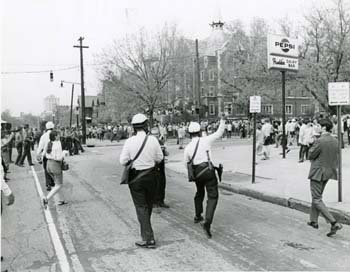
Police clear Neil Avenue
From The Ohio State Library
(Thanks to Keith Conrad for catching some errors in an earlier draft of this blog.)

Thursday, January 9, 2020

Ask not what HBCUs can do you for you....


Morris College founder J. J. Durham
From Wikipedia

I concluded my AMS article on James Solomon by emphasizing the important role that HBCUs have had in broadening participation in mathematics and encouraging readers to learn about how the AMS is currently collaborating with HBCUs and to think of ways for further collaboration.

When I made my suggestion, I (embarrassingly) did not know what the AMS was doing, so I emailed the AMS Executive Director Catherine A. Roberts. She helpfully provided a detailed description of existing efforts to promote diversity, some of which are directly tied to HBCUs.  Here are some of the things the AMS is doing:
  1. the AMS maintains a website with information about diversity issues;
  2. the AMS published (with the MAA) the book "Living Proof: Stories of Resilience Along the Mathematical Journey" which is available online as a free PDF.
  3. the AMS has a book program that annually offers an AMS published book to each HBCU.  If you work at or near an HBCU, make sure the school takes advantage of this program.
  4. the AMS provides free posters that you can order here.
Other suggestions are:
  • Donate to the National Association of Mathematicians.  NAM is a strong advocate for HBCUs, and much of their leadership is faculty at HBCUs.
  • Donate to the Mathematically Gifted & Black website.  They do a great job of highlighting the achievements of African American mathematicians, many of whom work at HBCUs.  Details on how to do this at the bottom of the page.
  • Have the AMS offer reciprocal membership with NAM.
  • Have the AMS provide funding to organizations running an AMS Special Session if at least X% of the speakers are from HBCUs.  Somebody should do research to estimate a good value for "X."
  • Ask the American Mathematical Society Council to acknowledge and apologize for the society's complicity with de jure discrimination.  Details on how to do this here
  • Ask for similar apologies from the Mathematical Association of American and Society for Industrial and Applied Mathematics.  (Not sure what exactly to do as I am less familiar with these organizations.)
  • Installing programs at the k-12 level in minority and low income schools.  Expand efforts to make existing programs more accessible to African Americans.
  • Ask the AMS to maintain a list of grants and fellowships aimed at improving the advanced STEM participation of groups historically underrepresented in STEM.  Examples are the SREB-State Doctoral Scholars Program, the Ford Foundation Fellowship Program, and the GEM Fellowship Program.
  • Ask the AMS to maintain a list of college and university programs aimed at improving the advanced STEM participation of groups historically underrepresented in STEM.  Examples are the Provost’s Postdoctoral Fellows Program at the University of Chicago, the MLK Visiting Professors and Scholars Program at MIT, the Grace Jordan McFadden Professors Program at the University of South Carolina.
  • Ask the AMS to create a program similar to aforementioned programs with the goal of increasing the number of African American mathematicians.  Alternatively provide greater support to existing programs.
  • To help increase the number of African American students in STEM fields particularly African American males, it is most effective to reach students by 5th grade. An idea would be to develop regionally (ex: begin in the Southeast then expand) an educational partnership between local elementary schools and Universities/Colleges. To increase the number of African American males pursuing STEM fields and pursuing a Ph.D. in STEM fields, African American males need to gain exposure at an early age to rigorous content in a successful environment.
  • One way to develop an educational partnership is: Local universities/colleges can develop summer programs where students are bused in during the summer for a 12-week program (free of charge with breakfast and lunch provided). Students can be exposed to rigorous content that will help them develop cognitive skills needed for higher order thinking. The consistent development of these cognitive skills will help prepare students to succeed in middle school, high school, and college. The consistency portion can be met through the ongoing educational relationship between elementary schools and Universities/Colleges. The elementary schools provide the students while the Universities/Colleges provide the curriculum taught by college professors and graduate students. The Universities/Colleges know what type of mindset they are looking for in college on both the undergraduate and graduate level so what better way to cultivate a mindset for success than to nurture a mindset of a 5th grader and to continue this nurturing over time
  • Similar to the summer programs, local universities/colleges can develop year-long programs where students are exposed to rigorous content after school that will help them develop cognitive skills needed for higher order thinking. The Universities/colleges must work with the local state department and local schools to change the societal thinking where more emphasis is placed on sports than education. The change begins with universities and colleges. When high schools, universities, and colleges, place a higher importance on sports than education then the youth also.  High schools, universities, and colleges must change their perspectives for society to change their perspective.
Roberts also mentioned several administrative things (e.g. hiring a consultant to write an advisory report) which might not be of direct interest but may produce future efforts.

I encourage you to think about how ways for further collaboration.  Even a cursory examination of the history of HBCUs like Morris College shows that these institutions have played an essential role in broadening participation in higher education.  Most obviously these institutions provided educational opportunities to African Americans during periods when they were excluded from most college and universities, but these schools also played less obvious but important roles.  For example, during the 1950s Red Scare, a number of HBCUs provided employment to (white) academics who'd been blacklisted from many universities.

Thanks to Matthew J. Madison, Carol McCain, Catherine A. Roberts, Ikhalfani Solan, Dylan Thurston, Chelsea Walton, Talitha Washington, and Shelby Wilson for contributing ideas and information!

Details on how to donate to the Mathematically Gifted & Black website

Sunday, January 5, 2020

Timmerman Attacks: Hoffman Update

Old cover from the Monthly Review
This blogpost is preceded by 
  1. "Timmerman attacks, Spring 1957"
  2. "Timmerman attacks, Fall 1957"
  3. "Timmerman attacks, Spring 1958"
  4. "Timmerman attacks: Allen University and Benedict College"
  5. "Timmerman attacks: the Benedict professors"
  6. "Timmerman attacks: the Allen University professors"
I just found an article Hoffman wrote after he retired that sheds some light on what happened at Allen University.  He spends the article reflecting on his academic career, and fills out part of the story about what happened.  Hoffman was from a Jewish family in New York, and he become committed to radical left-wing politics after his family experienced financial hardship during the Great Depression.  He was especially passionate about African American rights, and he applied for a position at Allen University with the goal of becoming of more involved in the civil rights movement.  Personally, I'm not sure if this reflects remarkable political commitment or breathtaking naivety.  In any case, his situation was different from that of people like Marion Davis who seems to have moved to Benedict primarily because the college was willing to hire Red Scare victims.  (I had a helpful email exchange with Davis's children: they said their parents were supportive of the civil rights movement, but they also don't recall them being actively involved at the time.  Judging from his publications, Marion's husband Horace seems to have been most passionate about labor issues.)

There are a few notable silences in article.  Hoffman says nothing about Toth desegregating the Allen students body (an event that made the news), and his discussion of his dismissal from Allen is as follows:
That two Northern whites [Hoffman and Rideout] and a Northern black [Wiggins] were never securely positioned in the Southern, African-American environment of Allen University was made evident by our third year there, when South Carolina's Dixiecrat Governor Timmerman, having a new A.M.E. bishop and a new college president to do his bidding, demanded our ouster as dangerous "reds." Since our only manifest subversiveness was opposition to every form of discrimination and bigotry, Allen's Board of Trustees refused to go along with the wishes of governor, bishop and president. The governor then deployed a powerful weapon, his decree that no graduate of Allen could be certified to teach in South Carolina's still segregated public schools until we were dismissed....  The trustees held out for two years then told us goodbye....
While I find Hoffman's political commitment very admirable, his use of scare quotes around the word 'reds" strikes me as disingenuous.  The Governor's accusation that he was a communist wasn't groundless: he made specific accusations of subversive activity (e.g. involvement in the American Students Union).  Moreover, Hoffman's very article in which the scare quotes appear supports the accusation: it is published in the US's longest running socialist magazine, the Monthly Review (in 1998 – 10 years after the fall of communist!).

More generally, Hoffman says nothing about his involvement with communism and little about his involvement with left political issues that are separate from African American rights.  For me, understanding the relationship between the civil rights movement and communism in the context of the Benedict and Allen controversy remains a challenge.

Saturday, December 21, 2019

Timmerman attacks: the Allen University professors

Photo of Edwin Hoffman
From West Virginia State University yearbook
This blogpost is preceded by 
  1. "Timmerman attacks, Spring 1957"
  2. "Timmerman attacks, Fall 1957"
  3. "Timmerman attacks, Spring 1958"
  4. "Timmerman attacks: Allen University and Benedict College"
  5. "Timmerman attacks: the Benedict professors"
  6. "Timmerman attacks: the Allen University professors"

In my last post, I described the Benedict faculty attacked by Governor Timmerman.  What about the faculty at Allen University?  Before describing them, I should say that it is a little artificial to separate  the faculty at the two schools.  Allen is across the street from Benedict, and at the time, the schools exchanged faculty and students.

Edwin D. Hoffman
Hoffman was a 40-year old Professor of History who'd been at Allen University since 1954.  He was born in Long Island, New York and studied at City College of New York and Columbia University, He had taught at Long Island University for seven years prior to coming to Allen.

It's unclear why he left Long Island for Columbia, SC.  A natural guess is that he'd been dismissed from LIU, but Timmerman didn't say this in his speech (and he highlighted the dismissals of the other professors).  He may have just left for personal or professional reasons.  (Update:  Hoffman wasn't dismissed from LIU.  He wanted to teach at a HBCU.  More here.)

Hoffman's highest degree was a Ed.D. (rather than a Ph.D.), but he seems to have studied African American history.  He published academic articles on the topic while at Allen.  He also seems to have been an excellent teacher.  Kay Patterson, a former state senator, speaks glowingly of being taught by him and Rideout in an interview.

After being dismissed from Allen University, Hoffman taught at Pembroke State College (a college which before the Brown decision had been for American Indians) for a few years before going to West Virginia State College (a public HBCU).

Hoffman worked in West Virginia until he retired in 1988.  He spent his retirement in California, teaching part time at Cal State Hayward.  He died in 2008.


Photo of John G. Rideout
From Thunder Bay University Yearbook

John G. Rideout
John. G Rideout was born in Vermont in 1915 and received a BA from Colby College, was a Rhodes Scholar at St. Edmund Hall, Oxford, and received a Ph.D. in English from Brown University in 1945.  His dissertation was on the poetry of Percy Bysshe Shelly.

He taught at several colleges before receiving his Ph.D. and then started teaching at the University of New Hampshire in 1946.   In New Hampshire, he became involved with left-wing politics, chairing the New Hampshire Progressive Party and running as their 1948 candidate for U.S. Senate.  These political activities attracted the attention of school and state officials, and he was forced to resign.  His resignation was reported in the New York Times in an article on challenges to academic freedom.

After leaving New Hampshire, he was able to find a position at Idaho State College in 1949, although his experience in New Hampshire was repeated, and he was forced to reign in 1953.  He ended up in Allen University after that, reportedly telling an associate that he was "going down there until things cool off".

After being dismissed from Allen, Rideout spent the next 6 years teaching at Huston-Tillotson University (a private HBCU in Austin, Texas) and then moved to Lakehead University (in Canada). He spent the rest of his career there, serving as Chair of the English Department for 16 years (1964 to 1980).  The university has honored him with a named award, the Rideout Memorial Bursary.  Rideout died in 1991.

While at Allen, Rideout was married to Miriam Rideout, and his children George and Margaret Bard were probably living at home.  As with many of the other professors, I can't find information about the other members of the Rideout family.

Forrest O. Wiggins
Photo from the University of Minnesota
Forrest Oran Wiggins
Forrest O. Wiggins was born in Indiana in 1907.  he received his B.A. from Butler University and then received his Ph.D. in philosophy from the University of Wisconsin in 1931, writing a dissertation on "The moral consequences of individualism".

After graduating, Wiggins taught at a series of HBCUs: Morehouse College, Howard University, Johnson C. Smith University, North Carolina College for Negroes (now NC Central University), and Louisville Municipal College.

He was hired by the University of Minnesota in 1946.  This was a significant event as he was the first African American professor hired at UM and one of only a handful of African Americans working a flagship state university.  He seems to have become involved with left-wing politics while at Minnesota.  Governor Timmerman, for example, says that he became an active member in the Socialist Workers Party in 1946, and he served as Vice Chairman of the Minnesota Progressive Party.  Wiggins was dismissed from Minnesota in 1952.

His dismissal was a major controversy.  The official reason for his dismissal was his poor scholarly record, although he had the support of both students and members of the Philosophy Department.  Professors in the Philosophy Department issued a 5-page report challenging the allegation's against Wiggins.  Wiggins contended that he was being dismissed because of his politics.  His job at Allen University was his first position after leaving Minnesota.

After being dismissed from Allen, he taught at Savannah State College for a few years before joining Hoffman at West Virginia State University, where he taught until he retired.  He died in Florida in 1982.


This series continues with "Timmerman Attacks: Hoffman Update."

Friday, December 20, 2019

Timmerman attacks: the Benedict professors

This blogpost is preceded by 
  1. "Timmerman attacks, Spring 1957"
  2. "Timmerman attacks, Fall 1957"
  3. "Timmerman attacks, Spring 1958"
  4. "Timmerman attacks: Allen University and Benedict College"


Who were the Benedict faculty accused of being communists?  The faculty members were Joseph Spencer Kennard Jr. (a religious scholar),  Lewis Smith (the Chairman of the Division of Humanities), and Marion Davis (an instructor in English).

Lewis Smith
Because his name is such a common one, its challenging to find information about Lewis Smith. He received an AB and a MA degree from Harvard University. He then was an English graduate student at the University of Iowa. He wrote the dissertation "Changing Conceptions of God in Colonial New England." He received his PhD in spring 1953.

Smith had started working at Benedict in 1956, so he'd been employed for a little over a year when the Governor Timmerman started attacking him. 

In his speech, Governor Timmerman made the following allegations against Smith:
  1. 1955 – Discharged dishonorably by U. S. Navy as Security Risk.
  2. 1956 – Told CP [Communist Party] leader he had been CP member.
  3. 1949-1951 – Refused to tell investigating committee whether or not had been, or is, CP member (Fifth Amendment).
(Timmerman went on to say of Smith, "It is believed that this subject is still a punk but given time may develop".)


Entrance to West China University in the 1920s
Photo from Wikipedia
Joseph Spencer Kennard, Jr. 
By contrast, there is a significant amount of information about J. Spencer Kennard, and he seems like a fascinating character.  He was born in 1890 in Ossining, New York to Isabella Daubey and J. Spender Kennard Sr, an internationally known lawyer and author.  Kennard had received an excellent education with a A.B. from Harvard University, a S.T.B. from the Princeton Theological School, a Ph.D. from Yale, and a Th.D. from the University of Strasbourg.  He was an active scholar in the 1940s and 1950s, publishing about 5-10 journal articles and a book.

Kennard seems to have been deeply religious and spent much of his life as a Baptist missionary.  He lived in Japan from 1920 to 1936 as a Baptist missionary.  This was a very eventful period as Japan was experiencing a rise in extreme nationalism and beginning to embark on a series of expansionists wars.  Kennard's time in Japan came to an end in October 1936 when he was barred from reentering the country after a trip back to the US.  Japanese officials justified their decision using language that anticipated Red Scare attacks in the US:
Maintaining Communist thoughts since prior to coming to Japan, Dr. Kennard has been connected with the Fellowship of Religion [the author meant "Reconciliation"] organization advocating anti-war principles and has propagated anti-war ideas. 
This was major news: it was reported in the New York Times.

After being banned from Japan, Kennard did missionary work in China and taught at the West China Union University.  He was in China from 1937 to 1944, a period that roughly coincided with China's war with Japan and overlapped with the Chinese Civil War.  Kennard was openly critical of the Chinese National Party and opposed providing them with US aid.  He went so far as to submit an opposition statement to the House Committee on Foreign Affairs.

His statement was titled "The year of the rat" and described Chinese Nationalist leaders as rats that have "gnawed at the pillars of society until today one of the world's greatest civilizations is threatened with collapse."  Because the Chinese Nationalist party was fighting the Communist Party of China, opposing them was a controversial position that would have brought accusations of being a communist.

Kennard returned to the US in 1944 after the Mission Board denied his request to continue working in China.  He then seems to have bounced around a bit, teaching at SUNY New Paltz (then State Teachers College), for example, and ended up at Benedict in 1952.

I should add that Kennard was married, and his wife May F. Kennard was also teaching at Benedict during this period.  She evidently had advanced training in English studies (the AAUP report describes her as the only Benedict teacher with advanced training that remained after the dismissals), but I haven't found any other information about her.  (Reading documents from the 1950s reminds me how much American society has changed when it comes to gender issues: the women are largely invisible in the accounts).

I haven't been able to find much information about what Kennard did after he was dismissed.  He was 68 years old at the time, so he may have just retired.  It seems that he moved back to the Northeast and remained involved in politics.  In 1965, for example, the New York Times published a letter from him criticizing US involvement in the Vietnam war.  He passed on in 1980 and is buried in Pennsylvania.

Home of Kennard's father,  Joseph Spencer Kennard, Sr.
From Book News, Volume 24
Marion Davis
Marion Davis may be familiar to the mathematician readers: she is the mother of Chandler Davis, a math professor at the University of Toronto and also a former target during the Red Scare (the University of Michigan has a lecture series honoring him).

She'd come to Benedict with her husband Horace B. Davis in 1955.  Horace had taken the position at Benedict after being dismissed from a faculty position at the University of Missouri at Kansas because he had been called before the House Un-American Activities Committee.

As with May Kennard, there isn't a lot of information about Marion Davis, except in relation to her husband.  He had left Benedict the year before the Governor's public attacks on Allen University and had gone to Raleigh, North Carolina to work at Shaw University.  She'd stayed at Benedict to continue teaching for a year.

Governor Timmerman's attacks against Davis seems pointlessly cruel to me.  By the time he publicly attacked her in January, she'd already decided to leave Benedict at the end of the semester to join her husband at Raleigh.  Moreover, at this time, she was fighting a battle with cancer.  Cancer claimed her life a few years later, in 1960.

Horace B. Davis
One thing I hadn't realized until revisiting the literature is that there seems to have been a seventh target of Timmerman's attacks: Marion Davis's husband Horace.  In his speech, Timmerman says that he'd left Benedict College after his "communist connections were revealed." I haven't been able to find any details about this, unfortunately.


This series continues with:
  1. "Timmerman attacks: the Allen University professors"
  2. "Timmerman Attacks: Hoffman Update"

Sunday, December 1, 2019

Timmerman attacks: Allen University and Benedict College

This blogpost is preceded by 
  1. "Timmerman attacks, Spring 1957"
  2. "Timmerman attacks, Fall 1957"
  3. "Timmerman attacks, Spring 1958"

W. S. Scarborough, one of the early professors at Allen University
Photo from Blackpast 

One thing that I found surprising about how the Governor's attacks on universities played out is that professors played essentially no role in the conflict.  The conflict played out almost entirely between the state government, the Board of Trustees, and the AAUP.  

While both Allen and Benedict ultimately dismissed the 6 faculty, the specifics of how this was done differed in important ways.  Allen University Board of Trustees was able to effectively resist pressure from Governor Timmerman and  President Veal for a year.  At two meetings, they were able to block attempts to dismiss faculty, and President Veal ultimately succeeded only after unilaterally replacing the Board Chairman with someone more supportive of him.

The Board of Trustees of Benedict College were less effective.  The month after Timmerman publicly accused Benedict of harboring communist workers, the Board of Trustees issued a statement stating that, after making a reasonable inquiry, they found no evidence of their faculty promoting communism.  However, at their next meeting, the Board of Trustees voted not to renew the contracts  of the accused faculty.

Presidents Bacoats and Veal at a political rally
Veal is the second-from-the right, Bacoats the fourth
From Richland Library

A close study of the meeting is revealing. The Benedict board was racially mixed, with about half the members being white and half black.  It seems that all members wanted to get rid of the accused faculty, but when deciding on how to do this, the board split along racial lines.  A majority of African American members advocated for not renewing contracts, while a majority of white members advocated for summary dismissal (the more punitive action).  White board of trustee members also gave voice to Governor Timmerman's concerns in a very direct way: one member was on the telephone with him during the meeting.

By contrast, at least a large majority of Allen University's Board of Trustees was African American.  This seems to have limited influence of the Governor on their decision making and empowered them to resist President Veal.

The difference in the board probably reflects the nature of the HBCUs.  Benedict College was founded by white Christian missionaries and until 1938 it was led by a white college president.  Allen University, on the other hand, was founded by African American ministers affiliated with the African Methodist Episcopal (or AME) church

It is illuminating to compare the governance of Allen and Benedict with that of S. C. State University.  Here is a photo of their Board of Trustees in 1952:

The 1950 Board of Trustees at S. C. State University
Photo from S. C. State University: A Black Land-Grant College in Jim Crow America
Notice anything?

The person in the middle, next to the Confederate flag, is Strom Thurmond.  I am guessing that he supported dismissing faculty who supported desegregation.  Two years earlier Thurmond had declared, "there's not enough troops in the army to force the Southern people to break down segregation and admit the [expletive deleted] race into our theaters, into our swimming pools, into our homes, and into our churches."  

You can listen to an Wikipedia's recording of Thurmond's speech here.  (✋Warning✋: This is a speech by Strom Thurmond in the 1940s.)


This series continues with:
  1. "Timmerman attacks: the Benedict professors"
  2. "Timmerman attacks: the Allen University professors"
  3. "Timmerman Attacks: Hoffman Update"


A War Hero turned Communist Worker?: Lewis Smith's military service

Aleck Lewis Smith was one of the professors that the governor of South Carolina publicly accused of being a "communist worker." Wh...