Tuesday, March 17, 2020

The Radical University of South Carolina

U of SC Professor Richard T. Greener
From Wikipedia

The University of South Carolina during the period from 1873 to 1877 is sometimes referred to as the Radical University because the university was reorganized by the Radical Republican state government.

One of the most revolutionary changes the state government implemented was the admission of African American students to the University of South Carolina.  I have seen this change referred to as the integration or desegregation of the university, but those terms do not capture how profound the change was.  During this period, African Americans not only attended the university, but they formed the majority of the student body, roughly half of the Board of Trustees, and included a faculty member.

During my lifetime, I have never seen this level of African American representation at flagship state university.  While every US university I've worked at has had African American students and faculty, the representation of African Americans is roughly at or below their level in broader society.  For example, African Americans make up roughly one-third of the population of South Carolina but only about one-tenth of the U of SC student body. Only 1 person on the 24-body Board of Trustees is African American.

Despite its revolutionary nature, it is hard to figure out what actually happened at the university during Reconstruction.  The admission of African American students is analyzed in many books on reconstruction including Eric Foner's Bancroft prize-winning book Reconstruction: America's Unfinished Revolution, but the analyzes are so different its hard to know what to make of them.  Foner, for example, describes the event positively and quotes the following newspaper account given by an African American student:
Right here allow me to say that our standard is high.  In Latin we pass, like other colleges, over the ground which lies between Caesar and Cicero on one side, and Terence and Tacitus on the other.  In Greek we pass from Xenophon and Homer to Sophocles and Plato.  In mathematics we attempt to fight our way from Euclid to analytic geometry.  We spend the usual amount of time in studying physics, chemistry and the modern languages.  In the departments of Bella Lettres, metaphysics, international law, sociology and political economist, we hold sweet communion with several of the grand old masters....
The student then goes on to describe the racial composition of the student body and explains
I am sorry that I have felt called upon to make so many references to races.  I do not like to do it; but I want it distinctly understood that the University of South Carolina is not in possession of any one race or any one condition of men.  Its advantages are being enjoyed by young men who want to make their State better by themselves having lived in it.
The finest argument in factor of "equality before the law" is found here in this peculiar place.  The two races study together, visit each other's rooms, play ball together, walk into the city together, without the the blacks feeling themselves honored or the whites disgraced...
Compare that account to the description given in an early (published in 1905) history of Reconstruction in South Carolina written by South Carolinian John S. Reynolds:
The requirements for admission were so lax – the regulations in this manner were so flagrantly disregarded – that the so-called University soon became little more than a high school, whose chief aim was to inculcate and illustrate the social equality of the black race with the white.  The establishment, taken as a whole, was a fraud upon the taxpayers – a fraud deliberately perpetrated in the name of progress and enlightenment!  In this degraded position the institution continued until it was closed by the white Legislature of 1877.
Earlier he described the Board of Trustees as "adventurers who were unknown or known unfavorably."

Certainly Reynolds and Foner have diametrically opposed political beliefs that are reflected in the differences in their descriptions, but a close inspection of accounts shows disagreement over basic facts.  For example, how many African Americans were enrolled?  The student indicates says that "a pretty large proportion of these [students] are of the Caucasian rate", while Reynolds says that African Americans made up "more than nine-tenths" of the student population.

Similarly, who were the African American students?  The image formed by reading Reynold's account is that they were probably fieldhands who had left plantations, but South Carolina was also home to a small (about 2% of the African American population) but significant population of African Americans who had been free before the Civil War, some of whom had achieved significant economic and political security.

What did the students do after the university was closed?  Was the education wasted on them (Reynolds certainly seems to think so) or were they able to complete their education and have successful careers?

The best description of the African American students is given in a May 8, 1911 Letter to the Editor of The State newspaper written by an alumnus, Cornelius Chapman Scott.  Scott describes the (impressive) accomplishments of some of the alumni, but there is no reasonably comprehensive overview of the students.  On this blog, I will try to flesh things out by writing short biographies of as many students as I can.  Roughly 100 students attended the university during this time, so compiling short biographies of everyone is a reasonable task.

University of South Carolina campus
Form the University of South Carolina

Sunday, March 15, 2020

Chandler Davis on loyalty oaths

Chandler Davis
From Wikipedia

The first substantive blogpost I made talked about the use of loyalty oaths at US universities in the 1950s with a view towards Abigail Thompson's editorial in the Notices of the AMS.  I tried to use the blogpost as an opportunity to visit loyalty oaths in South Carolina, and I tried to avoid offering personal opinions about Thompson's editorial.  (I wasn't entirely successful: I corrected some errors in a later blogpost.)

While hopefully not expressed in the blogpost, my personal opinion at the time was that Thompson's editorial was badly thought out and offensive.  She compares the current use of diversity statements in hiring to the use of loyalty oaths asserting non-membership in the Communist Party USA during the 1950s Red Scare.  During the Red Scare, professors who were refused to sign loyalty statements were questioned by investigative committee, fired from their jobs, and even, in some cases, sent to jail.  I was tempted to write that Thompson's remarks were really disrespectful to those people.

Whelp, I was wrong.  Totally wrong.  Remember the series of blogposts on Governor Timmerman's attacks on faculty at Benedict and Allen?  Two of the faculty members in question were the parents of  Chandler Davis.  Chandler Davis himself refuse to cooperate with the House Unamerican Activities Committee and ended up losing his position at the University of Michigan and served 6 months in a federal prison.

Why do I mention him?  He signed his name to one of the letters in support of Abigail Thompson!

Chandler Davis's signature to the Letter to the Editor in support of Abigail Thompson

I guess I was totally wrong about Thompson's editorial being disrespectful to victims of the Red Scare since one of the victims is openly supportive of her....

You can read the full letter here on page 9.

Friday, February 14, 2020

Communism in South Carolina

Photo of Harvey Klehr
From Emory University

This post is tied to my posts about Governor Timmerman's attacks on professors at Benedict College and Allen University.  The posts start here.

Last week Harvey Klehr, an Emory Political Science Professor and an expert on the American Communism movement, generously took the time to chat with me about communism in the Deep South, especially in South Carolina.  Talking to him put the Governor's attacks into perspective.

Recall that, in 1958, the Governor publicly accused 6 professors at Benedict College and Allen University of harboring communist workers.  After explaining how the schools were harboring "known communist workers," he said
It is believed that the presence of communists at these two Negro institutions is in furtherance of a long-range program to promote racial hatred among young and impressionable Negro students, looking toward an ultimate communist goal of creating civil and racial disorder.
When I first read the Governor's speech, I felt it was easy to dismiss the accusation as a nonsense: this seems like a ham-handed attempt to demonize a handful of liberal academics.  I think it is worth revisiting this issue.  A major accomplishment of Klehr's was to document that there were valid reasons to be concerned with communist infiltration.  The Soviet Union provided funding to the Communist Party USA (CPUSA), and members of the CPUSA were committing espionage for the Soviets.

The CPUSA was also actively supportive for African American rights and, at times, promoted radical positions.  For example, in 1920s the party endorsed a plan to create an independent African American nation within the United States.

The accusations were also taken seriously by people sympathetic to the dismissed professors.  Former Allen student and State Senator Kay Patterson spoke glowingly of Hoffman and Rideout in a 2008 interview, but he is also defensive about the accusations ("It is alleged that they were Communists. That’s the allegation but now they were the best teachers there")

Former State Senator Kay Patterson
Photo from Carolina Panorama December 15, 2016

The Governor made very specific accusations against the professors (he doesn't mention anyone by name, but he gives enough details to figure out who is who).  While overblown in some cases, the accusations were probably accurate.  The speech was part of the public record, so he probably had the text vetted by lawyers.  Moreover, he could draw on law enforcement to collect information on the professors (one of the Davis's children said that their parents had been under police and FBI surveillance for some time before the governor's speeches), so he had ample tools for documenting previous political involvement.

The most serious accusation is that Marion Davis joined the Communist Party (presumably meaning the CPUSA) in 1945.  Marion and her husband Horace (who is only tangentially mentioned in the speeches as he had already left South Carolina) were indeed members of the CPUSA.  Their son Chandler, for example, has discussed their membership in later interviews.  In the interviews, Chandler says they had left the party by the late 1950s (the time of the Governor's accusations).  This was not uncommon as many people left the party after 1956, as people became more aware of the crimes of Stalinism.

In any case, there is little information about what the Davises did in South Carolina.  The Governor is silent on this matter; the last accusation he makes is that Marion "Entertained CP leader in home at Kansas City" in 1953, two years before she moved to South Carolina.  While some of the dismissed faculty (like Hoffman) were actively involved in the civil rights movement,  Marion's daughter Terry Davis said that she doesn't remember her parents being involved in these issues (although they were later involved in civil rights issues in like lunch counter sit-ins in North Carolina).

Marion and Horace Davis were the only people whose names Klehr recognized.  The only other person accused of membership in a communist political party is Forrest O. Wiggins who was accused of being a member of the Socialist Worker Party (SWP).  While both the SWP and the CPUSA were communist political parties, they differed in important ways.  Most significantly, the CPUSA aligned itself the political positions of the Soviet Union (which helped fund the party), the SWP was Trotskyist and often in conflict with the Soviet Union. (Update: the FBI actually found no evidence that he was a member of the SWP. See this blogpost.)

The SWP and its activities are as well-documented as the CPUSA, but compared to the CPUSA, it was a much smaller organization, and it was not promoting the interests of a foreign nation the was the CPUSA was.

Whatever the SWP was doing in the late 1950s, I have been unable to find any information about what Wiggins was doing in South Carolina.  The Governor's last accusation against him is that he subscribed to the National Guardian.

Besides Wiggins and the Davises, the dismissed faculty weren't accused of being a member of being members of a communist political party.  Moreover, of all the dismissed faculty, the Davises were the only people Klehr (an expert on the CPUSA) recognized.  I am hesitant to say that that others weren't members of communist organizations (defenders of the Red Scare would argue that it is hard to document that people were party members because the organizations like the CPUSA were so secretive), but looking at the Governor's accusations, it looks like other dismissed faculty members had pretty far left political beliefs but were not Soviet agents.

Regardless of what the dismissed faculty were doing, there was hardly a credible communist threat to everything.  South Carolina was essentially a desert of communism.  The state provided a very weak basis for communist organizing.  A major source of recruits to communism was industrial workers in urban centers, but mid-century South Carolina was a largely rural state where much of the population worked as farmers.

We can put some numbers to communism in South Carolina.  Scholar Ernie Lazar has collected many FBI documents on the CPUSA.  Here are the FBI's membership number estimates:

December 31, 1952: 6 members
December 31, 1955: 5 members

June 30, 1957: 5 members
June 30, 1960: 0 members
June 30, 1965: 0 members

To be these numbers in perspective, the FBI estimated that the total membership in the CPUSA was  22,700 in 1954.

Governor Timmerman can, I suppose, claim to have been effective.  All 5 CPUSA members driven out of the state shortly after his governorship ended.


Saturday, February 1, 2020

#DisruptJMM, 1960 Edition

The Hotel Wade Hampton, location of the 1960 MAA meeting in South Carolina
U of SC, South Caroliniana Library

The hashtag #DisruptJMM was used a lot on social media to publicize "disruptive" actions at the 2020 Joint Mathematical Meetings that drew attention to issues facing groups historically underrepresented in math.  I think the idea first appeared and was strongly promoted in Piper Harris's post on the AMS Blog inclusion/exclusion.

As far as I can tell, nobody used the #DisruptJMM hashtag to raise awareness of the history of the professional societies (the AMS and MAA), and their meetings were impacted by racial segregation.  As I mentioned in a footnote of my Notices article, being able to participate in professional meetings was a major concern for African American mathematician in the 1950s and 1960s.

A very basic and practical concern was access to food and lodgings.  African American had to worry about whether they could make hotel reservations since many hotels, especially in the South, were racially segregated.  Once at a meeting, they might not be able to eat with their white colleagues since restaurants too were often racially segregated.

There were also more subtle concerns: African Americans might be excluded from leadership positions or passed over as invited lecturers, for example because of concerns of offending local segregationist politicians.

Sit-in protest  at a segregated lunch counter in Columbia, SC on February 16, 1961
From the Richland Library

How these fears played out is illustrated by what happened at the 1960 MAA meeting of the Southeastern section.  At the meeting, a group of mathematicians from Atlanta University left the  meeting in protest because the hotel refused to provide the African Americans among them with accommodations. Separate hotel accommodations were not the only indignity experienced by the African American participants.  They also were unable to eat with their white colleagues as most of the restaurants in the area refused them service (lunch counter sit-ins had started in March, but downtown businesses in the city wouldn't fully desegregate until 1962).

Atlanta University issue a press release about the protest.  The release was publicized in the Atlanta Constitution newspaper and Jet Magazine.

An announcement of protest against MAA meeting in Jet Magazine
From Jet Magazine, April 21, 1960

How did the MAA report on this event?   Here's the report in the August-September issue of the American Mathematical Monthly:

Report from the American Mathematical Monthly
No mention that the AU group left in protest!  In fact, the report goes on to list the talks given at the meeting, and among them is purportedly the following:

Abstract from the report in the American Mathematical Monthly
According to the press release, Dr. Shabazz never gave this talk, and he was quite upset about this fact.  None of the African American mathematicians in the Southeast would have had input into how this report addressed the AU protest because none of them were MAA officers.  Certainly Dr. Shabazz would have wanted it reported that he didn't give his talk.

The handling of the 1960 MAA meeting is especially striking in light of the fact that the MAA had passed an anti-discrimination resolution almost a decade earlier.  In response to a request from mathematicians at Fisk University, the MAA had passed a resolution affirming the organization's "steady intention to conducts its scientific meetings...so as to promote the interests of Mathematics without discrimination."

D. Baylis Shanks was one of the organizers of the 1960 MAA meeting
The organizers of the 1960 MAA meeting did not display much intent in conducting the meeting in a manner that avoided racial discrimination.  We can get some insight into the organizers thoughts from a 1981(!) account by the U of SC Department Chair, who was one of the organizers.  The Chair writes that the meeting was moved from the university campus to a local hotel "so that if any blacks showed up, the hotel, not the University, would have to handle the matter."  I read this to mean that the Chair was primarily worried about having to deal with controversy, and he had little interest in facilitating African Americans participation or fulfilling the MAA's anti-discrimination resolution.

The Chair's language, "handle the matters", also obscures the issue.  What exactly was the matter?  Allowing participation by African Americans wasn't as big a deal as the Chair's language insinuates.

No laws were in danger of being broken.  State laws made is illegal for U of SC to hire African Americans as professors or admit them as students, but African Americans weren't banned from campus.  For the entire 20th century, African Americans worked on campus in jobs like janitor or maintenance worker.  For example, the photo below depicts African American cooks who worked at the university.  African Americans alive in the 50s say they weren't allowed on campus, but what they presumably mean is that they weren't welcome on campus except as menial workers.

African American cooks on the University of South Carolina campus in 1919
From the 1919 Garnet and Black Yearbook

The situation with the Hotel Wade Hampton was similar.  Unlike some states, South Carolina did not have any laws requiring the racial segregation of hotels. The Hotel Wade Hampton excluded African Americans purely as a matter of hotel policy.  All in all, I find the organizing committee's actions pretty shameful.

Who were the mathematicians from Atlanta University that left in protest?  Of course, they included Dr. Shabazz who had planned to deliver a talk.  Shabazz is a well-known mathematician and educator who passed on a few years ago.  Many readers probably know about him, and if not, you should at least read his Wikipedia page.

One other professor was there: Subhash C. Saxena.  Dr. Saxena left Atlanta University in 1964 to move to Northern Illinois University.  Dr. Shabazz had left Atlanta that year, so this was a natural time for Saxena to leave.  He worked at a few different places before ending up at Carolina Coastal University in 1973, where he worked until he retired.  Carolina Coastal has honored Dr. Saxena in a number of ways, for example by holding a math contest named after him.

Subhash C. Saxena
From Carolina Coastal University
The other people from Atlanta University were graduate students: William E. Brodie and James D. Vineyard.  I haven't been able to find much information about them.  I couldn't find Brodie listed in Atlanta University records, so he may not have been a student there (Dr. Shabazz also mentored students at other universities, I think).  In a later interview, Dr. Shabazz said that Brodie taught at Florida A & M.

Vineyard was from Springfield, Illinois and had been an undergraduate at Blackburn College.  He graduated from Atlanta in 1961 with a master's thesis on "Field equations of general relativity."  He appears to have died in San Francisco on March 31, 1987.

Vineyard was one of the few (maybe the only?) white student in the Atlanta University Math Department, so he must have had an unusual and interesting experience.  If anybody know about these people, please let me know!


James Vineyard
From Springfield High School Yearbook (1955).

Sunday, January 26, 2020

"Prof. Solomon takes exam at USC"

James Solomon arriving to take the GRE
From State and the Columbia Record, July 28, 1963.

In my article on James Solomon and the desegregation of the University of South Carolina, I wasn't able to include the above photo in my AMS Notices article (photo permissions...).  This is a real shame because it played in an important role in researching the article.  This news item was the first time I found a documentation about Solomon as a mathematician.  (Most of the written material focuses on his work in public service: Director of Social Services, member of a School Board,....)

The photo also captures a lot about desegregation.  On a first viewing, I thought this just showed a normal if stressful experience that most math students go though.  Upon more careful consideration, I think Solomon's experience was totally different.

First, consider why Solomon had to take the exam.  Right now our PhD program requires general GRE scores and makes Subject GRE scores optional, but prior to 1954, the situation would have been different: the university essentially had an open-enrollment policy for white South Carolina residents.  What happened in 1954?  Brown v. the Board of Education made it illegal for U of SC to reject applicants on the basis of race, so university officials implemented a policy of requiring standardized admission scores, in part, to create a tool for restricting the admission of African American students.

A friend of mine asked me, how do I know this?  I know this because the officials themselves wrote that this was their purpose.  While the policy was presented to the public as an innovative policy that would help the university maintain academic standards in the face of increasing enrollment, there was a second line of reasoning that was kept private.  Check out the following excerpt from a report to the president about using standardized tests:

Description of the "Purpose of the Tests" from a November 1953 report of the University Exam Committee
From the University President's archives in the South Caroliniana Library

(The C. E. E. B. is the College Entrance Examination Board or what's usually called the College Board today.)

So one of the purposes of the exams policy was to make it less likely for the NAACP to intervene if the university denies admission to Blacks.  The other "whites-only" schools in South Carolina implemented similar policies around the same time.  The university archives have correspondence between the different university presidents expressing concern over desegregation and exploring implementing standardized tests as a way to mitigate the impact.

An interesting question that I can't fully answer is, how did school officials figure out how to do this? This use of standardized test is a relatively complicated scheme, and anyone who has interacted with university administration knows that universities often struggle to implement very basic policy changes.  (I think U of SC has spent a semester and counting trying to figure out whether students should be allowed to miss 10% of their classes or if 10% should be increased....).

R. Scott Baker's book Paradoxes of Desegregation sheds important light on what happened.  The idea of using standardized tests to maintain racially discriminatory practices originated in the 1940s in response to a lawsuit over public school teacher salaries.  The state government had separate pay scales for Black and White teachers with Blacks being paid substantially less than Whites.  The NAACP filed a lawsuit and the courts found this policy failed the "equal" part of "separate but equal".  State officials responded by replacing the old pay scale with one based on scores on a national tests (the NTE which has evolved in the current Praxis test).

By setting test cutoff scores appropriately, state officials found out that they could essentially reproduce the old racially discriminatory pay scale system while complying with the law.

Table of data on teacher exam scores
From the University President's archives in the South Caroliniana Library

The above table shows how the scores were used.  The grades "A, B, C, D" correspond to pay grades.  The cut-off scores are set so that 98.85% of Whites received higher salaries than 49.14% of the Blacks.  The table is taken from the University President's archived papers on university entrance exams.  Consider why the table is in the archives.  The data doesn't have anything to do with college admissions or anything else the President is for responsible.  Presumably the President had collected this material since it served as a model for how university officials hoped to use the SAT and GRE scores.

A lot of the specifics of how university officials developed out the exam policy are unclear to me.  For example, did university officials develop the policy themselves or did they collaborate with other people?  With the earlier N.T.E. exams, the pay policies were created by the South Carolina School Committee which, despite its name, was a committee within the state government charged with maintaining segregation in education.  Baker argues that the policy was largely developed by a prominant lawyer, David Robinson.  I did not see any material related to Robinson in the President's papers, but President Russell (who was a career politician) would have known Robinson socially, and may have worked with him earlier (in, for example, creating the teacher pay policy).

It is also unclear to me how involved the testing organization ETS was in all this.  The chair of the exam committee traveled to New Jersey to meet with ETS officials and learn more about how their exams worked, but I can't find any documentation about what was discussed.  On one hand, ETS's public record on segregation is quite positive: Wheeler's book A Campaign of Quiet Persuasion documents how ETS officials worked hard to ensure that their testing centers in the South were integrated.  On the other hand, I find it hard to believe that ETS officials wouldn't have figured out what U of SC was trying to do and I find it easy to believe that they would have comprised on politics for the sake of their business (expanding testing to the South represented a big financial opportunity).  Baker was able to document that this was the basic dynamic with the NTE score (which organized by an organization that was later incorporated into ETS).

South Carolina's policy of requiring SAT and GRE scores for admission was innovative. They were the first school in the South to do this, and the idea quickly spread to other schools in the region.  Presumably this was done for the same reason it was done in South Carolina: it provided a mechanism for restricting the admission of Black students.  T. D. Russell's article "To keep negros out..." shows that this was the case at UT Austin, but situation at other schools seems largely unexplored.  Great work for future researchers.

Tuesday, January 21, 2020

The Saint Louis University students

This post continues the discussing from the blogposts "Arnold Ross and the desegregation of Saint Louis University" and "The Saint Louis University students."

A companion post on Arnold Ross is the blogpost "Arnold Ross and the Afro-Am Student Protests" which discusses Arnold Ross's involvement with African American student protests at The Ohio State University.

I find it striking that, for all the attention given to the desegregation of Saint Louis University, almost nothing is said about the first African American students to enroll.  The most detailed account I have found is McCarthy's 1951 article "Facing the Race Problem at St. Louis University" in the Jesuit Educational Quarterly.  Here is what he says: "Five Negro students were therefore admitted to the 1944 summer sessions.  Two were male undergraduate who were enrolled in the College of Arts and Sciences.  Two men and one women, all public school teachers, were admitted to the Graduate School."

That is not much to go on.  I haven't been able to find any informations about the undergraduate students, but I was able to figure out the first students to receive master's degrees.  Recall the African American students were first admitted in summer 1944.  As far as I can tell, a master's degree was first awarded to an African American in May 1946.  That was when Margaret Taylor received her M.S. degree, and as far as I can tell, she was the only African American to graduate that year.  The next year, in June 1947, a larger cohort of African Americans students graduated.  The people I have identified are the following.

Sylvester Smith
Photo from Kinloch: Missouri's First All Black Town


Sylvester LeClaire Smith
Like Margaret Taylor, Smith's family had moved to St Louis from Mississippi.  Smith was born in 1915 in Macon, Mississippi to a large family of twelve boys and four girls.  When he was young, his family had moved to Kinloch, Missouri (a predominately African American city near the St Louis airport) to escape white supremacist violence.  He graduated from the second class of Vashon High School in 1932 and then enrolled at Lincoln University.  After completing a B.S. degree in education in 1937, he returned to Kinloch and began working the public school system.  Starting as a first grade teacher, he was rapidly promoted, becoming principal in 1938 and superintendent of schools in 1943.

Smith received a Masters of Education degree based on his thesis "Suggested procedure for an audio-visual program in an urban high school district." Smith spent his adult life in St Louis and was an active and involved member of the community.  He is featured, for example, in Lift every voice and sing: St. Louis African-Americans in the twentieth century: narratives, a collection of stories about African Americans in St Louis.  A Kinloch elementary school, Smith Elementary School, was named after him.  Smith died in 2005.

Everett Thaddeus Walker
Everett Thaddeus Walker was born in 1912 in Memphis, Tennessee.  After high school, he attended  LeMoyne College (now LeMoyne-Owen College), receiving an A.B. degree in 1939.  After college, he worked in Memphis and married Alpha Thames in 1942.  Shortly after marrying, he joined the U.S. Army and achieved the rank of staff sergeant.

After the war ended, he moved to St Louis and enrolled in Saint Louis University's graduate program.  He graduated with a Masters of Education specializing in government, history, and education, and he wrote a thesis on "The Political Status of the Negro in the South."

After receiving his master's degree, Walker taught in the St Louis public school system for a number of years.  He taught Social Studies and held the positions of Counselor and Administrator in Vashon, Slogan, and Northwestern High Schools. He taught for over 35 years and worked part-time as a real estate salesman. Walker died in 2008.

Nathaniel Watlington
Nathaniel Watlington was born in Matoaka, West Virginia in 1916, and he went to university at Hampton Institute, receiving a B.S. in 1939.  After college, he served in the Army for three years.

It was after serving in the army that he entered Saint Louis University as a graduate student.  He was an education student, and he received a Masters of Education with a thesis on "Legislation Affecting Negro Education in the Southern State".

The year before he completed his master's degree, he joined the faculty at Stowe Teachers College (now Harris-Stowe State University) where he taught until 1991 when he retired as an associate professor of biology. He can be seen in a group photo of college faculty in the book The Ville, St. Louis.

When he was in his 60s, Watlington returned to school and graduated in 1980 with a doctor of chiropractic from Logan College of Chiropractic in Chesterfield.  He worked as a chiropractor in St Louis for a numbers of years.  Watlington died in 2002.

Clovis Alonzo Bordeaux
Clovis A. Bordeaux was born in St Louis in 1917 to Elizabeth and Sam Bordeaux.  His father played baseball in the St Louis Negro League.  Bordeaux graduated from Sumner High School in 1934 and then received a B.S. in from Lincoln University in 1939. After college, he studied engineering at the Milwaukee School of Engineering and received a certificate in Radio Engineering. He was unable to find a job that used his technical training and ended up working odd jobs until 1941 when he enlisted in the Army Air Corp.

Bordeaux enlisted for 4 years and volunteered to serve in the 99th Pursuit Squadron – the first army flying unit for African Americans.  This was one of the units comprising the celebrated Tuskegee Airmen.  Bordeaux served in the Mediterranean and was a communications NCO, attaining the rank of Technical Sergeant.  Bordeaux said that his class of recruits was highly talented.  Everyone was a college graduate with technical or scientific training, including one math PhD.  The math PhD was almost certainly Luna Mishoe, the former president of Delaware State College and a graduate of South Carolina's own Allen University.

Bordeaux enrolled at Saint Louis University shortly after leaving the army.  Bordeaux graduated with a Masters of Science with a thesis on "A quantitative spectrographic determination of lead in zinc."  After getting his degree, he then moved to Chicago and worked on the Cyclotron Project with Enrico Fermi at the University of Chicago.  Later he and his family moved to California, where he worked at the Hughes Aircraft Company. Bordeaux died in 2011 at age 93.

Intriguingly none of his obituaries mention his degree from SLU (although they do mention his degrees from Lincoln and Milwaukee).

Clovis A.Bordeaux
From the St. Louis American, May 24, 2011
Who were the first students?
In his article, McCarthy says that the first entering class of African American students included three graduate students, one woman and two men.  If these numbers are correct, Taylor, Smith, Walker, Watlington, and Bordeaux couldn't all have been in the first entering class.  So who was?

The only person I am certain was in the entering class was Smith.  Both in his obituary and at SLU commemorations, Smith is described as entering as a student in June 1944.  Since Taylor graduated in 1946, it is natural to guess that she was also in the class, but of course, she could have enrolled in, say, Fall semester.

Bordeaux probably wasn't enrolled since he never taught in the public school and the first graduate students are all described as teachers.  That leaves Watlington and Walker, although the student could also have been someone who didn't graduate.

With more archival work, one could probably get a more complete picture of the early African American students at SLU.  A great project for an interested student!

(Other posts on St. Louis University are here and here.)

Sunday, January 19, 2020

The desegregation of Saint Louis University and its mysteries

Faculty at Saint Louis University in 1945
From 1945 Saint Louis University Yearbook
This post continues the discussing from the blogpost "Arnold Ross and the desegregation of Saint Louis University."

A companion post on Ross is the blogpost "Arnold Ross and the Afro-Am Student Protests" which discusses Arnold Ross's involvement with African American student protests at The Ohio State University.


In this post, I will continue talking about Arnold Ross and the desegregation of Saint Louis University.  In examining what happened, one thing that stands out is how different Ross's account is from the published accounts.

Recall here is what Arnold said:
One of my students at St. Louis University was the first black woman to receive an M.S. in mathematics in the South. She was handicapped because she had had polio when she was young, and she was paralyzed in the left leg. The students and the young priests were with me in saying she should be accepted to the university, and that’s actually what made it possible for the university to make an exception and to start accepting black students when it was a very unpopular thing to do.
This sounds straightforward, and I might expand on it as follows.  After finishing college, Margaret Taylor started working as a public school teacher in St Louis but after a few years decided she wanted to continue her education by getting a master's degree in math.  If it wasn't for segregation, this would have been easy as she could have started to attend Saint Louis University, but at the time, SLU and every other university in the state which offered a master's degree in math refused to admit Taylor because of her race.

Arnold Ross along with some students and young priests somehow became aware of her situation and began advocating on her behalf to the administration.  Taylor was a very sympathetic figure: she was a well-educated math teacher and a practicing Catholic who had a physical disability.  The administration decided to make an exception.  Once Taylor was admitted under an exception and attended without incident, university administrator realized that they should just end the practice of segregation.

Surprisingly this straightforward account is totally at odds with most published accounts.  There Margaret Taylor, Arnold Ross, the SLU students, and the young priests do not appear at all. Rather many published accounts attribute desegregation almost entirely to the actions of one faculty member: Father Claude H. Heithaus.

Father Claude H. Heithaus
From findagrave.com

Heithaus was a professor of classical archeology who had grown up in St Louis and worked at St Louis University since 1940.   A representative account of his role in desegregation is given in the article "Catholic integration in St. Louis, 1935-1947" by Donald J. Kemper, which was published in the Missouri Historical Review.  Kemper traces the origins of desegregation to activities of the local chapter of the Midwest Clergy Conference on Negro Welfare.  The MCCNW was an organization of clergy working to convert the large population of African Americans who had immigrated from the rural South to cities in the Midwest and North.  Local conference members had decided that it was essential to desegregate Catholic colleges, and in 1943, they helped an African American woman, Eloyse Foster, apply to Webster College (a Catholic woman's college).  Foster's admission was blocked by the Archbishop of St Louis, but the whole episode received considerable attention in the press.

Father Heithaus says that he learned about the Archbishop's defense of segregation and decided to take action.  In Kemper's words:
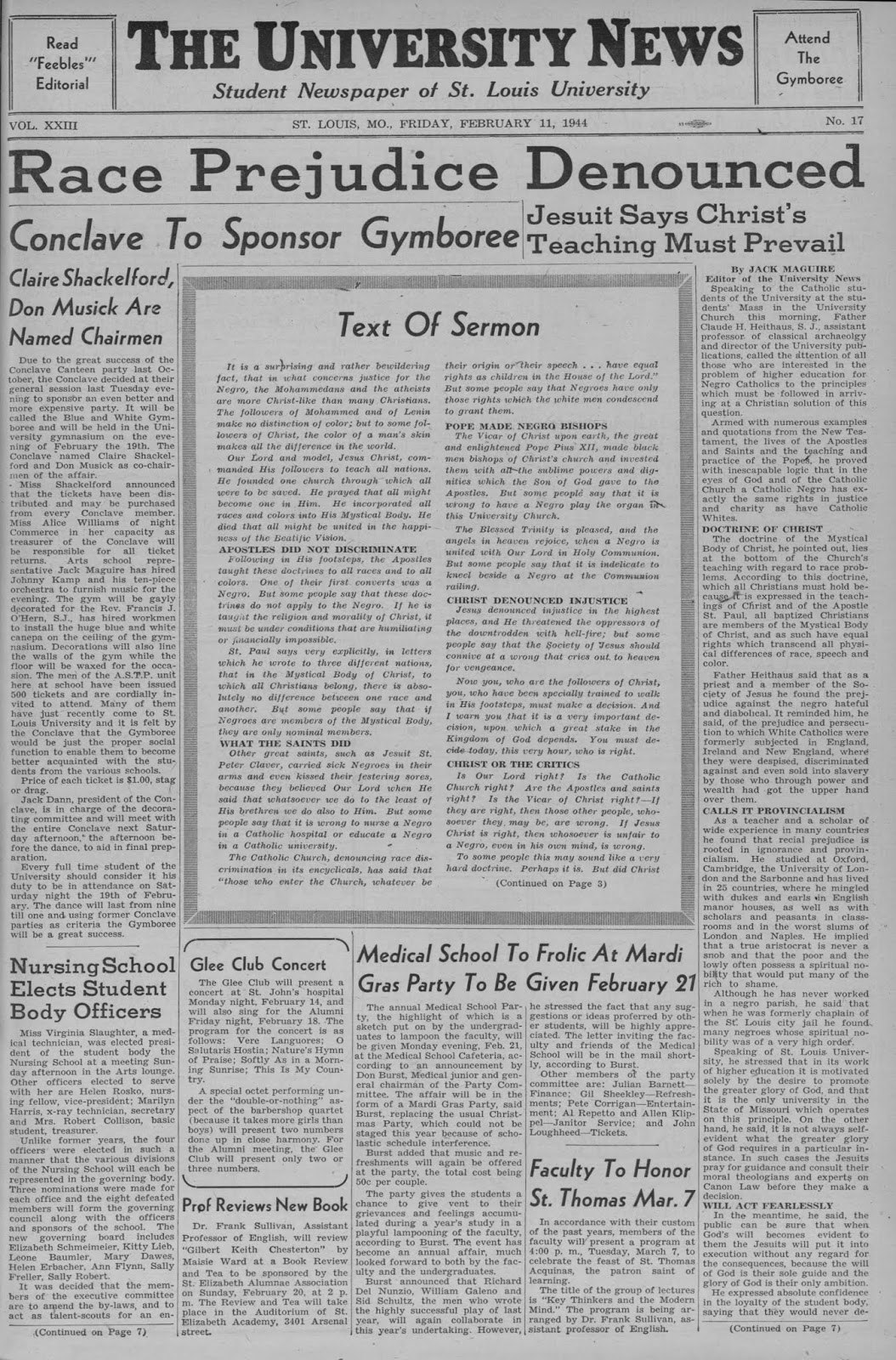
Noting his schedule to preach at the student Mass in the College Church on February 11, he decided to face the issue of the university's refusing entrance to blacks. In a carefully prepared sermon, which he distributed to the local dailies and reprinted in the student newspaper, Heithaus accused the university of being immoral, un-Christian and un-Catholic for discriminating against blacks. At the close of the sermon, he asked the mass of students to stand up and pledge never to have anything to do with discrimination against blacks. Nearly thousand students took the pledge, with no dissenters. The next summer, Saint Louis University began accepting black students.
Father Heithaus's speech was published on the front page of the student newspaper
The University News, February 11, 1944

What is going on here?  This is totally different from Ross's account.  Here desegregation is described as a fait accompli pulled off by Father Heithaus.  Arnold Ross, the students, and the young priests (which probably didn't include Heithaus; he was 46 years old, 8 years older than Ross) are nowhere to be seen.

The book Better the Dream on SLU goes a little deeper into desegregation.  The book presents Heithaus's speech as an important event, but one that was the culmination of agitation by a number of priests and university administrators.

Partial steps toward desegregation had been made a year before Heithaus's speech.  That year Interim University President Kelly created a committee charged with making a recommendation on desegregation.  The committee recommended against full desegregation and instead recommended desegregating the School of Medicine as an experimental first step. However, the recommendation was not implemented as a vote of the administrative board failed to produce a clear mandate.

The next academic year, President Kelly was replaced by Patrick J. Holloran.  Under pressure from priests to consider desegregation, President Holloran sent out letters to alumni and other friends of the university asking their opinion about admitting African American students.  The letter began circulating shortly before Heithaus's speech.  In fact, a copy of the letter, which had been intended as a discreet private inquiry, was published in newspapers the day of Heithaus's speech.

In the account in Better the Dream, it is unclear what impact Heithaus's speech had.  Heithaus received a great deal of public support, and President Holloran called a meeting of university administrators three days after the speech to discuss desegregation.  However, that meeting was inconclusive, and the President only publicly announced the decision to admit African American students in April, three months later.  Moreover, his announcement makes no reference to the speech, and it was made a few weeks after a qualified African American, Norman Cothran, had applied for admission.  Cothran's application might very well have been the primary catalyst.

A close study of the timeline in Better the Dream also calls into question part of the account in the Missouri Historical Review.  In the latter account, Heithaus unilaterally decides to take a stand against segregation, but the fact that the President's letter was leaked to the press on the same day as his speech suggests that it was part of a coordinated effort in favor of rapid desegregation.

University President Holloran
From findagrave.com

Finally, there is a third account of desegregation that seems to runs counter to both Ross's recollections and the accounts in sources like Better the Dream and the Missouri Historical Review article.  In 1951, John J. McCarthy, the Director of Public Information at SLU, published his article "Facing the Race Problem at St. Louis University" in the Jesuit Educational Quarterly.  Here's how he describes how segregation ended:
Response to the letters [from Holloran about desegregation] were quite strongly in favor of the step being taken.  A report of the results was given to a second joint meeting of the Board of Trustees and the Council of Regents and Deans, and the information was also passed on to Father Zuercher and to Father Maher.  The opinion was unanimous that the step should be taken.  Five Negro students were therefore admitted to the 1944 summer sessions.
In this account, not only do Arnold Ross, the students, and the young priests not appear, but Heithaus is absent as well.  This may reflect university politics.  Not long after the speech, President Holloran exiled Heithaus from SLU for agitating for further integration of the university.  (Accounts have Heithaus either leaving for Kansas City to work as an army chaplin or being sent to Marquette University in Wisconsin.)  As a university employee, McCarthy may have felt it best to avoid mentioning the matter.

A study of the historical sources being used sheds a light on the accounts.  The sources seem to primarily be interviews with Heithaus and SLU archival holdings (like minutes of meetings of the Board of Trustees).  Additional sources are going to be needed to create a full picture of desegregation that integrates Ross's recollections with the current published accounts.  I am not going to be doing this here, but in a later blogpost, I will put the African American students who desegregated SLU into the record.

This blogpost about Saint Louis University continues with  "The Saint Louis University students."

A War Hero turned Communist Worker?: Lewis Smith's military service

Aleck Lewis Smith was one of the professors that the governor of South Carolina publicly accused of being a "communist worker." Wh...