Friday, January 6, 2023

'sivilizing Freedmen in Arkansas: the Branch Normal College


An artist's depiction of the Arkansas river as viewed from Little Rock.
The view from Pine Bluff would have been similar


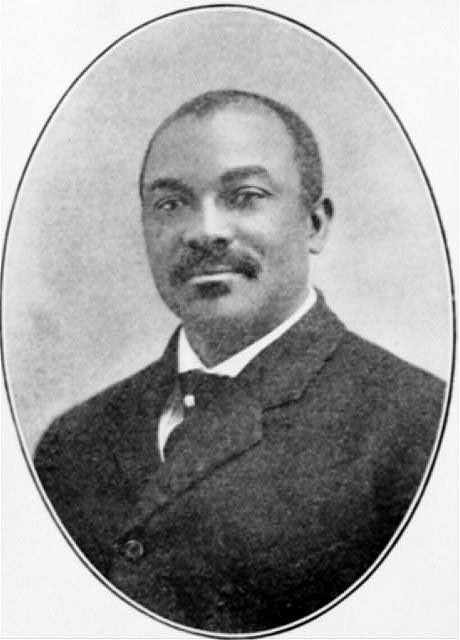
J. C. Corbin
From Wikipedia

On September 27, 1875, visitors to Pine Bluff, Arkansas could witness a scene that they could well mistake for a malaria-induced hallucination. In the middle of this rough river town in the Arkansas Delta, a scholarly-looking Black man was welcoming students to a newly opened college. That man was J. C. Corbin, a forty-two year old graduate of Ohio University and the founding principal of the Branch Normal College, Arkansas's public Historically Black College.

The mere existence of the college was a remarkable achievement. The college had been created by the state legislature two years earlier. This was a time when the state government was dominated by a Republican Party that strongly supported Black Arkansans. Much had changed in the intervening two years. The Republican party had collapsed in chaos, and political power was gained by conservative Democrats that included the state's former slave-owning elite. The new government rolled back many of the changes enacted by Republicans, but it preserved some measures enacted to support newly freed slaves as a paternalistic gesture intended to "fuse" Black voters with conservative Democratic politicians.

The early history of the Branch Normal College is of interest because it represents an unusual road in the development of higher education for freed slaves. Most HBCUs founded during this era were founded by men with a background either in the military or in missionary work. Fisk University's founding president Erastus M. Cravath was a white pastor affiliated with the American Missionary Association. Howard University was founded by the Union general O. O. Howard. Booker T. Washington, the most famous African American educator of the nineteenth century, was neither a military officer nor a missionary, but he had been mentored by Samuel C. Armstrong, who was both the son of missionaries in Hawaii and a former Union general.

Pine Bluff during the nineteenth century

Pine Bluff was a natural place to provide services for freed persons as the town had become a regional center for Black life. The town is located in the south central part of the state, on the Arkansas river. The surrounding area is part of the Arkansas Delta. In the years before the Civil War, aspiring planters brought large numbers of enslaved workers to the area as the Delta offers superior conditions for cotton-growing.

Census records clearly tell the story of this growth. In 1850, there were just under six thousand people living in the county. Ten years later, at the outbreak of the Civil War, the population had more than doubled to just over fifteen thousand. Throughout this period, just under half (or approximately forty-five percent) of the population was enslaved.

As a river town, Pine Bluff played a central role in this growth. The most efficient mode of transport in southern Arkansas was along a river, so aspiring planters arrived in the town by boat and then, after establishing themselves in the countryside, sent their cotton there to be sold at market. The town grew even faster than the surrounding countryside: the population increased four-fold, from just under three-hundred residents to almost one-thousand four-hundred. 

After the war broke out, the town's population swelled as freed slaves from the countryside went there seeking refuge. The town became a safe haven in fall 1863 when Union troops took control and set up a refugee camp. Soldiers remained there and even maintained an office of the Freedmen's Bureau until spring 1869. By 1870, Black residents represented nearly sixty-five percent of the town's population. This was a dramatic change. Before the war, they had been a substantial presence but never a majority.

The conditions that drew freedmen to the town also made it a challenging place to run a college. While Pine Bluff offered great economic opportunity before the war, it had never been an easy place to live. The town was subject to frequent flooding, and the climate was subtropical with hot humid summers. This made for an unhealthful, malarial environment that forced newcomers to go through a long and difficult period of enduring sickness while they acclimated. 

The war, especially the large influx of refugees, strained Pine Bluff's meagre public infrastructure, so problems with sanitation worsened the already bad public health conditions. Disease ran rampant through the freedmen population, and mortality rates soared.

In the face of these considerable obstacles, Corbin had few resources to support the newly formed college. During the first years, the college was run out of a rented house that also served as Corbin's residence. He was the sole faculty member and was even responsible for menial tasks like cleaning the classrooms. 

Skeptics would have questioned the value of providing Corbin with even this modest level of support. Slaves had largely been deprived of education, and Arkansas had only a negligible population of free persons of color. During the first few years after the war, the Freedman's Bureau and missionary societies had run schools for free slaves, but teachers focused on imparting basic skills like literacy rather preparing students for college. Corbin's own official reports on the college communicates a sense of frustration with the difficulties in recruiting and retaining qualified Black students. So, who were the students?

Map of Pine Bluff in 1869. The location of the Branch Normal in 1875 is indicated in red.
From Arkansas Digital Archive

The first students at the Branch Normal College

The first class of students consisted of seven students drawn from Pine Bluff and Drew County (another county located in the delta). The students appear to have come from families of relative privilege. Consider the student Robert Allen. Robert was twenty years old and was living with his parents in Drew County. Robert was born in Arkansas, but his parents had moved from out-of-state (from North Carolina and Virginia). There's no record of Robert's family before the war, but they were almost certainly enslaved. (No free persons of color lived in Drew County in 1860). Robert's father was a wagon maker and a carpenter. These were skilled professions that put the family on firm economic ground and enabled the father to purchase real estate.

Also a member of the first college class was Angeline Vester. Angeline was thirteen years old, much younger than Robert, and had moved from out-of-state. She had been born in Louisiana and had moved to Drew County with her mother and stepfather. The stepfather was a Union veteran (formerly a private in the 98th Colored Infantry), and he likely brought the family to Arkansas to take advantage of the availability of farm land. By the time Angeline began her studies, the family was running a farm.

Pine Bluff in 1908
The location of the Branch Normal College in 1883 is indicated by the light blue dot.

From the Library of Congress

The Branch Normal College in the 1880s

The college graduated its first student in 1882, seven years after it opened. A second student graduated the following year. Both students, James C. Smith and Alice A. Sizemore, remained at the Branch Normal to work as teachers, the first ones Corbin hired. Both were in their earlier twenties, so they had little direct experience with enslavement, but they had grown up around people who did. No information about Alice's background is available, but James seems to have come from a background similar to that of Robert Allen. James was born in Arkansas, but his parents had moved from out-of-state (from North Carolina, likely forcibly by an enslaver). His father worked as a carpenter and wheelwright.

The college moved to permanent facilities in January 1883. The new location was a modest one: a two-story brick building constructed on a twenty acre plot in the western outskirts of town. The college still offered no living facilities, so students continued to live off-campus in rented rooms.

The Branch Normal College in 1908. Only the left-most building existed in 1883.
The right-most building is a dormitory that was built in 1887.
The building between them is a shop building constructed in 1893.
From the Library of Congress

The college celebrated its achievements at a June 1883 public ceremony held to mark the end of the academic term. The event was held off-campus at St. John's AME church. The nature of the event reveals a bit about how Corbin ran the college. The event opened with a prayer by Rev. Sylvester Hutchinson, likely the pastor at St. John's. This was followed by three student speeches: a salutatory (or welcome speech) on "Fame," a speech on "The Human Hand," and a graduating address by Alice A. Sizemore on "The Past." At the end, Frank J. Wise, a prominent white lawyer,  presented diplomas. Music was played between the speeches. The first speech was preceded by the singing of the anthem and Hallelujah by the college choir. The "First Regimental March" was played next, following by "Spirit Creator of Mankind" by the Belgian composer Louis Lambillotte, and finally Gloria from Mozart's Twelfth Mass. 

The song "First Regimental March" was likely the "Marching Song of the First Arkansas Colored Regiment." Singing this son was an act of major political significance. The song was written during the Civil War, and it is sung to the tune of "John Brown's Body." The lyrics proudly proclaim Black soldiers' opposition to the Confederacy. Some lines are "We are going out of slavery; we're bound for freedom's light; / We mean to show Jeff Davis how the Africans can fight" and "[Former enslavers] will have to bow their foreheads to their colored kith and kin." This was a remarkably bold act by students and faculty at a college funded by a state legislature dominated by former Confederate soldiers!

While not as blatant, the rest of the event also held political significance. The speeches displayed academic knowledge and were the types of speeches delivered by students at Predominantly White Institutions during the 19th century. When had graduated from Ohio University several decades earlier, Corbin had delivered a speech on "The Dangers of Literary Distinction." Compares these speeches to those delivered by students at HBCUs like Booker T. Washington's Tuskegee Institute. At a similar exercise held in 1882, the titles of Tuskegee student speeches included "Go to Work" and "The Drunkard's Daughter." The content of the speeches was not recorded, but the titles suggested that they were exhortations to avoid vices that whites alleged were prevalent among freedpersons.

Later that year, in December, the Branch Normal College held another public exhibit. At this event, students gave speeches displaying their knowledge of classical culture. One student delivered a declamation of Anthony's Oration over Caesar, while another gave one on "Rome." Other speeches emphasized students' connections to American culture. One student read a selection from George Washington's Inaugural Address, another spoke on "Revolutionary soldiers."

The music choices suggest similar attitudes. The songs played at the June event were taken from the European musical tradition. This ran counter to common expectations. In public music performances, especially those held for white audiences, students at HBCUs typically played music that came from (sometimes real, sometimes imagined) Black traditions such as spirituals.

A closer look at Branch Normal Students

We can get an unusually close look at Branch Normal students during the 1880s thanks to the work of an interviewer employed by the Works Progress Administration. In the 1930s, the WPA sponsored a project to interview freed slaves. Among those interviewed was Joseph Samuel Badgett, a former at the Branch Normal. Here's what Badgett told the interviewer about his experiences:

After that I went to Pine Bluff. The County Judge at that time had the right to name a student from each district. I was appointed and went up there in '82 and '83 from my district. It took about eight years to finish Branch Normal at that time. I stayed there two years. I roomed with old man John Young.

You couldn't go to school without paying unless you were sent by the Board. We lived in the country and I would go home in the winter and study in the summer. Professor J.C. Corbin was principal of the Pine Bluff Branch Normal at that time. Dr. A. H. Hill, Professor Booker, and quite a number of the people we consider distinguished were in school then. They finished, but I didn't. I had to go to my mother because she was ill. I don't claim to have no schooling at all.

John Young is listed in the 1893 college catalogue as living in Pine Bluff, but I can't find any other information about him. The other two people he mentions were deceased at the time of the interview, but they had been prominent educators and religious leaders.

Former Branch Normal student A. H. Hill
From "The Sons of Allen"

A. H. Hill was Andrew Henry Hill. Hill was born after the war (in 1870) in Brentwood, Tennessee. I haven't been able to find much information about the parents, and in particular, it unclear if they were free or enslaved. When Hill was a child, the family moved to Monroe County and started a farm. When he was a young teenager, Hill became active in the AME church, but instead of immediately entering the ministry, he decided to enroll at the Branch Normal College. He completed his studies there in 1899 and then went to Ohio to attend Wilberforce University. He graduated the university three years later and then returned to Arkansas to serve as a minister at an AME church in Fort Smith. He also served president of Shorter College (an HBCU in Little Rock that is affiliated with the AME church) for almost a decade and was a minister in Pine Bluff.
Joseph A. Booker
From Encyclopedia of Arkansas

Professor Booker was Joseph Albert Booker. His life before the war is relatively well documented. In 1859, Booker was born enslaved on a plantation near the modern town of Portland, Arkansas. The plantation was run by John P. Fisher, an early settler from New Hampshire. By the time Booker was born, Fisher's plantation was a sizable farm of 600 acres which was cultivated by fifty-five enslaved workers. 

Booker experienced great hardship as a child. Both parents died when he was a baby. According to one account, his father was whipped to death for teaching other slaves to read. Booker remained on Fisher's plantation until after the Civil War. By 1870, he and his sister were working as farm laborer for a Black farmer (Jonia Georg).

A modern photo of the Fisher plantation where Booker was born
From Wikipedia

Booker followed a path similar to that of Hill. He became interested in Christianity as a teenager (although he joined the Baptist church rather than the AME church) and enrolled at the Branch Normal College. The timeline of his studies is a little confused. Badgett says that Booker was at the school in 1882 or 1883, but accounts of Booker's life state that he attended from 1878 to 1881. In any case, at some point, he left the college and moved to Nashville, Tennessee in order to attend Roger Williams University, a now defunct HBCU founded by white abolitionists. He stayed at the university for five years, earning a bachelor's degree in 1886. Booker returned to Arkansas after completing his education. He served as minister for a church in southern Arkansas for year, and then he was elected president of Arkansas Baptist College, a HBCU in Little Rock. He remained in that position for the rest of his life.

Booker credited J. C. Corbin for instilling in him a deep love of learning while he was at the Branch Normal College, but politically, the two differed in important respects. Booker was a supporter of Booker T. Washington and even hosted him when he visited Arkansas. In keeping with Washington's views, Booker advocated a conservative political approach that emphasized accommodation over confrontation. In the 1900s, he served on a city vice commission charged with cleaning up Little Rock's red light districts, and he was appointed by the governor to a race relations committee created in response to a major 1919 race riot. 

Joseph A. Booker
From AARG

Joseph Samuel Badgett was not a major public figure like Booker or Hill, but his life is also well-documented. In his interview, he says that his mother was enslaved and "had Indian in her." The last statement is consistent with other public records which record her race as "mulatto." Joseph was born during the last year of the Civil War, so he was born into slavery but had no memory of being a slave. 

Joseph says nothing about his father in his interview, and federal census records are contradictory about basic facts concerning him. The father is described as being born in Ohio in 1900 and 1910, but the 1940 census states he was born in Texas. One possibility for this silence and confusion is that the father was his enslaver, or another white man living in the household.

Joseph's enslaver was likely Madison Badgett, the only adult male with the last name "Badgett" who was recorded as living in the county in 1860. That year, Madison Badgett enslaved two women whose ages match the ages of Joseph's mother and older sister. No enslaved men were in the household, lending further support to the theory that Joseph's father was his enslaver. 

After emancipation, Joseph's mother found work as a domestic servant, and he helped support her by working as a farmhand. Joseph was educated in the state's newly formed public schools, and his teachers included J. C. Smith. Smith was likely teaching between terms at the Branch Normal College to earn some extra income.

His WPA interview focuses on his early life, but Joseph achieved major personal success after leaving the college. He settled in Little Rock and worked as an upholster and then as a barber. At the time of his interview, he had owned his own home for decades.

The Branch Normal College changed significantly after Corbin left. His departure was part of a wave of changes throughout the south as populist politicians rose to political power and created the Jim Crow political system that sought to reduce Black citizens to a state of near-slavery. At the Branch Normal, Arkansas politicians worked to replace the college's academic coursework with training for semi-skilled professions. The campus environment during the 1920s was depicted by novelist Chester Himes (whose father had been on the faculty) in his autobiography and, in fictionalized form, in his novel The Third Generation. Himes depicts the Branch Normal as a wild place where the children of poor and ignorant sharecroppers learned to become "good farmers an' good blacksmiths an' good Nigras," in the words of the governor in The Third Generation. The learning of classical western culture that Corbin had promoted was entirely gone.

Map of Pine Bluff in 1923. The location of the college is indicated in red.
University of Arkansas Library

Friday, December 16, 2022

Frank R. Veal: Allen University's "Judas?"

Veal and a dean were featured in a 1961 advertisement for evaporated milk
Ebony magazine


As Allen University president, Frank R. Veal played a crucial role in the South Carolina governor's attacks on HBCUs during the late 1950s. He comes off badly in the public record. A protest flyer named Veal as one of the "Judases, Uncle Tom's, and tools of Timmerman" who was carrying the state to deeper ruin. The AAUP report on the incident used more restrained language but likewise condemned him. It determined that he had grossly violated established rules for academic due process, and his actions were "either complete administrative confusion or hypocritical lip service used as a device to conceal administrative misdeeds." Here we take a closer look at Veal's record. 


Most surprising is that, prior to moving to South Carolina, Veal enjoyed close interactions with prominent members of the Communist Party. It appears that the South Carolina press and government officials never learned of this despite the amount of attention they paid to events at Allen.


Veal was born in 1907 to a middle-class family in Milledgeville, Georgia. Veal's father worked as a machinist and a laundryman and was able to purchase his own home. After graduating from high school, Veal left Georgia for South Carolina to attend Allen University. This began a life-long connection with the university and the AME church. He graduated with an A.B. degree in 1932 and then remained at the university for a year to teach history. He then pursued religious studies for most of the 1930s. He earned a B.D. from the divinity school at the University of Chicago and possibly an S.T.N. degree from Boston University. (The BU degree is mentioned in one newspaper article, but I could not find it in university records.) In the mid-1930s, he worked as an assistant football coach at Howard University while also taking classes. He earned a B.D. degree from Howard in 1937.


In 1940, Veal moved to Ohio to work as a minister for the African Methodist Episcopal Church. He would serve as a religious minister for most of the 1940s. He was first stationed in the city of Newark, but the next year he moved to Brown Chapel in Cincinnati. Within the church community, he is remembered for raising funds to expand the chapel's physical infrastructure. 


Veal became active in politics while in Ohio. His political work started with civil rights activity. He was a leader in the local chapter of the NAACP. This brought him into regular contact with left-wing political activists in the city. In the late 1940s, leftists, both in the city and nation-wide, were organizing around the third-party presidential candidate Henry A. Wallace. Wallace had served as Roosevelt's Vice President but had split with mainstream Democrats over foreign policy and communism. Wallace advocated for adopting socialist democratic policies and peaceful coexistence with the Soviet Union. Many of Wallace's supporters were part of the socialist democratic organization the Progressive Citizens of America. In 1948, Wallace ran as a third-party presidential candidate, and the PCA formed the backbone of his political party, the United States Progressive Party.


An important part of the Progressive Party's platform was racial equality, so Veal's work in the NAACP naturally drew him into the Progressive's orbit. He served on a November 13, 1947 committee that welcomed Wallace when he came to Ohio to campaign. He also appeared at a January 21, 1948 Progressive Citizens rally held in Columbus. 


Veal's involvement with the Progressive Party attracted negative attention from internal security forces. The Progressive Party heavily drew membership from communists and was even believed by some conservatives to be under communist control. As a result, many people involved with the Progressives came under FBI investigation. Veal himself came to the FBI's attention after an informant reported that he was a communist. 


The accusation of communist membership was not absurd. Cincinnati was in fact home to a significant number of members of the Communist Party USA (CPUSA). In Ohio, almost 3,000 people joined the Party. As a major industrial center, Cincinnati was a center for many of the regional CP's activities.


Dorothy Pilder
High school yearbook photo from Ancestry

Although both the Progressive Party and the Communist Party reached out to African Americans, African American membership was small. Many local Party members were white union members. For example, the communist labor organizer Talmadge Raley was born to poor farmers in Kentucky and had moved to Cincinnati to work at a porcelain factory. By the 1940s, he was working as an union organizer and then as a local union representative for the United Electrical, Radio, and Machine Workers of America.


Talmadege was unusual in that much of the CP's membership was made up of white immigrants, especially Jewish immigrants from Eastern Euope. Typical was Dorothy Pilder (later Dorothy Renfrow). Dorothy was born in Cincinnati, but her parents were Yiddish-speaking immigrants from Russia who ran a delicatessen. Others were from a working-class background. The Party member Victor Keller (or Kellar) was a Ukrainian immigrant who worked as a machine operator in a clothing factory. 


Louis B. Renfrow
Harvard yearbook photo via Ancestry


While Veal's involvement with the Progressive Party brought him into regular contact with members of the CPUSA, his direct engagement with the CP was not very significant. The only information the FBI was able to collect was a report that Veal had been put on a local CPUSA committee charged with handling religious matters. After a year, the Cincinnati FBI office decided to close Veal's file. The file ends with the remark that he was "never considered sufficiently important to be designated as the subject of a Security Card Index."


The Cincinnati office had reviewed its records on Veal because he had moved to South Carolina in August 1948. Veal left Ohio to assume leadership of "Mother Emanuel,the Emanuel African Methodist Episcopal Church in Charleston. This was an honor. The church is one of the oldest and largest African American churches in the south.


Veal's largely dropped out of progressive politics after moving to South Carolina. Continued involvement with the Progressive Party was unworkable. In November, Wallace was soundly defeated in the presidential election, receiving even fewer votes that States' Rights candidate Strom Thurmond, and support for the Progressives collapsed throughout the nation. The Progressive Party never enjoyed strong support in South Carolina, and interest in communism was essentially non-existent.


After he moved, Veal fell within the jurisdiction of the Savannah office of the FBI. That office reviewed the files collected by the Cincinnati office and solicited information from law enforcement officers as well as informants. Their investigation failed to produce any indication that Veal was engaged in subversive activities. One FBI agent (Carlton M. Dillard) requested permission to interview Veal with the goal of developing him as a source of information about communists. Permission was denied, and the FBI again lost interest in him.


Veal moved from Charleston to Columbia in 1952 to serve as pastor for the Emmanuel AME Church. That year, he was one of three African Americans to run for the U.S. House of Representatives. All three lost the election by a significant margin, but their campaigns were significant as the candidates were the first African Americans in South Carolina to run for major political offices in over a generation. 


After he had served as a pastor in Columbia for a year, Veal left the church to work in higher education. He was elected president of Paul Quinn College in Waco, Texas. The college is closely affiliated with the AME church, so his election was natural one. Veal served without attracting any controversy for three years and then returned to Columbia after being elected president of Allen University. He replaced Samuel R. Higgins who stepped down after being elected an AME bishop. 


What are we to make of this? In a report, an FBI agent dismissed Veal's activities in South Carolina with the remark that they were "self-centered to promote his own welfare." An informant the agent contacted (Albert B. Brooks) went further. He said that Veal was "over-ambitious" and trying to get elected as Allen University president with the "ultimate aim" of becoming an AME bishop.


The broad contours of the FBI agent's report appear correct. As early as 1948, the press reported that Veal was trying to replace Samuel R. Higgins as Allen University president. A charitable interpretation of his record is that he was an ambitious religious leader who wanted to advance the cause of African Americans but also recognized the constrains imposed political reality. In Ohio, with its more liberal political culture, Veal built relations with progressives, but in the conservative strong-hold of South Carolina, he recognized that he needed to respect the state's staunchly segregationist culture.


Whatever plans Veal had to use the Allen University presidency to advance his standing within the AME church were ruined by the negative publicity surrounding the governor's attacks. He remained as Allen University president until 1962, but he never received his desired bishopric. Instead, he returned to Ohio to serve as pastor of the Bethel AME Church in the town of Lockland (a suburb of Cincinnati). He remained there until his death in 1969. 


Sources


1) "Three Negro Candidates in South Carolina." Jackson advocate. [Jackson, Miss.], August 2, 1952, p. 1.


2) "Move to Oust Dr. Samuel Higgins as Allen U. Head" The Ohio daily-express [Dayton, Ohio]., June 14, 1948, p. 2

Monday, December 5, 2022

Horace B. Davis: Turning Red in the Black Belt

Newspaper announcement of the hiring of Horace B. Davis and two other professors
The Sou'wester newspaper; September 14, 1929

Horace B. Davis and his family arrived in Memphis, Tennessee in fall 1929. They moved because Horace had been hired to teach at Southwestern University (now Rhodes College). The job was just a paycheck for him. The scholarship that had funded him for the last three years had run out, and his political activities had made university administrators hesitant to employ him. 

Horace's arrival on campus did not attract any special attention. The school newspaper announced his hire in an article discussing all the new additions to the faculty, but it just offered a brief summary of his educational history. Horace's most notable appearance in the student newspaper was in a satirical issue published shortly before April 1st (a traditional day for practical jokes). Among students, Horace evidently had developed a reputation both for his interest in international politics and his appearance. The article humorously reported that Horace had recently been absent from his class, and one rumor held that he had gone to a London disarmament conference, but in fact, he had been having his suit cleaned and pressed. That task, the paper reported, was so taxing that he had to spent an entire day resting in bed.

Even though Tennessee is a border state, and Memphis was a regional commercial center, Horace found the city to be a deeply southern place. Much of the economy revolved around cotton which was grown on large farms by sharecroppers. Unfavorable leases trapped sharecroppers in debt, leaving them stuck in rural poverty. Black sharecroppers had it especially bad as the state's legal system provided them with little protection from unscrupulous landlords. In one discussion with a landlord about farming, Horace was  told candidly about the way things worked. The landlord explained that most sharecroppers maintained their own financial records and checked them against the records maintained by their landlord. When asked what sharecroppers did when two accounts did not agree, he said, "they lose."

Horace's home at 1650 Monroe Avenue, Memphis, TN
From Redfin

The lack of legal protection left Blacks exposed to violence. While Horace was living in the city, a Black streetcar passenger was shot to death by the conductor. The conductor was upset because he'd been questioned about whether he had correctly computed change for a fare payment. Although he committed the act in front of witnesses, the conductor was never charged with murder. Instead, he was sentenced to a month in jail for carrying a firearm without a permit. 

The violence of Memphis even struck close to Horace's home. He employed a young Black woman, Lillie Mae Harris, to do domestic work. One night after work, while waiting at a bus-stop, Lillie was forced into a car by two young white men. They proceeded to take her to an isolated area and then raped her. Even though she had taken note of the men's license plate number, she did not file a police report as her family discouraged her, arguing that there was no hope of seeing the rapists punished.

Lillie's mother worked as kitchen staff at Southwestern University, and she and Horace developed good social relations with each other. Through their interactions, Horace learned much about the complexities of Jim Crow social etiquette. One time Lillie and her mother invited Horace and his family to visit their uncle who lived in the country and worked as a sharecropper. Always eager to learn about the lives of workers, Horace happily accepted the invitation. 

Lillie's uncle was a gracious host. He welcomed Horace to his home and spoke freely about life in rural Tennessee. However, he also respected the social rules of Jim Crow. He served Horace and his family a meal at the dinner table, but he and his family declined to join them and instead ate in the kitchen.

One of the uncle's neighbors was a white sharecropper. He and the uncle enjoyed relations that were friendly but strangely shaped by segregation. Horace wanted to meet the white sharecropper to learn more about working conditions in the area. The uncle introduced the two. Horace was invited into the sharecropper's home, and the two candidly discussed farm life. During the whole visit, the uncle waited outside. Although the uncle and the farmer were on good terms and even hunted together, the uncle seemed to feel that it would have been improper to join a conversation between white men. 

Surprisingly, Horace had largely positive things to say about teaching at Southwestern University. At the time, the university was a small school of about five hundred students and was associated with the Presbyterian church. The student body was all-white and largely drawn from the region around Memphis. The typical incoming freshman had received a limited education from the state's primitive high school system. The university offered a somewhat old-fashioned curriculum (the most popular course was a language course on Ancient Greek), but academic standards were high. After four years at the university, most students graduated with an academic education that compared well with that offered by universities in the north.

Horace experienced first-hand how the university molded students. He was assigned to teach a freshman class that had an open-ended curriculum and was designed to help students adjust to college work. Wanting to promote critical thinking, Horace selected a textbook titled Introduction to Critical Thinking that included both a chapter on Darwin's theory of evolution and a chapter on higher criticism of the Bible. The university president objected to the use of such textbook in a freshman class at a church-affiliated school in Bible Belt, so Horace instead taught anthropology with an emphasis on the work of Franz Boas, especially his ideas about cultural relativism and his opposition to scientific racism. 

On racial issues, Horace found that many of his students held regressive views. Once he held a classroom poll on whether it was ever justified to burn a man to death. The poll showed the class to be evenly split on the issue, but when he rephrased the question as one about "lynching" rather than "burning," he was shocked to find that twenty-six of the twenty-nine students were in favor. However, the students were tolerant of opposing views on these issues. Although the students soon realized that Horace did not share their political views, they were friendly and remained engaged in their coursework. A biology professor he knew had an even more positive experience. Many of his students were able to reconciled his lectures on evolution with their religious beliefs.

Horace planned to return to New York to complete his dissertation at the end of the academic year. His departure was announced in the student newspaper without any great fanfare: "Scott [another professor], Davis plan to work on Ph.D. degrees," read the headline. Over the course of the next month, circumstances would change rapidly. Horace and his wife Marion would find themselves under the scrutiny of the national press.

By the end of the academic year, Marion had joined the Communist Party USA. Accounts of when she joined are conflicting. In his autobiography, Horace stated that she joined while they were living in Pennsylvania, but Marion wrote that she joined while living in Memphis. The decision to join was a life-changing one: party membership potentially exposed her to negative press and police repression. However, it was one made without any fanfare. Marion and Horace subscribed to the American Communist Party's newspaper, the Daily Worker. The newspaper regularly included a form that readers could send to the Party if they were interested in learning more about communism. Marion decided to fill out the form after witnessing both the worsening national economic condition (the Great Depression had begun) and the regressive political situation in Memphis. In June, shortly before she and Horace planned to leave Memphis, she became a card-carrying Communist when a Communist organizer visiting from out-of-town, Tom Johnson, presented her with her Party membership card. 

By this time, Marion had attracted the attention of local law enforcement. Law officers were evidently monitoring her mail as the police commission, Clifford Davis, later testified that she had sent a letter to the communist-organized civil rights organization, the American Negro Labor Congress. In it, she expressed optimism about the prospects for political organizing in the south. 

Although they had only been in Memphis for a year, Marion and Horace had been able to connect with the handful of communist sympathizers living in city. Those people included a former Party member by the name of Joseph Norvell. Born Josef Nowosielski in Chernivhove, Russia, he had moved to the United States in 1911 and lived in St. Louis for a number of years before moving to Memphis to work as a grocer. By the time Horace met him, he had left the Party but remained supportive of its cause. 

In late May, Horace received letters from two Party members, Robert W. Dunn (an acquaintance from the northeast) and Tom Johnson (a party organizer in Birmingham), asking him to organize a political protest. The communist-affiliated National Textile Workers Union had been trying to organize mill workers in Georgia. At a May 21 political rally, six organizers had been arrested on insurrection charges. Horace was asked to organize protest against their arrest.

Horace and Marion found Memphis to be difficult place for political organizing. Only a handful of people were interested in participating. However, after deliberating on the matter, they decided to go ahead and hold a protest. They were scheduled to leave in a few weeks, and Horace told Marion, "I somehow don't want to go away from this place without taking some kind of stand against the things I've seen."

On Thursday June 5, Marion successfully applied for a permit to hold a public meeting on the next day at Confederate Park, a public park by the Mississippi River. She and Horace then distributed leaflets announcing the meeting and gave notice to the press. That evening, a reporter came to their home to interview them about the upcoming meeting. Marion recalled giving the reporter "a mouthful." They not only spoke about the Atlanta arrests, but they also spoke in favor of social equality for Blacks and about the success of the Soviet Union. The next morning the interview formed the basis of article in which Marion's picture appeared beneath the caption "Communist leader." 

After the article came out, events progressed rapidly. Tom Johnson arrived from Birmingham  to help with organizing. It soon became clear that they would experience significant pushback. Horace and Marion began receiving angry anonymous phone calls from people who had learned of the upcoming protests from the news. The most significant phone call they received was one from police commissioner Clifford Davis. Around lunchtime, he told them that he had withdrawn the protest permit, and he had two hundred legionnaires (members of a war veterans organization) who were prepared to break up the meeting if they persisted. Horace and Tom Johnson immediately left home to meet with the commissioner and discuss the matter.

Clifford Davis
From "ET" via findagrave

In meeting with the police commissioner, Horace and Tom were walking into a lion's den. Clifford Davis was an important figure in Memphis's white supremacist power structure. Although it was not widely known at the time, he was not only in charge of the police; he was also a leader of the local Ku Klux Klan. The Memphis Klan was very different from the Klan that Horace had encountered in Pittsburgh. While the Pittsburgh Klan focused on anti-immigration, the Memphis Klan sought to enforce racial segregation and suppress labor organizing through extralegal violence. In doing so, it was acting as the extra-legal arm of the wealthy cotton planters who dominated city politics.

The meeting between Horace, Tom, Clifford and the city officials rapidly fell apart. What had started as a discussion over a park permit escalated into a discussion over social equality between blacks and whites. It ended when Clifford had Horace and Tom arrested on charges that they were going to provoke a riot by speaking out on racial issues at a permit-less meeting. He then sent two police officers to Horace's home to meet with Marion. 

The ostensible reason for having police meet Marion was to inform her that her husband had been arrested. However, their actions demonstrated that their goal was to arrest Marion and anyone else they could find. When the police officers arrived at the home, they rang the doorbell and then forced their way in after Marion answered. They began inspecting her bookshelves, and when she asked to see a search warrant, they responded by laughing. Seeking an excuse to arrest her, they asked Marion if she was still planning to hold the protest meeting. She deflected the question several times, and the officers finally became frustrated and simply told her that she was under arrest. 

After being booked, Marion was imprisoned by herself in a small room containing only a small bed and a barred window. Over the course of the evening, the police tried to extract more information from her. First, an official asked Marion if she wanted to contact her children, thinking that she had left them with other organizers and would inadvertently disclose their identities. This ruse proved unsuccessful, so she was put in contact with another prisoner who tried to extract information through casual conversation. This too failed, so the prison matron tried getting information from Marion but without success. The next day Marion along with Horace and Tom were released.

Tom was escorted by the police and onto a train leaving town. Horace and Marion were allowed to return to their home. They found it in a terrible condition. The police officers had searched bookcases and filing cabinets for incriminating material and left everything in disarray. To add insult to injury, before leaving, they had left cigar ashes and footprints all over the floor. 

Horace and Marion spent the next day and a half packing up their household. On Monday night, they went to the train station to leave Memphis for Minneapolis. When they arrived, they found that their problems with law enforcement had not come to an end. Also waiting for their train was a group of suspicious-looking men who Marion thought had been send to surveil them. Later, after everyone had departed on the train, Marion's suspicious were confirmed by a friendly train porter who discretely called her attention to a badge that one of the men was wearing. To dodge the men, Horace and Marion got out at the Chicago stop and then re-boarded.

The arrests made the news. Many newspapers celebrated the police. The headline of the article published in the Chattanooga Daily Time read "Communist party nipped at Memphis." The Sceola Times went even further by condemning the university that had employed Horace: "It appears that the good people of Memphis made a mistake in contributing to the fund to secure Southwestern for that city. This school should be located in Chicago or some other northern city where the people believe in and practice social equality. There is certainly no demand for such an institution in Memphis or in any other southern city." Horace remained unrepentant. He told one reporter, "I have broken the law twenty times in my economics class at Southwestern this past year. I believe in social equality and have taught this principal [sic] to my students." 

Police commissioner Davis remained equally firm. The day that Horace, Marion, and Tom were released from jail, police officers arrested Joe Norvell on suspected possession of "dangerous literature." The negative attention contributed to him losing his grocery business. The police commissioner told newspapers that he would continue to fight communism in the city: "I think there are some more of them here. And we aren't going to use any pussyfooting methods in stamping this out." 

By November, the police commissioner felt that he had stamped out communism. He and other city leaders testified before a House special committee charged with investigating communist activities. He told the committee that now there were no active communists in the city, and he planned to keep them "shut out." The chief of police went a step further. He told the committee that  "Memphis is too small and hot for any communists."

Despite the rhetoric, the CPUSA would send more organizers to the city in a few years. They never built a large movement, but they would struggle with Clifford Davis and other members of the city's white power structure for decades.

Joe Norvell in 1941
From Naturalization Records via Ancestory.com


Sources

1. "Cotton will be grown by power tools." The Oklahoma Weekly Leader [Oklahoma City, OK]. May 16 1930. p. 1. 

 2. "Race equality is taught by communists." The Bee [Danville, Virginia]. June 7, 1930. p. 2. 

3. "Professor Jailed over 'Red' meeting." Illustrated Daily News [Los Angles, California] June 7, 1930. p. 7. 

4. "Equal rights backer filed in Tennessee." Warren Times Mirror [Warren, Pennsylvania] June 7, 1930. p. 6. 

5. "Arrest trio for communist acts." The Bristol Herald Courier [Bristol, TN]. June 7, 1930. p. 1. 

6. "Communist plot in Memphis uncovered." The Brownsville Herald [Brownsville, TX]. June 7, 1930. p. 

7."Trio charged with attempt to organize communistic group." Johnson City Chronicle [Johnson City, TN]. June 7, 1930. p. 2.

8. "Communist party nipped at Memphis." Chattanooga Daily Time [Chattanooga, TN] June 7, 1930. p. 1.

9. "Jail bars meet of communists." The Knoxville Journal [Knoxville, TN]. June 7, 1930. p. 1.

10. "'Communists' released." The Morning Chronicle [Manhattan, KS] June 8, 1930. p. 3. 

11. "Three free as communists." The Brownsville Herald [Brownsville, TX]. June 8, 1930. p. 32. 

12. "The drive is ended on communism." The Knoxville Journal [Knoxville, TN]. June 8, 1930. p. 11. 

13. "Southwestern teacher defies authorities." The Steele Enterprise [Steele, MO]. June 16, 1930. p. 5. 

14. Look up Sceola Times

15. "Sedition charge threat in Tenn. by Legion, cops." The daily worker [Chicago, IL], June 10, 1930, Final City Edition, p. 1.

16. "Investigation of Communist Propaganda: Hearings Before a Special Committee to Investigate Communist Activities in the United States of the House of Representatives Seventy-First Congress Second session, Pursuant to H. Res. 220." Part 6, Vol No. 1.


Wednesday, November 30, 2022

Horace Bancroft Davis: Radicalized in Wartime France

Horace Bancroft Davis was born on August 10, 1898 in Newport, Rhode Island to Anna and Horace Andrew Davis. The Davis family had deep roots in the northeast. Horace's ancestors had come to America during the 17th century. Anna's family were Quakers, and her father and grandfather had been active in the abolition movement. Before the Civil War, her grandfather's home was a stop on the Underground Railroad. Her father, Norwell Penrose Hallowell, served in the Civil War. He commended one of the first Union regiments of African Americans troops, the 55th Massachusetts and led them in the Battle of Fort Wagner (featured in the film Glory).

Horace B.'s family enjoyed major financial security when he was growing up. They received a steady income from financial returns from a pharmaceuticals company (the Angier Chemical Company) that his grandfather had helped found. Horace B.'s father earned a law degree from Harvard University and once maintained a law practice, but he did little legal work and largely supported the family though the income from the grandfather's company and other investments. 

The family moved to Staten Island (in New York City) when Horace B. was young. They moved a second time, to Boston, when Horace B. was a teenager (in 1911). The family settled into the town of Brookline, and Horace B. attended a private school (the Country Day School for Boys of Boston) in the neighboring town of Newton.

Horace B.'s father was active in the Republican party and once received the party's nomination for New York state legislature. Members of Horace's extended family carried on the tradition set by Anna's abolitionist ancestors. One of Horace B.'s cousins taught at a black school in the south, the Calhoun Colored School. Based in Lowndes County, Alabama, the Calhoun School had been founded in 1892 to provide practical training, in the spirit of Booker T. Washington's Tuskegee Institute.

Horace visited the Calhoun School for one winter vacation while a high school student. Towards the end of 1916, he began having some health issues. To help him recover, his cousin invited him to stay with her as Alabama offered a much milder winter than Boston as well as outdoor opportunities like horseback riding. 

Horace B.'s visit to Alabama was his first time in the south. On the visit, he got to know black sharecroppers as his horseback rides took him through the farming area that surrounded the Calhoun School. Horace recalled the environment around the school as largely apolitical. Teachers focused on training students for skilled trades and avoided discussion over issues like political rights. However, students and teachers did celebrate holidays of special significance to Blacks. Horace participated in a January 1 celebration of Emancipation Day. Other participants included people who had personally experienced slavery. When asked, they would discuss their experiences, which they recalled as horrible and traumatic, but they preferred to avoid such discussions. In general, Horace B. recalled that the atmosphere was "forward-looking," and people avoided dwelling on the horrors of slavery.

Horace B. got to see more of the south on his return trip to Boston. His cousin took him to several HBCUs, including the Tuskgee Institute, Morehouse College, and the Hampton Institute. Horace recalled being impressed by buildings at Tuskgee, especially by the fact that they'd largely been built by the institute's own students.

Horace At Harvard

After graduating from high school (around 1917), Horace began attending Harvard University. This was somewhat of a family tradition. Not only was his father an alumnus of the university, but Horace's older brother Hallowell was a student. However, Horace's studies were interrupted by the First World War.

The United States entered the war in spring 1917, shortly before Horace began university studies. The Davis family was divided over the war. Horace's father approved of the war effort as he generally was a strong supporter of President Wilson. He became active in the war effort after he was recruited to move to Washington D.C. and serve on the Committee on Public Information (a propaganda agency created to promote enthusiasm for the war). Among his other activities on the committee, he authored a 1918 Fourth of July statement issued by the president.

Horace's mother was opposed to the war. She reached this opinion after consulting with the writing of Quakers on pacifism. Horace became convinced by her argument, and he joined her in opposing the war. 

Horace B. Davis, circa 1917
From a 1917 passport application

Horace was never drafted into the military, but he decided to leave university to perform war-related humanitarian work. He volunteered for the American Friends Service Committee, a newly founded, Quaker-run organization. The committee was created to provide non-military service opportunities for people who wanted to be involved in the war effort. Horace was sent to Ornans, France to help build portable housing that would be shipped near the frontlines. Unfortunately, the health problems Horace had experienced a few years earlier returned. He was hospitalized in Ornans and then went to Samoëns (in the French Alps). During the last few of the months, he stayed in Paris.

Horace's work put him in some danger. While he was living there, Paris experienced nightly air raids and artillery bombardments. A greater danger for volunteers in the Friends Service was the influenza epidemic then raging through Europe. A number of volunteers that Horace knew fell ill, and a few even died. 

Horace regarded his volunteer service as a major event in his political development. The work put him in close contact with political objectors, and he was exposed to left-wing ideas. By the end of his service, his views on the war had changed. He continued to oppose it, but now for political reasons rather than religious ones.

In total, Horace spent the last sixteen months of the war in France working for the Friends Service. Afterwards, he returned to Boston and resumed his studies at Harvard University. He returned a changed man. He had become deeply interested in the labor movement and decided that he wanted to work as a labor intellectual. At university, he changed his major from English to Economics. 

Horace's mother had also become interested in left-wing politics, especially labor issues, during the war. Her interests developed through conversations with several leftist activists she hosted as guests. A major influence on her was the labor economist Robert W. Dunn. Horace never wrote about how his mother got to know Dunn, but they likely knew each other through common social connections. Both were raised as Quakers in Pennsylvania, and Dunn served in the American Friends Service Committee.

Horace and his mother became actively involved in the labor movement in early 1919. That February immigrant workers in the mill town of Lawrence went on strike to protest a decrease in wages. Many liberals in Boston were supportive of the strike, and three Boston pastors, Abraham Muste, Harold Rotzel, and Cedric Long, acted as spokesmen and leaders of the strike. Horace's mother knew the pastors because they all had been involved in the anti-war movement, and she and Horace joined them in supporting the strike.

Horace's activities included regular trips to Lawrence with other Bostonians to speak at meetings of strikers. Mill management together with the Lawrence city administration responded harshly to the strike. Horace recalled once traveling to Lawrence by train with twenty other activists. Upon arriving at the train station, they were met by a detachment of mounted police who rode their horses up to the sidewalk in an effort to intimidate and provoke the activists. Their efforts were unsuccessful, and Horace was able to participate in a strike meeting and then return to Boston without major incident. Other efforts were more disruptive. The pastors Musta and Long were once beaten by police and then arrested for inciting a riot. Two immigrant strike leaders were kidnapped, beaten, and left in another city. Despite the police violence, the workers were ultimately victorious. After four months, the mill owners agreed to a wage increase larger than the one strikers had originally demanded, and the strike ended.

That spring, a friend of Horace's (Arthur Fisher) planned to spend the summer working for a farmers' political organization, the National Nonpartisan League. The League was based in North Dakota and promoted a mildly socialist program that included state ownership of banks and agricultural facilities (like grain elevators) and state supported social programs like health insurance. Horace found the League's program appealing, and he traveled to Minnesota and spent the summer working as an organizer in Murray County.

Most of Horace's work for the League consisted of visiting farmers house-to-house and hosting meetings in schoolhouses. He succeeded in enrolling over one-hundred farmers in the League. Horace found it personally rewarding to see farming first-hand. Despite his success, he found that the work was a poor fit for him because he was too introverted. At the end of summer, he returned to his college studies.

Harvard provided Horace with an environment to explore his interest in left-wing politics. In spring 1919, students formed the Student Liberal Club. One of the first activities was to host a series of lectures on the then on-going Russian Revolution. The speakers included the statistician J. A. Hourwich and the war correspondent Colonel B. Roustam-Bek. Initially, Horace was blocked from joining the club because of personal issues with the cub leader of the club, but he later was able to join and even played a leadership role.

Horace found the Harvard administration generally to be conservative, but they were receptive to bringing left-wing speakers to campus to debate conservative professors. In December 1920, the Student Liberal Club hosted a discussion on "The Types of Socialism" with representatives of several socialist parties. The physician and activist Antoinette Konikow spoke about the Communist Labor Party (a forerunner of the CPUSA), the magazine editor Harry W. Laidler about the Socialist Party, and John T. "Red" Doran about the Industrial Workers of the World. The conservative Harvard economist Richard S. Merriam attended and debated the speakers. Horace was especially impressed with Doran. After introducing him, Merriam challenged him by asking, why should Harvard students be interested in socialism when they already have excellent opportunities to join the most privileged classes in America? Doran responded: "Circumstances will make you socialists." He proceeded to tell the audience about the repression that the IWW had experienced. In 1916, a group of about three hundred IWW members who had traveled to Everett, Washington to support a strike by shingle workers were attacked by over two hundred police officers and deputized vigilantes. The attack left at least five dead and more than twenty injured. The next year the Justice Department, newly empowered by federal laws created to support the war effort, raided IWW meeting halls and charged one hundred and one members with violations of the Espionage Act and similar laws. Horace reported that his argument was "big hit" with the audience.

During his senior year, Horace took advanced courses on economics with professors Frank Willliam Taussig, Allyn A. Young, and William Z. Ripley. The classes were a mixed bag. Ripley's class was on labor theory, and it was a "washout." Horace said Ripley didn't know the subject and showed up to lecture unprepared. The other two professors taught courses on theory. He said that Young's class was his favorite, but Taussig had a big impact on his teaching style. Taussig taught following the Socratic method, and Horace used the same method once he started teaching.

In general, Horace wrote he really enjoyed his courses. He especially enjoyed the courses he took on anthropology and drama. 

The faculty member who had the greatest influence on Horace was Harold J. Laski, a lecturer in the government and history departments. Laski was regarded as the most left-wing faculty member on campus. In fall 1919, he attracted negative attention for speaking out in support of a strike by Boston police officers. Among the more liberal students, Laski was a well-regarded teacher who was known for regularly hosting students, including Horace, at his home. 

At Laski's suggestion, Horace spent the summer after his junior year (in the year 1920) in England doing volunteer work for the Labour Research Department. The Department mostly researched information for Labour Party M.P.'s to use in their speeches. Horace's work involved estimating the minimum wage rates over a period of years. He also used his time in England to visit a few industrial cities, to meet with union leaders and workers, and to participate in trade union conferences. At the end of the summer, Horace returned to America impressed by the "greater solidarity and outright strength of the British union movement."

Horace B. Davis, circa 1920
From The Harvard Freshman Red Book, 1920

Horace graduated from Harvard the next year. By this time, he had decided he wanted to work as a researcher for labor organization. However, he found that, in contrast to Europe, no such jobs were available in America. He decided instead to try to find work in the steel industry. In the summer of 1921, he left Boston for Pittsburg, a major center in the steel industry. 

Horace traveled by hitchhiking and (illegally) hoping trains. Along the way, he picked up work when he could. He worked as an agricultural laborer and as a construction worker in Steelton and Jeanette (cities in Pennsylvania). When he finally arrived in Pittsburg, he found that his travels were for naught. There was an economic downturn, and steel mills were not hiring. Horace decided to head south for Clarksburg, West Virginia. In Clarksburg, he found a few days work at a plate mill and then continued his travels. 

After leaving Clarksburg, Horace ran into trouble. He had (illegally) hoped a passenger train, and when the train arrived in the town of Piedmont, he was caught and arrested by a station cop. After learning Horace's identity, the cop became almost apologetic. He explained that he had mistaken Horace for a boy who had escaped from a nearby reformatory. Despite this, he still put Horace in jail.

The day after he was arrested, the cop informed Horace that the railroad company had decided to prosecute him for trespass and a company lawyer was on his way. The cop further explained that Horace would likely be sentenced to thirty days roadwork. He then left, only to come back a few minutes later. He released Horace from his cell, returned his personal belongings, and explained how to cross the border to Maryland (where he'd be free from West Virginia law). Horace asked if he would need to return later to stand trial. The cop said no and encouraged Horace to leave. When he checked his wallet, Horace realized that the cop's benevolence had not come for free: $10 was missing. The cop explained that this had been taken for "bail money."

Horace did not need further encouragement, and he left the jail for Maryland. By the time he crossed the border, it was late, so he slept in a barn. The next morning, he hitched a ride to Baltimore and then took a train to New York City. His experiences "on the bum" evidently made academic life seem more appealing. The day after he arrived in New York City – two days after he'd been arrested in West Virginia – he enrolled in Columbia University's graduate program in economics.

Graduate School

Horace enrolled Columbia University without any real enthusiasm for academics. His heart was in the labor movement. Despite this, he had a successful first year. His undergraduate coursework at Harvard had fully prepared him for Columbia graduate program, and he successfully passed his general exams that year, a year earlier than most students.  

Horace spent considerable time at the New School for Social Research which was home to a number of left-wing thinkers. Among those at the school was the celebrated economist and sociologist Thorstein Veblen. During his first semester, Horace attended Veblen's class, but it was "a washout." The class was held in a room that was connected to Veblen's lodgings. At the appointed hour, Veblen would walk into the classroom, lecture for an hour in front of twelve students seated around a table, and then leave. By December, Horace had dropped the course.

More influential was the economist Leo Wolman. In addition to his faculty position, he was director of research for the Amalgamated Clothing Workers Union. This was exactly the sort of work that Horace was interested in. Horce attended a labor seminar that Wolman ran. Although Horace was uninterested in completing a dissertation, at Wolman's suggestion, he became interested in writing a book on the New York building trades. 

Beyond the university, Horace developed a social circle of left-wing thinkers that included the legal scholar Karl Llewellyn and the psychologist Gardner Murphy. Conversations with them helped solidify Horace's political ideas. 

Towards the end of his first year in graduate school, Horace was encouraged to apply for a job in the International Labor Office in Geneva. Such a position was attractive as it would provide Horace with an opportunity to learn about European labor movements first-hand. He received a job and left for Geneva in fall 1922. He traveled to Europe via an Italian ocean liner, and he used the opportunity to study Italian. Unfortunately, during the voyage, he was seriously injured. Years earlier, he had suffered a sports injury to his knee, and one day during his trip, something in the knee "snapped," and he became immobilized. As a result, when he arrived in Geneva, he had to postpone starting his job to recuperate. 

When he finally started working for the Interational Labor Office, Horace was disappointed by his duties. He was largely responsible for reading newspapers for the Labor Office's information service. This worsened his health problems. The lighting in his office was poor, and after some time, the strain on his eyes developed into a permanent eyesight problem. For the remainder of his life, he would only be able to read text for a few hours a day.

By the end of 1922, Horace decided to leave the job in Geneva and focus on his health. At their invitation, he stayed with two on his cousins at their house on the Balearic Islands (off the coast of Spain). Horace continued to have problems with his knee, and he spent most of his visit bedridden. 

He returned to America in 1923. He continued to focus on his health, staying at his parents' home in Brookline (near Boston). His time in the Boston area brought him into contact with the local Communist Party. The CPUSA leader Harrison George stayed at his family's home. He invited Horace to join the communist party, but he declined as he decided the party's politics conflicted with his own on matters such as pacifism.

Horace felt fully recovered from knee problems by fall 1924. Wanting first-hand experience working in industry, he set out for second time for Pittsburg to find a job in steel. 

Repeating his trip from a few years earlier, Horace hopped trains and hitchhiked his way to Pittsburgh. This time he met with greater success. He found employment at the Edgar Thomson Steel Works, part of the U.S. Steel Corporation. The steel mill drew workers from all over. Working at the plant, Horace met Blacks from the south as well as immigrants from Italy and the former Austro-Hungarian Empire. Mill workers were divided along racial lines with immigrants holding most of the semi-skilled jobs. 

Relations between the new arrivals and the long-time workers could be tense. Horace rented a room from a white American who been working as a steel worker for twenty years. He would complain that immigrants were flooding the labor market as they had large families and were willing to accept low wages. While Horace was renting from him, the landlord was a member of the Ku Klux Klan. Horace was surprisingly non-critical of his Klan membership. He wrote that his landlord was drawn to the Klan by its anti-immigrant politics and the social access it offered (in Pittsburgh, the Klan was a middle-class organization, so it provided social opportunities that were otherwise unavailable to a working-class man like the landlord). 

The Pennsylvania Klan was at the height of its influence during the 1920s. In an intimidating demonstration of its power, the Klan burned a cross on a hill overlooking Pittsburgh while Horace was living in the city. At the time, the Klan focused on advocating for anti-immigrant policies and for alcohol prohibition. Surprisingly, anti-Black racism was not a major feature of the Klan even though the city's Black population was growing rapidly.

At the steel plant, Horace was first employed on a labor gang that was responsible for cleaning up the yard, a menial position. He held that position for a short time and was then assigned to a six-man team responsible for tapping a blast furnace (i.e. removing molten pig iron). Horace was surprised to find the work less exhausting than he was expecting. The processes of took about forty minutes, but then the team would wait for hours until the furnace needed to be tapped again. Workers on the team had much of that time to themselves and could even nap if they wanted to. Horace used this free time to explore the steel plant and study other aspects of its operations. Wanting to better understand the work done at the mill, he took several other jobs including that of ore dumper.

While working at the steel mill, Horace tried to join the Amalgamated Association of Iron and Steel Workers, one of the major steel workers' unions and a precursor to the United Steelworkers. Unfortunately for Horace, he tried joining at an inopportune time. Five years earlier, shortly after the end of World War I, steel companies had decisively defeated a national steelworkers strike (the Steel Strike of 1919) led by the Amalgamated Association. During the 1920s, there was no major effort at union organizing in the steel industry. Horace went so far as to travel to the Amalgamated Association's headquarters and met with the union president, Michael F. Tighe. However, at the meeting, Tighe lectured against organizing strikes and declined to admit Horace into the union.

In spring 1925, Horace attended a meeting of regional meeting of Quakers (a Young Friends Conference) and organized a workshop on industrial relations. Horace came away from the meeting feeling like the Quakers were not an effective movement for labor organizing. While the Quakers had been a large part of his introduction to left-wing politics, he would become decreasingly involved with the religion.

After working in the steel industry for a year, Horace decided to return to Columbia University. He remained indifferent to academic life but decided that teaching was a good way to earn an income. He was able to secure an appointment as an instructor in Columbia's Economics Department for the 1924-25 year. The next year, he moved to Cornell University to fill in for an economics professor (Sumner Slichter) who was on leave. 

While at Cornell, Horace received a job offer from the University of California at Berkeley. However, he declined the offer in favor of a scholarship (the Amherst Scholarship) that allowed him to travel abroad and conduct research for his dissertation. Horace spent the next two years in various European countries, studying labor issues there. He and his family lived in Middlesbrough, England; Paris, France, and Dortmund, Germany.

Horace's fellowship was renewed for a third year, and he decided to return to Pittsburgh to continue his study of the steel industry. He arrived in 1928 and settled into a home near Schenley Park, near a steel mill (the Jones and Laughlin mill) he wanted to study.

When he arrived in the city, labor activity centered on the coal industry. State-wide, workers had been organized in the United Mine Workers (UMW) union, but workers unhappy with the union were working with the American Communist Party (CPUSA) to form a new union, the National Miners Union (NMU). This new union was small, and its membership was largely new immigrants from eastern and Southern Europe.

The NMU held a national convention that began on September 9. The first day was chaos. Because of communist involvement, the city police were hostile to the union, and they showed up to arrest participants. NMU members also had to contend with UMW toughs who showed to assault people.

Horace was present at the convention, and when the police showed up, he along with many union leaders fled by automobile. They went to a suburb, Wilmerding, that was outside the jurisdiction of city police. There, the convention resumed at the hall of a Lithuanian fraternal order sympathetic to the union. 

Tensions died down the next day. A judge released the arrested NMU members after asking them to take a anti-communism oath. Horace and some left-wing professors at the University of Pittsburg were able to have a meeting with the city mayor and the chief of police. They were able to convince the mayor to tell the police chief to stop police harassment of the NMU. The Wilmerding sheriff and some deputies went to the convention meeting to observe, but they were treated in a friendly manner, and no arrests were made. 

Horace found himself arrested during his year in the city. At the time, local communists were fighting with city officials for the right to hold street corner meetings. In August,  local communists tried to hold a street corner meeting described in the press as an "international red day" meeting. Their permit to assembly had been revoked, and the police arrested twenty-three participant. Horace was not among the participants, but he and a local economics professor he was friendly with (Colston Warne) arrived in the area shortly after the arrested were made. A police officer told them to move on, and Horace's friend responded in a disrespectful manner, so the officer arrested the both of them. They ended up spending the night in jail with the communists who'd been arrested earlier. They met with the judge the next day. In a later account of his experience, Horace wrote that the judge was in a good mood and dismissed all charges against everyone. At the time, the press reported the situation was more tense. The judge was reported to have issued $10 fines, and four of the arrested communists refused to pay and were sentenced to ten days in jail.  A police inspector for the district received a note threatening violence if there were further arrests. The message was from an individual who signed note "International Organization Cooperation," and asked "Please don't arrest those speakers from the park any more, or I will blow up your home – also the police station." The inspector dismissed the writer as a "crank," and nothing further came of the matter.

During this time, Horace occasionally did work for the Federated Press, a left-wing news service. Among the articles he published was one in the The New Republic about an incident at the University of Pittsburg where three students active in left-wing politics had been expelled. His most noteworthy article was an article in The Nation that developed from a trip he took to Birmingham, Alabama. 

Birmingham was of interest to Horace because it was a major center for the steel industry. While there, he visited all-Black company town run by a U.S. Steel subsidiary. In interviewing workers, he learned that a Black mechanic at the Fairfield Works, Matt Lucas, had recently been murdered. Lucas's foreman felt that Lucas had been disrespectful, and shortly thereafter, Lucas was shot to death by three company guards. The company town was so isolated that, not only had the press not reported on the murder, but word of the incident hadn't even spread informally among Blacks in Birmingham.

Horace was able to draw attention to Lucas's murder by publishing an article on the incident in The Nation. Unfortunately, he was unsuccessful in getting justice for Lucas's family. The steel company eventually gave his family $700 as restitution, but the guards who murdered him not only avoided criminal conviction but they even kept their jobs. 

At the end of the year, Horace's scholarship funding came to an end. He began looking for further work, but his options were somewhat limited as many university administrators were leery of hiring someone so active in left-wing politics. He ended up finding a position at Southwestern Presbyterian University (now Rhodes College), a small private school in in Memphis, Tennessee.

Horace's move to Memphis would prove eventful. It was there that Horace first came to the attention of the FBI. We'll explore exactly what happened in a future post.


Sources

1. "Threat Sent to Policeman in Pittsburg." The Oil City Derrick [Oil City Pennsylvania], 3 August, 1929. pg. 1.

Saturday, November 26, 2022

Joseph Margolis: Dissent at the segregated University of South Carolina

Joseph Margolis in 1956
From The State newspaper September 9, 1956

As South Carolina's largest public university, the University of South Carolina naturally played an important role in the civil rights movement within the state. In desegregating, the university avoided the sort of mob violence that was seen in many other other states (most famously in Mississippi but also in Georgia and Alabama). State politicians have celebrated this as "integration with dignity," an achievement they credit to the state's culture. The view was pithily summarized by the first student to desegregate a public university in the state (former Charlotte mayor Harvey Gantt): "If you can't appeal to the morals of a South Carolinian, you can appeal to his manners."

South Carolina politicians certainly should be celebrated for avoiding violence, but an examination of the desegregation of higher education reveals a more complicated, troublesome, and often undignified process. While working to prevent political violence, state politicians also employed heavy-handed methods to suppress dissenting voices. The best-known case is the 1955 dismissal of Chester C. Travelstead, dean of the college of education. Less well-known is the case of philosophy professor Joseph Margolis. I'll discuss what happened to him in this blogpost.

Margolis was not an obvious target for segregationist politicians. He had been hired in fall 1956 as part of a general effort to improve academics and scholarship at the university. The arrival of Margolis and eleven other new professors was announced in an article in The State newspaper that included their photographs beneath the approving title "Many-degreed professors come to the university." 

The USC job was Margolis's second. He had received a bachelor's degree in Romance languages at Drew University, but he then turned to studying philosophy, receiving a M.A degree from Columbia University in 1950 and then a PhD three years later. He had been teaching at Long Island University since 1947 and had been promoted to assistant professor in 1954, after he earned his PhD. (Allen University professor Edwin Hoffman also studied at Columbia and then taught at Long Island University, but I haven't found any evidence that the two knew each other.)

Had they examined his background, South Carolina politicians, who were almost uniformly strongly supportive of the military, would have positively noted that Margolis was a decorated army veteran. Before beginning his graduate studies, Margolis had volunteered in the army. Not only had he served in a paratrooper unit during World War Two, but he had been wounded in the Battle of the Bulge, and his twin brother had died while serving in France.

Margolis's job application gave no indication of political controversy. His dissertation "The Art of Freedom: An Essay in Ethical Theory" was on ethics, a topic he explored in his first journal publication "Some Famous Ghosts in Ethical Theory." By the time he arrived in South Carolina, he had published a number of journal articles, including one on the philosophy of art, a developing interest. Between these publications and his Ivy League degree, Margolis's hire did much to advance administrators' goal of improving scholarship at the university.

Almost certainly no South Carolina politician took the time to read any of Margolis's work, but if they had, the only article that would have been of more than scholarly interest was the one titled "That All Men Are Created Equal." In it, Margolis interrogates the idea of equality among mankind. He observes that the idea is commonly held even though people are not equal in any simple sense since they clearly exhibit different levels of talent and ability. He proceeds to examine the ways in which people can be understood to be equal.

The broad contour of his argument was one state politicians could recognize. Although they had not engaged with the idea in any serious, intellectual way, politicians had been arguing for generations that state laws and social practices had to recognize the purported "reality" that Black were inferior to whites even though people of both races were recognized as equal under federal law. 

Even the manner in which Margolis framed his argument would have appealed to them. To illustrate his point, he began by quoting a speech by Stalin in which he makes makes the seemingly contradictory statement that Marxism means equality of all but also starts with the assumption that people are not equal in "tastes and requirements." Certainly South Carolina's staunchly anti-communist politicians approved of university professors criticizing communist ideology. 

Margolis attracted politicians' attention in December 1957 (his second year at the university) when he published an article titled "The Role of the Segregationist." In it, Margolis lays out an unusual assessment of the battle over desegregation. He argues that white segregationists are not so much actually resisting desegregation as futilely playing a theatrical role in national politics. In his view, the Supreme Court, with its recent decisions declaring segregationist laws unconstitutional, had forced southern white conservatives to rapidly face the reality of the unjust nature of segregation. They had not been given enough time to come to terms with their views, so they were falling back on a traditional role that had been established during the Civil War: performing doomed resistance to the federal government. In turn, the federal government was responding by working even harder to force state governments in the south to comply with court decisions. The net result was that everyone acting in a way that was emotionally satisfying but made genuine reform and productive compromise nearly impossible. 

Margolis certainly was not sympathetic to segregation, and he wrote several passages that would have angered any segregationist reading them. However, he was also somewhat critical in his assessment of desegregation. He acknowledged white southerners' "legitimate hatred for the revenge of Reconstruction" – a remarkable statement as this "legitimate" hatred had led to wide-spread extralegal political violence that included the death of hundreds of freedmen. After remarking that white southerners cannot "simply make an about-face now and clasp the Negro to [their] bosom," he parenthetically remarks that "no one asks for this, of course," although only a few years later Martin Luther King would call on Americans to do just that. Margolis must have been surprised at the political movement that King and other Black leaders later created as he wrote that Blacks' "impulse to organize" had been slowed by the "inexperience of [their] race." 

Regardless, all nuances in Margolis's writing were lost on South Carolina politicians. Margolis published in the American Association of University Professors Bulletin. This was certainly not a periodical regularly read by politicians, but it attracted attention in South Carolina after the Charleston Post and Courier newspaper called attention to it. By early January (only a month after the article was published), a number of state newspapers including the Barnwell People-Sentinel and the Summerville Scene were publishing articles condemning Margolis. The original Post and Courier article was written by William D. Workman. Workman was an influential journalist who worked closely with state politicians to fight desegregation. He almost certainly wrote his article with the intent to bring public condemnation down on Margolis. 

Margolis soon found himself at odds with some of the most powerful political figures in the state. In late December, the Speaker of the South Carolina House Solomon Blatt wrote to the acting university president Robert Sumwalt concerning Margolis's employment. Blatt wrote that "something should be done" about Margolis before the start of spring term because otherwise "the University is going to be in terrible shape and we might run into trouble with the legislature." This was no idle warning. Blatt was an important, politically powerful alumnus who had long wielded control over the university. Blatt was not the only politician to get involved on the issue. Similar views were expressed by U.S. Senator Strom Thurmond, Governor George B. Timmerman, and former governor James F. Byrnes.

University officials obliged state politicians and the press. In February, Margolis's department chair (Kershaw Walsh) recommended that Margolis's yearly contract not be renewed after disingenuously reporting that he was not getting along with his colleagues. When word of the non-renewal reached the faculty, several influential professors (chemistry professor Delos DeTar, physics professor Anthony French, math professor Tomlinson Fort, and engineering professor Rufus Fellers) protested that this was a violation of national standards. Some even threatened to resign if the administration followed through on the matter.

President Sumwalt held fast to the plan, and Margolis was dismissed from his job in a manner that validated the concerns of the faculty. Margolis was told that, in accordance with accepted practice, he would be allowed a hearing concerning his dismissal, but before this occurred, William Workman  reported in the Post and Courier that "Prof. Margolis will not be at the University next year." Margolis evidently recognized that the writing was on the wall. By May, he had arranged short-term employment at the University of California at Berkeley and requested a leave of absence. His request became moot as the trustees approved of his dismissal a month later.

The protests against Margolis's dismissal yielded little substance. Nobody followed through on their threat to resign. Margolis requested that the American Association of University Professors investigate whether the university had followed recommended practices for dismissing university faculty. Despite the egregious nature of the administration's actions, the association reported an inconclusive finding and made no public remarks on the issue. While Margolis's dismissal was celebrated by the Post and Courier, the campus newspaper The Gamecock took no notice of the incident. The city newspaper The State simply reported that Margolis would be teaching at Northwestern University over the summer and at Berkeley in the fall. Overall, events demonstrated that politicians were free to dismiss dissenting USC faculty.

Margolis's employment at the University of South Carolina continued to be a political issue even after he left. He had been hired while Donald S. Russell was serving as university president. The year after Margolis was dismissed, Russell ran for governor. Although, as president, Russell had worked hard behind the scenes to effectively limit desegregation, he was criticized for his record. A political advertisement published in The State called him a "socialistic 'do-gooder'." The article by Margolis, who was described as "[a]nother Russell employee," was cited as evidence of Russell's "socialistic" views. Russell lost the election, although his record on segregation played only a minor role. He was defeated by Fritz Hollings who held moderate views on racial issues. This was only a minor setback for him as he won the gubernatorial election after Hollings's term in office ended. Within South Carolina, the whole matter of Margolis's employment was soon forgotten. 

Margolis too appears to have quickly moved beyond his experience in South Carolina. Ultimately, he enjoyed a successful academic career, publishing over thirty books.  After holding a series of short-term academic positions, he was hired by Temple University in 1967. He remained there until his death in 2021. The Philadelphia Inquirer published a length obituary about him, but it gave no mention of his experience in South Carolina. 

Margolis's last word on South Carolina appears to have been an article he published in winter 1958, while teaching at Berkeley. Titled "The American Negro and the Issue of Segregation," the article describes what Margolis viewed as the significant features of racial segregation in the south especially with a view towards comparing the practice with racial issues concerning people in other countries such as India, France, Great Britain, and the Soviet Union. The article reads as a rebuke of segregationists: while many attempted to justify segregation by pointing to racial conflict in other countries, Margolis concluded that these comparisons were superficial and did not amount to a "cogent defense." 

The most pointed remark Margolis made in the article was one unnoticed by most readers. Although he had been dismissed over the summer, he gave as his professional affiliation "on leave of absence from the University of South Carolina."

Margolis's Author's Bio for his 1958 article
From  “The American Negro and the Issue of Segregation.”


Select Publications by Margolis

1.  “The American Negro and the Issue of Segregation.” The American Scholar 28, no. 1 (1958): 73–79.

2. “Some Famous Ghosts in Ethical Theory.” The Journal of Philosophy 51, no. 19 (1954): 549–59. 

3. "Reviewed Work: Feeling and Form; a Theory of Art Developed from Philosphy in a New Key by Susanne K. Langer." The Journal of Philosophy 52, no. 11 (1955): 291–96.

4. “‘That All Men Are Created Equal.’The Journal of Philosophy 52, no. 13 (1955): 337–46.

5. “In the Name of Human Finitude: An Examination of Reinhold Niebuhr’s Christian Realism and Political Problems.” The Journal of Philosophy 53, no. 8 (1956): 276–84.

6. "Reviewed Work: Creation and Discovery; Essays in Criticism and Aesthetics by Eliseo Vivas." The Journal of Philosophy 54, no. 4 (1957): 100–107.

A War Hero turned Communist Worker?: Lewis Smith's military service

Aleck Lewis Smith was one of the professors that the governor of South Carolina publicly accused of being a "communist worker." Wh...